
Divine Names on the Spot III
Naming and Agency in Ancient Greek and West Semitic Texts
Edited by T. Galoppin Edited by S. Lebreton

In the line of the previous volumes of the series “Divine Names on the Spot” devoted to the study of divine names in Greek and Semitic contexts, this third one focuses on the question “who named the gods?” Naming the divine, within the ritual communication or in narratives and discourses about gods and goddesses, involves choices, negotiations or strategies by human agents, in accordance with traditions or in order to activate innovations. Always context-sensitive, the agency of human addressers, narrators, or beneficiaries of the divine powers must be put forward as a main factor of these processes. From the addresses to the gods by kings in Cyprus to the carriage drivers naming Poseidon Helikapanaios in Thessaly, through the carving of divine names on a cup found in Jerusalem, the dozen of contributions gathered here make steps for a long exploration of divine names in the making, and suggest a few directions and orientations for investigating human agency in religious history. <br /><br />Dans la continuité des précédents volumes de la série «Divine Names on the Spot» vouée à l’étude des noms divins en contextes grecs et sémitiques, ce troisième opus est consacré plus précisément à la question «qui nomme les dieux?» Nommer la divinité, dans le cadre de la communication rituelle ou dans les récits et discours sur les dieux et les déesses, implique des choix, des stratégies ou des négociations de la part d’agents humains, en tenant compte de traditions ou de manière à activer des innovations. Toujours dépendante des contextes, l’agentivité des destinateurs humains, des narrateurs ou de quiconque bénéficie de l’action des dieux doit être prise en compte comme l’un des facteurs principaux de ces processus. Depuis les adresses faites aux dieux par les rois de Chypre jusqu’aux conducteurs de chariots nommant Poséidon Helikapanaios en Thessalie, en passant par l’expertise qui a inscrit des noms divins sur une coupe trouvée à Jérusalem, la douzaine de contributions rassemblées ici sont autant d’étapes d’une longue exploration de la fabrique des noms divins, proposant quelques orientations et directions pour l’étude de l’agentivité humaine en histoire des religions.
- Edited by T. Galoppin
- Edited by S. Lebreton
Other Titles in this Series


 Représenter dieux et hommes dans le Proche-Orient ancien et dans la Bible
Actes du colloque organisé par le Collège de France, Paris, les 5 et 6 mai 2015
Volume 287

 Götter bewohnten Ägypten
Bronzefiguren der Sammlungen »Bibel + Orient« der Universität Freiburg/Schweiz

 Anfänge der ägyptischen Kunst
Eine problemgeschichtliche Einführung in ägyptologische Bild-Anthropologie





 Formen für ägyptische Fayencen aus Qantir Band II
Katalog der Sammlung des Franciscan Biblical Museum, Jerusalem und zweier Privatsammlungen
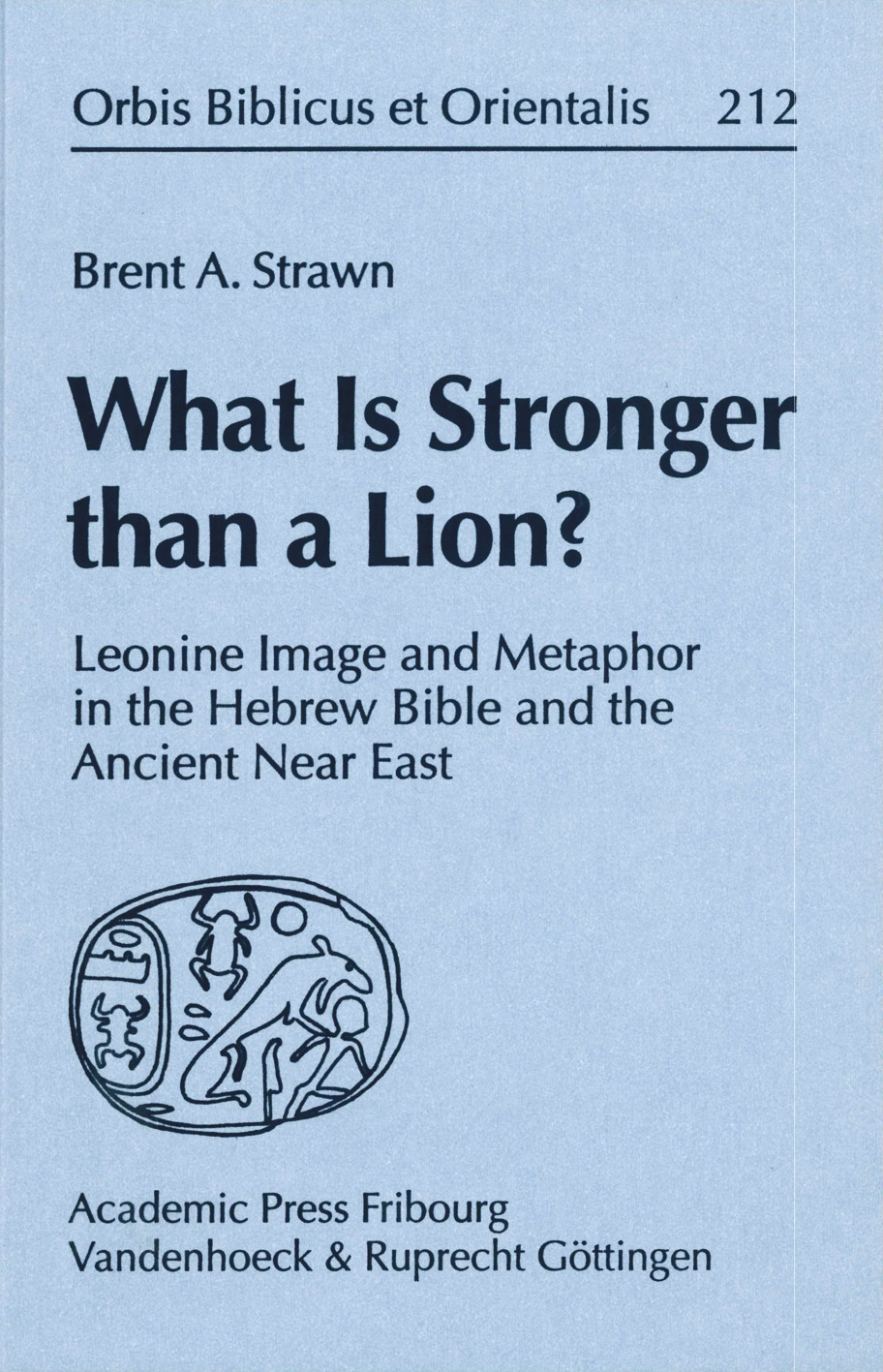 What Is Stronger than a Lion?
Leonine Image and Metaphor in the Hebrew Bible and the Ancient Near East


 Architecture, Iconography, and Text
New Studies on the Northwest Palace Reliefs of Ashurnasirpal II
Volume 301
 Goddesses in Context
On Divine Powers, Roles, Relationships and Gender in Mesopotamian Textual and Visual Sources
 The Awakening of Osiris and the Transit of the Solar Barques
Royal Apotheosis in a Most Concise Book of the Underworld and Sky
 L’Ecrit et l’Esprit
Etudes d’Histoire du texte et de théologie biblique en hommage à Adrian Schenker
 When Gods Speak to Men
Divine Speech according to Textual Sources in the Ancient Mediterranean Basin
Volume 289
 Eine königliche Weisheitslehre?
Exegetische Analyse von Sprüche 28-29 und Vergleich mit den ägyptischen Lehren Merikaras und Amenemhats

 Göttliche Körper – Göttliche Gefühle
Was leisten anthropomorphe und anthropopathische Götterkonzepte im Alten Orient und Alten Testament?
 Divine Names on the Spot II
Exploring the Potentials of Names through Images and Narratives
Volume 299
 Comment devient-on prophète?
Actes du colloque organisé par le Collège de France, Paris, les 4-5 avril 2011
Similar Books


 Contesting Labeled Identities
The Sociology of Gentilics in Biblical and Northwest Semitic Literature

 Drunk the Potion, No Whit Charmed
The Doctrine of Pure and Perfect Souls from Iamblichus to Damascius

 Epigraphic “Shades” from Hellenistic Thrace
Contextualizing Inscriptions in Greek from Thracian Tombs

 Epiphanies of the Divine in the Septuagint and the New Testament
Fifth International Symposium of the Corpus Judaeo-Hellenisticum Novi Testamenti (CJHNT), 14-17 May 2015, Nottingham


 Gold, Silver and Glass: Power Networks, Cultural Identities, Technology Transfers and Agency across the Old World (7th Century BC – 1st Century AD)
Proceedings of a Conference Held at the British Museum, 16–18 June 2023
 Language and Power in the Roman Empire and Early India
Hierarchy, Ambiguity, and the Art of Reading the Signs in Cosmopolitan Cultures
 Late Antique villae in the Balkans (3rd–7th c. AD): Current Research Questions and Perspectives
HAEMUS Companion to the Late Antique Balkans 1
Volume 4


 Nurturing the Elite
Representations of Drinking, Eating, and Religious Vessels in Palmyrene Funerary Iconography
Volume 13





 Roman Copies, Collecting, and Culture in the Bay of Naples and Beyond
Papers in Honor of Eugene J. Dwyer




 The Compositional History of the Book of Kings
An Analysis of the Evaluative Frameworks in 1 Kings 14–2 Kings 25




 Zooarchaeology of Ancient Greek Sanctuaries in Southwestern Sicily
Faunal Analysis from Selinus and Akragas as Evidence of Differences in the Treatment of Animals for Ritual Purposes
