
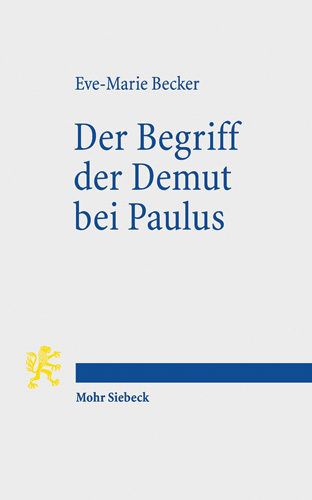
Der Begriff der Demut bei Paulus
By (author) Eve-Marie Becker
Paperback (Published)
(January 2016)
ISBN: 9783161541711
4.29 x 6.97 inches
Price: $44.00
In stock
English summary: In what was probably his last letter to the Philippians, Paul urges his readers to practice humility (Phil 2:3). Eve-Marie Becker’s interpretation pays equal attention to the historical background, ethical and ecclesiastical functions of Paul’s admonition. Humility’s seeming ambiguity as a “European” value is discussed as well as the extent to which humility was originally an early Christian virtue initiated by the apostle to install identity. German description: Der Begriff der ‘Demut’ ist taglich in unserem kulturellen, intellektuellen, politischen und religiosen Leben prasent. Haben wir es hier mit der Wiederkehr einer christlichen Tugend oder mit dem Versuch zu tun, ein inter-religioses Ethos zu installieren, das auch in nicht-christlichen Kulturkreisen bekannt ist? Was bedeutet die inflationare Verwendung des Demut-Begriffs? Eve-Marie Becker begibt sich zunachst auf eine kulturgeschichtliche Spurensuche zum Gebrauch und Missbrauch des Begriffs der Demut. Sie fuhrt dann zuruck zum begrifflichen und konzeptionellen Ausgangspunkt der r bei Paulus liegt: In seinem letzten Schreiben aus romischer Haft fordert der Apostel seine Adressaten in Philippi zu einer Gesinnung der Demut auf (Phil 2,3). Hinter dieser Forderung steht – wie sich zeigen wird – kein plakativer oder moralistischer Appell, sondern eine kluge Einsicht in eine an Christus orientierte Gestaltung ekklesialer Gemeinschaft.
Geboren 1972; 2001 Dr. theol.; 2004 Habilitation; 2006-18 Professorin für neutestamentliche Exegese an der Universität Aarhus/Dänemark; 2016-17 Distinguished Visiting Professor of New Testament an der Emory University in Atlanta/USA; seit 2018 Professorin für Neues Testament an der Westfälischen Wilhelms-Universität Münster.
- By (author) Eve-Marie Becker
Similar Books


 Apocrypha, Magic, Liturgy
The Multiple Identities of Coptic Prayers in Late Antique and Early Islamic Egypt
 Athanasius of Alexandria, Epistula ad episcopos Aegypti et Libyae
Old Slavonic Version and English Translation
Volume 261



 Contesting Labeled Identities
The Sociology of Gentilics in Biblical and Northwest Semitic Literature
 Cyril of Alexandria’s Christological Exegesis
Explorations of Partitive Exegesis in the Dialogues on the Trinity
Volume 70

 Epiphanies of the Divine in the Septuagint and the New Testament
Fifth International Symposium of the Corpus Judaeo-Hellenisticum Novi Testamenti (CJHNT), 14-17 May 2015, Nottingham


 Extracanonical Traditions and the Holy Land
Texts, Rituals, and Material Culture in Late Antique Palestine
 From Joseph to Jesus
The Joseph Narrative as a Compositional Template from Old Greek Esther to the Gospel of Luke
Volume 125





 Nicholas of Lyra’s Commentaries on the Gospels of Matthew and Luke
Franciscan Exegesis in a Time of Crisis
 Paradise Lost in Transmission
The Return to Eden in the Apocalypse of Peter within Its Ethiopic and Early Christian Contexts



 Punning in Odd or Elegant Constructions in Jeremiah
The Convergence of Linguistics, Rhetoric, and Textuality in the Hebrew Text of Jeremiah

 Reformed Covenantal Eudaimonism
Wilhelmus à Brakel (1635–1711) on Highest Good, Virtue, and Law
Volume 87