
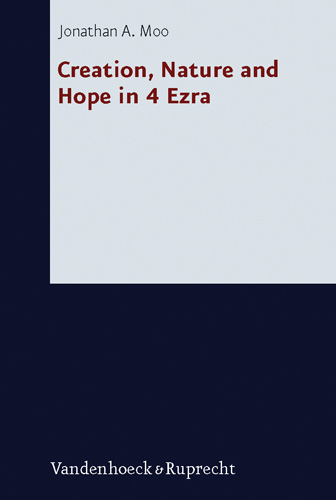
Creation, Nature and Hope in 4 Ezra
By (author) Jonathan A. Moo
Hardback (Published)
(May 2011)
ISBN: 9783525531037
6.34 x 9.33 inches
Price: $138.00
In stock
Mankind is corrupt.
“This is a groundbreaking study, examining the theme of creation in 4 Ezra more thoroughly than has been done before. Moo reads the text with an exceptional alertness to data relating to creation and nature and notices details often overlooked.” — Edward Adams, Journal for the Study of the New Testament This exegetical study of creation and nature in 4 Ezra argues that this first-century Jewish apocalypse’s profound pessimism concerning humankind and the present age is matched by a surprisingly robust belief in the goodness of the created order. 4 Ezra presents the natural world as standing with God over and against corrupt humankind, envisions substantial elements of continuity between the ages, and hints that those parts of the earth that remain unsullied by humankind still stand witness to God’s sovereignty, love and justice and even serve as material pointers to the new creation. This study calls into question the persistent assumption that apocalypticism and the ‘apocalyptic eschatology’ of the historical apocalypses in particular necessarily entails a profound dualism. Emerging as it does from an experience of historical disaster and unresolved questions of theodicy, 4 Ezra especially is often considered an apocalypse in which the doctrine of the two ages has been radicalised to the extent that creation, history and life in this world have lost their meaning or significance. The results of this study, however, indicate that while 4 Ezra considers the world of humankind to be corrupted and corrupting, in the natural world the creator’s sovereignty is not so obscured, and there his original intentions for creation can still be perceived. This study provides a fresh reading of 4 Ezra that takes seriously the book’s unity and coherence. Its conclusions suggest that it may be best to abandon the label ‘apocalyptic eschatology’ given its potential to mast the interesting complexities and mix of continuity and discontinuity that attend the portrayal of creation, nature and hope in an apocalypse like 4 Ezra.
- By (author) Jonathan A. Moo
Other Titles in this Series
 Creation, Tabernacle, and Sabbath
The Sabbath Frame of Exodus 31:12-17; 35:1-3 in Exegetical and Theological Perspective

 Zwischen Landnahme und Königtum
Literarkritische und redaktionsgeschichtliche Untersuchungen zum Anfang und Ende der deuteronomistischen Richtererzählungen

 Der zweite Korintherbrief
Literarische Gestalt - historische Situation - theologische Argumentation. Festschrift zum 70. Geburtstag von Dietrich-Alex Koch


 „Wie die Verwundeten ‒ derer du nicht mehr gedenkst”
Zur Phänomenologie des Traumas in den Psalmen 22, 88, 107 und 137
 The Spirit World in the Letters of Paul the Apostle
A Critical Examination of the Role of Spiritual Beings in the Authentic Pauline Epistles
 Die Ortsangaben im Buch Genesis
Ein historisch-topographischer und literarisch-topographischer Kommentar
 »Blickt auf Abraham, euren Vater«
Abraham als Identifikationsfigur des Judentums in der Zeit des Exils und des Zweiten Tempels

 Die himmlische Bürgerschaft
Untersuchungen zu einem urchristlichen Sprachmotiv im Spannungsfeld von religiöser Integration und Abgrenzung im 1. und 2. Jahrhundert




 Divine Substitution
Humanity as the Manifestation of Deity in the Hebrew Bible and the Ancient Near East
Similar Books


 Apocrypha, Magic, Liturgy
The Multiple Identities of Coptic Prayers in Late Antique and Early Islamic Egypt
 Athanasius of Alexandria, Epistula ad episcopos Aegypti et Libyae
Old Slavonic Version and English Translation
Volume 261



 Contesting Labeled Identities
The Sociology of Gentilics in Biblical and Northwest Semitic Literature
 Cyril of Alexandria’s Christological Exegesis
Explorations of Partitive Exegesis in the Dialogues on the Trinity
Volume 70

 Epiphanies of the Divine in the Septuagint and the New Testament
Fifth International Symposium of the Corpus Judaeo-Hellenisticum Novi Testamenti (CJHNT), 14-17 May 2015, Nottingham


 Extracanonical Traditions and the Holy Land
Texts, Rituals, and Material Culture in Late Antique Palestine
 From Joseph to Jesus
The Joseph Narrative as a Compositional Template from Old Greek Esther to the Gospel of Luke
Volume 125





 Nicholas of Lyra’s Commentaries on the Gospels of Matthew and Luke
Franciscan Exegesis in a Time of Crisis
 Paradise Lost in Transmission
The Return to Eden in the Apocalypse of Peter within Its Ethiopic and Early Christian Contexts



 Punning in Odd or Elegant Constructions in Jeremiah
The Convergence of Linguistics, Rhetoric, and Textuality in the Hebrew Text of Jeremiah

 Reformed Covenantal Eudaimonism
Wilhelmus à Brakel (1635–1711) on Highest Good, Virtue, and Law
Volume 87