
Christologie und Ethik im Philipperbrief
Studien zur Handlungsorientierung einer frühchristlichen Gemeinde in paganer Umwelt
By (author) Heiko Wojtkowiak
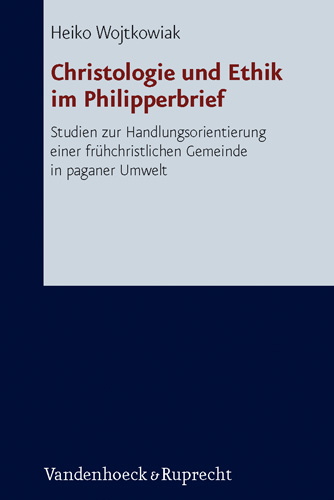
Hardback (Published)
(May 2012)
ISBN: 9783525535417
6.34 x 9.33 inches
Price: $200.00
In stock
Was he a model figure or not? Heiko Wojtkowiak deals with the question of the relationship between Paul’s strict ethical mandates toward the congregation of the Philippians and Christ’s own actions. His intention is to illuminate the relationship between paraklesis and Christ’s saving action as stated in Paul’s letter to the Philippians. To approach this diputed question, he looks at the role Christ is given in the epistle as a moral model and particularly illuminates the Christian Psalm (Phil. 2.6-11) and its role in the epistle.
English summary: The slightly revised version of a doctoral dissertation directed by D.-A. Koch and presented in 2011 to the Evangelical theological faculty of the Westfalische Wilhelms-Universitat in Munster, this volume investigates the relationship between Christology and ethics in Paul’s letter to the Philippians, that is, how his ethical exhortations relate to Christ and his saving activity. Its 67-page introduction treats methodology, terminology, the history of research on the topic, Philippi, the situation in which the letter was composed, and the question about literary unity. Then it considers the so-called Christ-hymn in Phil 2:6-11 and its ethical implications, as well as the reception of the Christ-hymn: the unity of the community in Christ (1:27-2:18), the example of Paul and the “enemies of the cross” (3:2-4:3), and the example of Epaphroditus (2:25-30). Next it reflects on the suffering of Christians and pagan religiosity. Then it interprets Philippians as the reaction to a conflict of values in Philippi, with special reference to 4:8-9 and 1:12-26. Wojtkowiak concludes with reflections on the significance of his work for the exegesis of Philippians, the christological basis of Pauline ethics in Philippians, and the place of Christ’s function as an example in Pauline ethics. New Testament Abstracts (57/1-2013), Boston College School of Theology and Ministry German description: Heiko Wojtkowiak beschaftigt sich mit der Verknupfung von Christologie und Ethik im Brief des Paulus an die Gemeinde in der romischen Kolonie Philippi. Seine Leitfrage lautet: In welchem Verhaltnis stehen die ethischen Mahnungen zu Christus und dessen Handeln? Damit reagiert er auf die in der Forschung umstrittene Frage, ob und inwiefern Christus innerhalb des Philipperbriefes und allgemein in der paulinischen Ethik die Rolle eines Vorbilds einnimmt. Diese Frage betrifft insbesondere die Intention des Christuspsalms in Phil 2,6-11, welcher Christi Menschwerdung, seinen Tod und seine anschliessende Erhohung schildert. Dominierte bis zur Mitte des 20. Jahrhunderts ein vorbildethisches Verstandnis des Abschnitts, wurde nach Ernst Kasemanns Intervention (1950) eine derartige Auslegung in weiten Teilen der Forschung abgelehnt und stosst nach wie vor auf erhebliche Vorbehalte. Eine Klarung der Verbindung zwischen Paraklese und Christi Heilshandeln erfolgt durch die Untersuchung sowohl des Christuspsalms selbst als auch von dessen Rezeption innerhalb des Philipperbriefes. Aus dieser ethischen Leitfrage entwickelt Wojtkowiak die wahrscheinliche Deutung, dass Paulus mit dem Brief als Ganzem auf eine konkrete Konfliktsituation, eine durch Leidenserfahrungen ausgeloste Krise der heidenchristlichen Gemeinde, reagiert. Als ursachlich fur diesen Konflikt wird der soziale, geistige und kulturelle Hintergrund der Adressaten angefuhrt, insbesondere die Bedeutung von Leidenserfahrungen fur pagan sozialisierte Menschen. Gleichzeitig erfolgt eine Gesamterklarung des Philipperbriefes, die weiterfuhrende Ergebnisse auch fur in der aktuellen Forschung umstrittenen Einleitungsfragen (Abfassungsort und -zeit sowie literarische Einheitlichkeit des Briefs, Verfasserschaft von Phil 2,6-11) bietet.
Dr. theol. Heiko Wojtkowiak ist Verwalter der Professur für Biblische Theologie an der Leuphana Universität Lüneburg.
- By (author) Heiko Wojtkowiak
Other Titles in this Series
 Die himmlische Bürgerschaft
Untersuchungen zu einem urchristlichen Sprachmotiv im Spannungsfeld von religiöser Integration und Abgrenzung im 1. und 2. Jahrhundert




 Divine Substitution
Humanity as the Manifestation of Deity in the Hebrew Bible and the Ancient Near East


 Der eine Gott Israels und die Mächte der Welt
Der Weg Gottes im Alten Testament vom Herrn seines Volkes zum Herrn der ganzen Welt


 Paulus und die antike Welt
Beiträge zur zeit- und religionsgeschichtlichen Erforschung des paulinischen Christentums
 How Prophecy Works
A Study of the Semantic Field of נביא and a Close Reading of Jeremiah 1:4–19, 23:9–40 and 27:1–28:17


 Jakob, der ambivalente Ahnherr Israels
Die Jakoberzählung auf dem Weg von der Volks- zur Völkergeschichte

Similar Books


 Apocrypha, Magic, Liturgy
The Multiple Identities of Coptic Prayers in Late Antique and Early Islamic Egypt
 Athanasius of Alexandria, Epistula ad episcopos Aegypti et Libyae
Old Slavonic Version and English Translation
Volume 261



 Contesting Labeled Identities
The Sociology of Gentilics in Biblical and Northwest Semitic Literature
 Cyril of Alexandria’s Christological Exegesis
Explorations of Partitive Exegesis in the Dialogues on the Trinity
Volume 70

 Epiphanies of the Divine in the Septuagint and the New Testament
Fifth International Symposium of the Corpus Judaeo-Hellenisticum Novi Testamenti (CJHNT), 14-17 May 2015, Nottingham


 Extracanonical Traditions and the Holy Land
Texts, Rituals, and Material Culture in Late Antique Palestine
 From Joseph to Jesus
The Joseph Narrative as a Compositional Template from Old Greek Esther to the Gospel of Luke
Volume 125





 Nicholas of Lyra’s Commentaries on the Gospels of Matthew and Luke
Franciscan Exegesis in a Time of Crisis
 Paradise Lost in Transmission
The Return to Eden in the Apocalypse of Peter within Its Ethiopic and Early Christian Contexts



 Punning in Odd or Elegant Constructions in Jeremiah
The Convergence of Linguistics, Rhetoric, and Textuality in the Hebrew Text of Jeremiah

 Reformed Covenantal Eudaimonism
Wilhelmus à Brakel (1635–1711) on Highest Good, Virtue, and Law
Volume 87