
Animal Metaphors and the People of Israel in the Book of Jeremiah
By (author) Benjamin A. Foreman
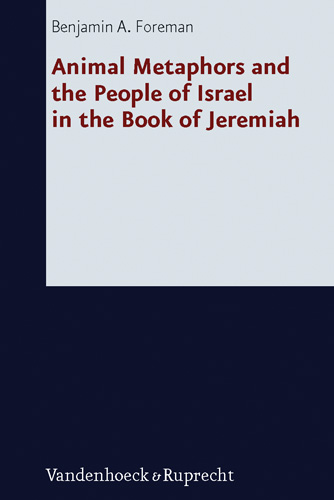
Hardback (Published)
(October 2011)
ISBN: 9783525532584
6.34 x 9.33 inches
Price: $213.00
In stock
A study on a neglected key to understanding Jeremiah.
Though interest in the use of metaphor in the Hebrew Bible has gained momentum in recent years, there is, to date, no investigation which concentrates exclusively on the animal metaphors in the book of Jeremiah. In this book, the author brings to light this neglected area of study by examining the language and imagery of the animal metaphors for the people of Israel in the book of Jeremiah. The contribution that these metaphors make to the theology of the book is given special attention, and since different interpretations have been given to many of the metaphors in question, the author resolves some of the questions regarding the meaning of these images in his in-depth study. Additionally, scholars have not tended to research metaphors for the nation of Israel and thus this volume draws attention to a particular subject which has largely been overlooked. In chapter one Foreman familiarizes the reader with the major theoretical approaches to metaphor and spells out the approach taken in his investigation. Eighteen metaphors are then thoroughly analyzed in chapters two, three, and four. These metaphors are grouped into three categories, each of which constitutes a chapter: pastoral metaphors, mammal metaphors, and bird metaphors. Chapter five draws the results of the inquiry together. This study reveals how animal metaphors make important theological claims about the nation of Israel and demonstrates that they are essential elements of the message of the book of Jeremiah. Foreman’s elucidation of the language and imagery of the animal metaphors for the people of Israel leads to a richer understanding of these metaphors and ultimately contributes to a more precise interpretation of the message of the book of Jeremiah as a whole.
- By (author) Benjamin A. Foreman
Other Titles in this Series
 Die himmlische Bürgerschaft
Untersuchungen zu einem urchristlichen Sprachmotiv im Spannungsfeld von religiöser Integration und Abgrenzung im 1. und 2. Jahrhundert




 Divine Substitution
Humanity as the Manifestation of Deity in the Hebrew Bible and the Ancient Near East


 Der eine Gott Israels und die Mächte der Welt
Der Weg Gottes im Alten Testament vom Herrn seines Volkes zum Herrn der ganzen Welt



 Paulus und die antike Welt
Beiträge zur zeit- und religionsgeschichtlichen Erforschung des paulinischen Christentums
 How Prophecy Works
A Study of the Semantic Field of נביא and a Close Reading of Jeremiah 1:4–19, 23:9–40 and 27:1–28:17


 Jakob, der ambivalente Ahnherr Israels
Die Jakoberzählung auf dem Weg von der Volks- zur Völkergeschichte

Similar Books


 Apocrypha, Magic, Liturgy
The Multiple Identities of Coptic Prayers in Late Antique and Early Islamic Egypt
 Athanasius of Alexandria, Epistula ad episcopos Aegypti et Libyae
Old Slavonic Version and English Translation
Volume 261



 Contesting Labeled Identities
The Sociology of Gentilics in Biblical and Northwest Semitic Literature
 Cyril of Alexandria’s Christological Exegesis
Explorations of Partitive Exegesis in the Dialogues on the Trinity
Volume 70

 Epiphanies of the Divine in the Septuagint and the New Testament
Fifth International Symposium of the Corpus Judaeo-Hellenisticum Novi Testamenti (CJHNT), 14-17 May 2015, Nottingham


 Extracanonical Traditions and the Holy Land
Texts, Rituals, and Material Culture in Late Antique Palestine
 From Joseph to Jesus
The Joseph Narrative as a Compositional Template from Old Greek Esther to the Gospel of Luke
Volume 125





 Nicholas of Lyra’s Commentaries on the Gospels of Matthew and Luke
Franciscan Exegesis in a Time of Crisis
 Paradise Lost in Transmission
The Return to Eden in the Apocalypse of Peter within Its Ethiopic and Early Christian Contexts



 Punning in Odd or Elegant Constructions in Jeremiah
The Convergence of Linguistics, Rhetoric, and Textuality in the Hebrew Text of Jeremiah

 Reformed Covenantal Eudaimonism
Wilhelmus à Brakel (1635–1711) on Highest Good, Virtue, and Law
Volume 87