
Sparta in Plutarch’s Lives
edited by Philip Davies and Judith Mossman
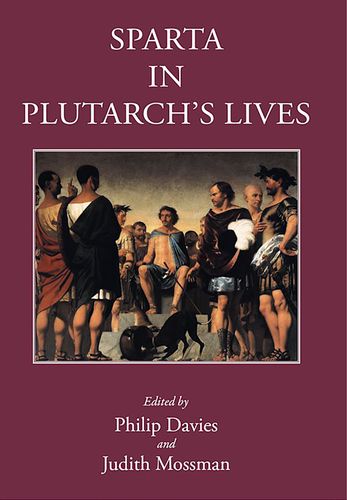
Plutarch (born before AD 50, died after AD 120) is the ancient author who has arguably contributed more than any other to the popular conception of Sparta. Writing under the Roman Empire, at a time when the glory days of ancient Sparta were already long in the past, Plutarch represents a milestone in Sparta’s mythologisation, but at the same time is a vital source for our historical understanding of Sparta. In this volume, eight scholars from around the world come together to consider Plutarch’s understanding and presentation of Sparta, his flaws and significance as an historical source, and his development of Sparta as a resonant subject and theme within his bestknown work, the Parallel Lives. This book is the latest in a series which the Classical Press of Wales is publishing on major sources for Sparta. Volumes on Xenophon and Sparta (Powell & Richer 2020) and Thucydides and Sparta (Powell & Debnar 2021) have already been released, and a further volume on Herodotus and Sparta is currently in preparation
Philip Davies’ research interests focus on ancient Sparta. He is the author of the forthcoming monograph Standing among the Spartans: Institutions and Status within the Spartiate Community, as well as various articles/chapters on interpretative issues raised by our diverse ancient sources for Sparta. He is Assistant Professor of Ancient Greek History at the University of Nottingham. Judith Mossman specialises in Greek literature of the fifth century BC and the second/third century AD and is the author of two books and multiple edited volumes and articles on Euripides and Plutarch. She is currently professor and Pro Vice-Chancellor (Arts and Humanities) at Coventry University. At the time of writing she is Vice-President of the Hellenic Society and President of the International Plutarch Society.
- Edited by Philip Davies
- Edited by Judith Mossman
Other Titles in this Series

Similar Books


 Contesting Labeled Identities
The Sociology of Gentilics in Biblical and Northwest Semitic Literature

 Drunk the Potion, No Whit Charmed
The Doctrine of Pure and Perfect Souls from Iamblichus to Damascius

 Epigraphic “Shades” from Hellenistic Thrace
Contextualizing Inscriptions in Greek from Thracian Tombs

 Epiphanies of the Divine in the Septuagint and the New Testament
Fifth International Symposium of the Corpus Judaeo-Hellenisticum Novi Testamenti (CJHNT), 14-17 May 2015, Nottingham


 Gold, Silver and Glass: Power Networks, Cultural Identities, Technology Transfers and Agency across the Old World (7th Century BC – 1st Century AD)
Proceedings of a Conference Held at the British Museum, 16–18 June 2023
 Language and Power in the Roman Empire and Early India
Hierarchy, Ambiguity, and the Art of Reading the Signs in Cosmopolitan Cultures
 Late Antique villae in the Balkans (3rd–7th c. AD): Current Research Questions and Perspectives
HAEMUS Companion to the Late Antique Balkans 1
Volume 4


 Nurturing the Elite
Representations of Drinking, Eating, and Religious Vessels in Palmyrene Funerary Iconography
Volume 13





 Roman Copies, Collecting, and Culture in the Bay of Naples and Beyond
Papers in Honor of Eugene J. Dwyer





 The Compositional History of the Book of Kings
An Analysis of the Evaluative Frameworks in 1 Kings 14–2 Kings 25




 Zooarchaeology of Ancient Greek Sanctuaries in Southwestern Sicily
Faunal Analysis from Selinus and Akragas as Evidence of Differences in the Treatment of Animals for Ritual Purposes