
The Isaianic Denkschrift and a Socio-Cultural Crisis in Yehud
A Rereading of Isaiah 6:1–9:6[7]
By (author) Alexander V. Prokhorov
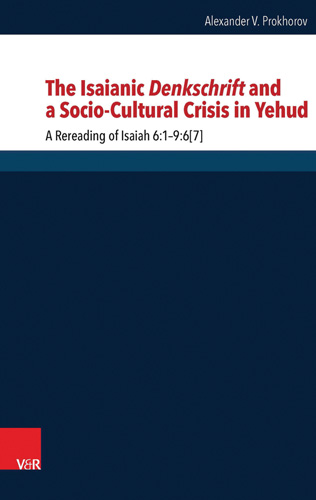
Hardback (Out of print)
(May 2015)
ISBN: 9783525540442
6.34 x 9.33 inches
Price: $200.00
On back order
English summary: This study of the Isaianic Denkschrift (Isaiah 6:1-9:6) is both a traditional and an innovative one. It defends the integrity of the Denkschrift, yet on grounds wholly other than those outlined by the early proponents of the unity of the composition. The present work is founded on an inquiry into the ideological matrix of the composition on one hand and, on the other, on the understanding of the activity of mantic (prophetic) figures in the Near East during the early first millennium BCE that has emerged in recent scholarship. The presentation of Yahweh as a royal character in the Denkschrift is interpreted as an integral part of the symbolic universe promoted by the composition. Several levels of social discourse of the Denkschrift are identified: the author(s) is simultaneously engaged in the creation of Judaean autonomous cultural identity, in polemical activity with the rival Yahwist community (the North, or Samaria) and in the safeguarding of the privileged position of the former Babylonian exiles among the community of Jerusalem and Judah. Two interrelated hypotheses are developed in the book: regarding the historical milieu in which the Denkschrift was composed and regarding the place of the composition in the formation of First Isaiah. As for the first, Prokhorov proposes that the early second-temple community of Yehud matches the profile of a society whose problems the Denkschrift is addressing and reflecting. As for the second, the author maintains the view that the Denkschrift marks one of the final stages of the creation of First Isaiah whose original nucleus consisted of the Hezekiah narrative (now found in chapters 36-39 of Isaiah), which, in turn, modified the respective Deuteronomistic material. German description: This study of the Isaianic Denkschrift (Isaiah 6:1-9:6) is both a traditional and an innovative one. It defends the integrity of the Denkschrift, yet on grounds wholly other than those outlined by the early proponents of the unity of the composition. The present work is founded on an inquiry into the ideological matrix of the composition on one hand and, on the other, on the understanding of the activity of mantic (prophetic) figures in the Near East during the early first millennium BCE that has emerged in recent scholarship. The presentation of Yahweh as a royal character in the Denkschrift is interpreted as an integral part of the symbolic universe promoted by the composition. Several levels of social discourse of the Denkschrift are identified: the author(s) is simultaneously engaged in the creation of Judaean autonomous cultural identity, in polemical activity with the rival Yahwist community (the North, or Samaria) and in the safeguarding of the privileged position of the former Babylonian exiles among the community of Jerusalem and Judah. Two interrelated hypotheses are developed in the book: regarding the historical milieu in which the Denkschrift was composed and regarding the place of the composition in the formation of First Isaiah. As for the first, Prokhorov proposes that the early second-temple community of Yehud matches the profile of a society whose problems the Denkschrift is addressing and reflecting. As for the second, the author maintains the view that the Denkschrift marks one of the final stages of the creation of First Isaiah whose original nucleus consisted of the Hezekiah narrative (now found in chapters 36-39 of Isaiah), which, in turn, modified the respective Deuteronomistic material.
Dr. Alexander V. Prokhorov spent one year tutoring at the University of Aberdeen and now serves as editor in Moscow.
- By (author) Alexander V. Prokhorov
Other Titles in this Series
 Christologie und Ethik im Philipperbrief
Studien zur Handlungsorientierung einer frühchristlichen Gemeinde in paganer Umwelt
 Macht und Weisheit
Untersuchungen zur politischen Anthropologie in den Erzählungen vom Absalomaufstand
 From Qumran to Aleppo
A Discussion with Emanuel Tov about the Textual History of Jewish Scriptures in Honor of his 65th Birthday


 Anthropologische Aufbrüche
Alttestamentliche und interdisziplinäre Zugänge zur historischen Anthropologie
 Heiliges Land und Nähe Gottes
Wandlungen alttestamentlicher Landvorstellungen in frühjüdischen und neutestamentlichen Schriften

 Expanding Ezekiel
The Hermeneutics of Scribal Addition in the Ancient Text Witnesses of the Book of Ezekiel




 Fremdlinge im eigenen Land
Zur Entstehung und Intention der priesterlichen Passagen der Vätergeschichte

 The Meaning of the Letter of Aristeas
In light of biblical interpretation and grammatical tradition, and with reference to its historical context


 Zwischen Landnahme und Königtum
Literarkritische und redaktionsgeschichtliche Untersuchungen zum Anfang und Ende der deuteronomistischen Richtererzählungen


 A Theocentric Interpretation of הדעת טוב ורע
The Knowledge of Good and Evil as the Knowledge for Administering Reward and Punishment

 Creation, Tabernacle, and Sabbath
The Sabbath Frame of Exodus 31:12-17; 35:1-3 in Exegetical and Theological Perspective


Similar Books


 Apocrypha, Magic, Liturgy
The Multiple Identities of Coptic Prayers in Late Antique and Early Islamic Egypt
 Athanasius of Alexandria, Epistula ad episcopos Aegypti et Libyae
Old Slavonic Version and English Translation
Volume 261



 Contesting Labeled Identities
The Sociology of Gentilics in Biblical and Northwest Semitic Literature
 Cyril of Alexandria’s Christological Exegesis
Explorations of Partitive Exegesis in the Dialogues on the Trinity
Volume 70

 Epiphanies of the Divine in the Septuagint and the New Testament
Fifth International Symposium of the Corpus Judaeo-Hellenisticum Novi Testamenti (CJHNT), 14-17 May 2015, Nottingham


 Extracanonical Traditions and the Holy Land
Texts, Rituals, and Material Culture in Late Antique Palestine
 From Joseph to Jesus
The Joseph Narrative as a Compositional Template from Old Greek Esther to the Gospel of Luke
Volume 125





 Nicholas of Lyra’s Commentaries on the Gospels of Matthew and Luke
Franciscan Exegesis in a Time of Crisis
 Paradise Lost in Transmission
The Return to Eden in the Apocalypse of Peter within Its Ethiopic and Early Christian Contexts



 Punning in Odd or Elegant Constructions in Jeremiah
The Convergence of Linguistics, Rhetoric, and Textuality in the Hebrew Text of Jeremiah

 Reformed Covenantal Eudaimonism
Wilhelmus à Brakel (1635–1711) on Highest Good, Virtue, and Law
Volume 87