
Vowed to Community or Ordained to Mission?
Aspects of separation and integration in the Lutheran Deaconess Institute Neuendettelsau, Bavaria
By (author) Judith Lena Böttcher
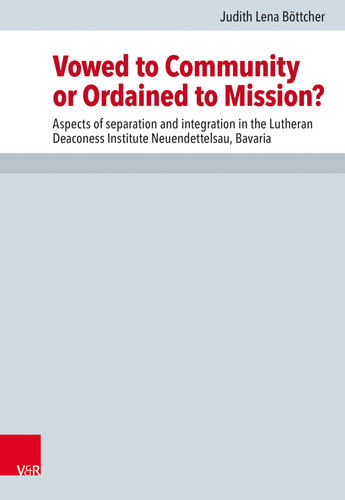
Hardback (Published)
(October 2018)
ISBN: 9783525552636
6.69 x 9.76 inches
Price: $82.00
In stock
Deaconesses from a gender perspective
Lena Bottcher offers an overdue exploration of the early years of the deaconess community in Neuendettelsau from a gender perspective. Drawing on rich archival material, she focuses on the process of a distinctive collective identity. Central to this study is the assumption, drawn from the social sciences, that collective identity is a social construction which requires the participation of the whole group through identification and which is consolidated by developing specific rituals, symbols, codes and normative texts, which facilitate integration, and by constructing external boundaries, which separate from the world and the wider church. This approach highlights the fact that the women were not merely passive recipients but participated and contributed to the formation of a distinct Neuendettelsau deaconess culture. Thus, this study offers an explanation for the popularity such institutes enjoyed amongst single and widowed Protestant women in the latter half of the nineteenth century. In consequence, this study significantly widens the scope of historical research on the Institute which so far has tended to take into account solely the male perspective of the Rektoren.
Dr. Judith Lena Bottcher ist lutherische Pfarrerin Evangelisch-Lutherischen Kreuzkirchen Kolbermoor.
- By (author) Judith Lena Böttcher
"Bottcher has written a deeply researched and thoughtfully nuanced study of this deaconess community and the women who constituted it. She has plumbed a rich archive of materials on the life of this community, and her application of social-scientific methods to this material is both appropriate and highly illuminating. Her study leads the reader beyond a binary understanding of women's religious lives in the nineteenth century and invites parallels with similar communities of the time. This is a work that will be very useful to our further understanding of women and religious communities in the modern era." --Granquist, Mark, Luther Seminary
—
Other Titles in this Series
 Professoren im Norden
Lutherische Gelehrsamkeit in der Frühen Neuzeit am Beispiel der theologischen Fakultäten in Kopenhagen und Uppsala

 »Wir sind zum wechselseitigen Gespräch geboren«
Philipp Melanchthon und die Reichsreligionsgespräche von 1540/41
 Provokateure, Tabubrüche und Denkabenteuer
Grenzüberschreitungen im frühen und spätantiken Christentum. Gedenkschrift für Thomas Karmann
 Dialogflugschriften der frühen Reformationszeit
Literarische Fortführung der Disputation und Resonanzräume reformatorischen Denkens
 Der Weg zur christlichen Vollkommenheit
Eine Studie zu Walter Hilton auf dem Hintergrund der romanischen Mystik
 Handlungsspielräume und Handlungsoptionen von Pfarrern und Gemeindegliedern in der Zeit des Nationalsozialismus
Eine vergleichende Studie für die Evangelisch-Lutherische Kirche in Bayern anhand der oberfränkischen Dekanate Bayreuth und Coburg
 Religio
Dritter Band: Die Geschichte eines neuzeitlichen Grundbegriffs im 17. und frühen 18. Jahrhundert
 Was ist Heilsgeschichte im (früheren) Mittelalter?
Untersuchungen zur Geschichtsschreibung in der lateinischen Kirche, von der Väterzeit bis ins 12. Jahrhundert
 Kindesaussetzung und Moral in der Antike
Jüdische und christliche Kritik am Nichtaufziehen und Töten neugeborener Kinder
 Das Christentumsverständnis Wilhelm Boussets
Evangelische Theologie im Spannungsfeld von Historismus und Rationalismus


 Religio
Vierter Band: Die Geschichte eines neuzeitlichen Grundbegriffs im 18. und frühen 19. Jahrhundert
 Migration and Faith
The Migrations of the Schwenkfelders from Germany to America – Risks and Opportunities

 Hilaria evangelica academica
Das Reformationsjubiläum von 1717 an den deutschen lutherischen Universitäten
 Die beiden Rezensionen von Augustins Adnotationes in Iob im Licht von Hieronymus‘ erst Ijob-Übersetzung
Genetische Analysen aufgrund der ältesten Codex-Fragmente Inguimbertinus 13 und Ashburnhamianus 95
 Kirchengeschichte
Selbstverständnis, Zukunft und Herkunft einer akademischen Disziplin. Junge Perspektiven
 Die Textvorlage von Augustins Adnotationes in Iob
Studien zur Erstfassung von Hieronymus‘ Hiob-Übersetzung iuxta Graecos
 Historismus und Kirchengeschichtsschreibung
Leben und Werk Albert Haucks (1845–1918) bis zu seinem Wechsel nach Leipzig 1889
Similar Books

 A Companion to Christianity and Sport in Europe and North America (19th-21st centuries)
Volume 1: Western and Eastern Europe
 A Connecting Polemic in the Medieval Mediterranean
The Correspondence of Leo III and ʿUmar II
Volume 6





 Ars Prophetica
Theology in the Poetry of Twentieth-Century Hebrew Poets Avraham Halfi, Shin Shalom, Amir Gilboa, and T. Carmi
 As Messianism Turns to Heresy
The Regenstein Chair Lectures On Lurianic Kabbalah and Shabbatai Tzevi at Hebrew Union College - Cincinnati





 Creating the Woman in Antiquity
Proceedings of the 16th Melammu Workshop, Innsbruck, 2–3 June 2022
Volume 13
 Cultic Kisses
Fruitful Encounters Between Deities and Humans. Festschrift for Angelika Berlejung on the Occasion of Her 65th Birthday
 De/colonizing Theologies
Glocal Histories, Contemporary Challenges, Theoretical Reflections
Volume 4
 Drunk the Potion, No Whit Charmed
The Doctrine of Pure and Perfect Souls from Iamblichus to Damascius






 Extracanonical Traditions and the Holy Land
Texts, Rituals, and Material Culture in Late Antique Palestine
 Fear, Fear of God, God-Fearers
Philological and Historical Perspectives on the World of Ancient Judaism and Christianity

