
The Mariavites
Heresy, The Apocalypse, and Poland's Female Savior
by Damian Cyrocki
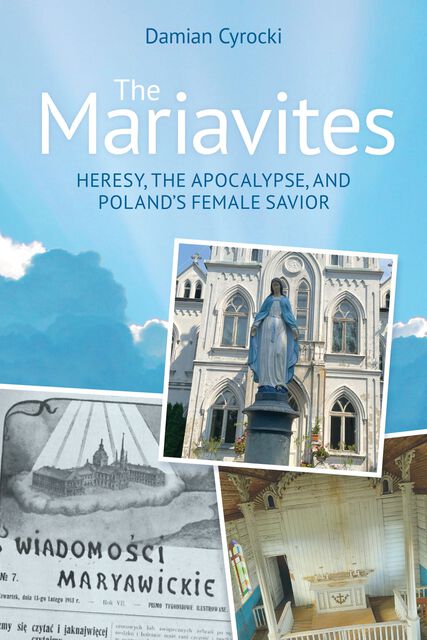
With reference to the original Polish documents, the volume clarifies for the first time the ideology, logic, motives, and theological tradition underpinning of this new religious movement. In addition, it looks at the Mariavites in the context of the influence of nineteenth-century Polish messianism, as well as the ancient Christian sources and Catholic Tradition which the Mariavites used abundantly.
The Mariavites are an independent Catholic movement who were excommunicated from the Roman Catholic Church in late 1906. This book gives a history of the beginnings of the movement focusing on how the early Mariavites understood the establishment the Kingdom of God on earth (and, more precisely, in Poland). Their history dates to 1893, when the nun, Feliksa Maria Franciszka Kozlowska (1862-1921) claimed to receive revelations of Divine Mercy recommending that she she create a priests congregation of Mariavites. Due to the fraught political situation relating to the occupation of Polish lands, the Mariavites initially had to act in secret, while their mission was not accepted by the hierarchy of the Roman Catholic Church. Being outside official church structures, they introduced a number of controversial measures, especially in the interwar period after the death of their founder. Priests married nuns, nuns were ordained, compulsory confession before a priest was abolished, and finally Kozlowska was understood to be the embodiment of the Holy Spirit. These are just some of the changes that were intended to restore the state from before original sin. The Mariavites covers these and other central features of their apocalyptic or millenarian theology, including those involving the rapid exaltation of Mateczka after her death, blending of traditions associated with Mary and Jesus, and establishment of the Kingdom of God on earth through her mission. With reference to the original Polish documents, the volume clarifies for the first time the ideology, logic, motives, and theological tradition underpinning of this new religious movement. In addition, it looks at the Mariavites in the context of the influence of nineteenth-century Polish messianism, as well as the ancient Christian sources and Catholic Tradition which the Mariavites used abundantly.
- By (author) Damian Cyrocki
Similar Books

 A Companion to Christianity and Sport in Europe and North America (19th-21st centuries)
Volume 1: Western and Eastern Europe
 A Connecting Polemic in the Medieval Mediterranean
The Correspondence of Leo III and ʿUmar II
Volume 6





 Ars Prophetica
Theology in the Poetry of Twentieth-Century Hebrew Poets Avraham Halfi, Shin Shalom, Amir Gilboa, and T. Carmi
 As Messianism Turns to Heresy
The Regenstein Chair Lectures On Lurianic Kabbalah and Shabbatai Tzevi at Hebrew Union College - Cincinnati


 Creating the Woman in Antiquity
Proceedings of the 16th Melammu Workshop, Innsbruck, 2–3 June 2022
Volume 13
 Cultic Kisses
Fruitful Encounters Between Deities and Humans. Festschrift for Angelika Berlejung on the Occasion of Her 65th Birthday
 De/colonizing Theologies
Glocal Histories, Contemporary Challenges, Theoretical Reflections
Volume 4
 Drunk the Potion, No Whit Charmed
The Doctrine of Pure and Perfect Souls from Iamblichus to Damascius






 Extracanonical Traditions and the Holy Land
Texts, Rituals, and Material Culture in Late Antique Palestine
 Fear, Fear of God, God-Fearers
Philological and Historical Perspectives on the World of Ancient Judaism and Christianity


 Gender and Iconography in Antiquity
Femininities, Masculinities, Ambiguities, and Beyond in the Ancient Levant, Near East, and Mediterranean