
Stars, Life and Intelligence
Being a Darwinian and a Believer
by Terry Kelly
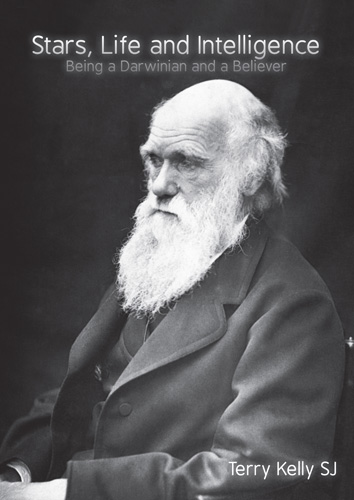
This book is divided into two parts. The first part deals with the current understanding of evolution. The second part brings together the scientific picture with various responses to the ‘God question’. Science is a powerful discourse; it has unravelled for us the workings of nature, and technology has enabled us to apply the findings in many ways to further knowledge, to perform complex tasks, to further communication, and to make life easier and more exciting. But there are boundaries and limits to science. First, the final models of how nature is working are never the final word: they are always awaiting ‘falsification’, never blessed with certain ‘verification’. Second, the deeper one goes towards hoped-for truth, the more one is confronted with counter-intuitive models such as quantum theory, ‘spooky-action’ at a distance, the dark energy of the vacuum, the Big Bang etc. Third, science cannot advance beyond the questions accessible by scientific experiment: questions about purpose and God, right and wrong, good and evil, are not accessible to science. Scientific conclusions, however, can then be subjected to reasonable analysis, philosophical reflection, aided perhaps by religious beliefs. Today a dilemma is often offered for consideration: ‘either evolution by natural selection, or God and purpose.’ Is this delemma a false one? Can purposeful creation and natural selection both be true? Such are the features of evolution, one can argue strongly the case for a purpose. One can at least say belief in God sits well with evolutionary theory. To come to this conclusion we need to extend and improve our image of the God of Abraham, Moses and Jesus. God is intelligent, subtle, powerful- respectful of the freedom with which the divine will has endowed creation itself and homosapiens.
This book is divided into two parts. The first part deals with the current understanding of evolution. The second part brings together the scientific picture with various responses to the ‘God question’. Science is a powerful discourse; it has unravelled for us the workings of nature, and technology has enabled us to apply the findings in many ways to further knowledge, to perform complex tasks, to further communication, and to make life easier and more exciting. But there are boundaries and limits to science. First, the final models of how nature is working are never the final word: they are always awaiting ‘falsification’, never blessed with certain ‘verification’. Second, the deeper one goes towards hoped-for truth, the more one is confronted with counter-intuitive models such as quantum theory, ‘spooky-action’ at a distance, the dark energy of the vacuum, the Big Bang etc. Third, science cannot advance beyond the questions accessible by scientific experiment: questions about purpose and God, right and wrong, good and evil, are not accessible to science. Scientific conclusions, however, can then be subjected to reasonable analysis, philosophical reflection, aided perhaps by religious beliefs. Today a dilemma is often offered for consideration: ‘either evolution by natural selection, or God and purpose.’ Is this delemma a false one? Can purposeful creation and natural selection both be true? Such are the features of evolution, one can argue strongly the case for a purpose. One can at least say belief in God sits well with evolutionary theory. To come to this conclusion we need to extend and improve our image of the God of Abraham, Moses and Jesus. God is intelligent, subtle, powerful- respectful of the freedom with which the divine will has endowed creation itself and homosapiens.
- By (author) Terry Kelly
Similar Books

 A Companion to Christianity and Sport in Europe and North America (19th-21st centuries)
Volume 1: Western and Eastern Europe
 A Connecting Polemic in the Medieval Mediterranean
The Correspondence of Leo III and ʿUmar II
Volume 6





 Ars Prophetica
Theology in the Poetry of Twentieth-Century Hebrew Poets Avraham Halfi, Shin Shalom, Amir Gilboa, and T. Carmi
 As Messianism Turns to Heresy
The Regenstein Chair Lectures On Lurianic Kabbalah and Shabbatai Tzevi at Hebrew Union College - Cincinnati


 Creating the Woman in Antiquity
Proceedings of the 16th Melammu Workshop, Innsbruck, 2–3 June 2022
Volume 13
 Cultic Kisses
Fruitful Encounters Between Deities and Humans. Festschrift for Angelika Berlejung on the Occasion of Her 65th Birthday
 De/colonizing Theologies
Glocal Histories, Contemporary Challenges, Theoretical Reflections
Volume 4
 Drunk the Potion, No Whit Charmed
The Doctrine of Pure and Perfect Souls from Iamblichus to Damascius






 Extracanonical Traditions and the Holy Land
Texts, Rituals, and Material Culture in Late Antique Palestine
 Fear, Fear of God, God-Fearers
Philological and Historical Perspectives on the World of Ancient Judaism and Christianity


 Gender and Iconography in Antiquity
Femininities, Masculinities, Ambiguities, and Beyond in the Ancient Levant, Near East, and Mediterranean