
Rationale V
Commentary on the Divine Office
by William Durand and edited by T. Thibodeau
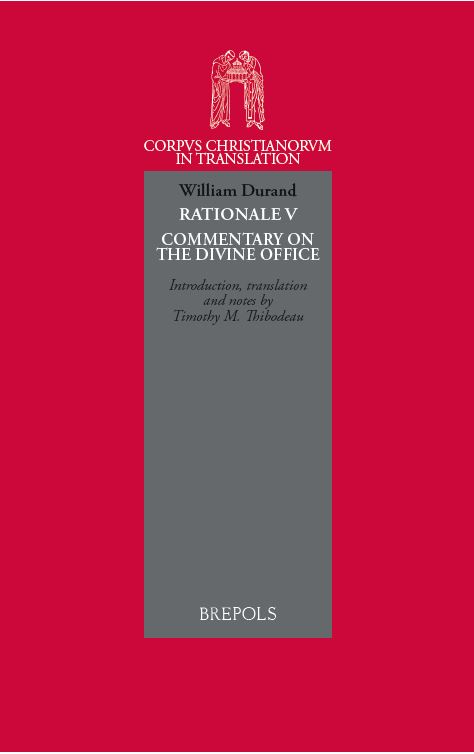
William Durand (c. 1230-Nov. 1, 1296), Bishop of Mende, France, was unquestionably the most renowned liturgical scholar of the later Middle Ages. His encyclopedic allegorical exposition of the rites and worship services of the Latin Church, the Rationale divinorum officiorum, or “Rationale for the divine offices,” is the best known medieval work in its genre. Divided into eight books of varying length, the Rationale is exhaustive in its treatment of a wide variety of subjects: the church building and liturgical art; the ministers of the church and their functions; liturgical vestments; the Mass and the Divine Office; the Church’s calendar and its feast days. Modern scholarship has clearly shown that Durand’s Rationale superseded all previous liturgical commentaries within only a few years of its publication (c. 1292-1296). By the end of the fifteenth century, it had become one of the most widely disseminated treatises of its kind in western Europe. Book 5, Durand’s detailed commentary on the Divine Office, has never been translated into English. The present volume makes this important text available for modern students of liturgy, musicology, theology, and art history for whom the original Latin text is not accessible. The present translation also provides extensive annotation and explanation of Durand’s sometimes cryptic etymologies, while bringing to light important source material embedded within his commentary. The source text of this volume appeared in Corpus Christianorum Continuatio Mediaeualis as Guillelmus Durantus – Rationale divinorum officiorum V-VI (CCCM 140A). References to the corresponding pages of the Corpus Christianorum edition are provided in the margins of this translation.
William Durand (c. 1230-Nov. 1, 1296), Bishop of Mende, France, was unquestionably the most renowned liturgical scholar of the later Middle Ages. His encyclopedic allegorical exposition of the rites and worship services of the Latin Church, the Rationale divinorum officiorum, or “Rationale for the divine offices,” is the best known medieval work in its genre. Divided into eight books of varying length, the Rationale is exhaustive in its treatment of a wide variety of subjects: the church building and liturgical art; the ministers of the church and their functions; liturgical vestments; the Mass and the Divine Office; the Church’s calendar and its feast days. Modern scholarship has clearly shown that Durand’s Rationale superseded all previous liturgical commentaries within only a few years of its publication (c. 1292-1296). By the end of the fifteenth century, it had become one of the most widely disseminated treatises of its kind in western Europe. Book 5, Durand’s detailed commentary on the Divine Office, has never been translated into English. The present volume makes this important text available for modern students of liturgy, musicology, theology, and art history for whom the original Latin text is not accessible. The present translation also provides extensive annotation and explanation of Durand’s sometimes cryptic etymologies, while bringing to light important source material embedded within his commentary. The source text of this volume appeared in Corpus Christianorum Continuatio Mediaeualis as Guillelmus Durantus – Rationale divinorum officiorum V-VI (CCCM 140A). References to the corresponding pages of the Corpus Christianorum edition are provided in the margins of this translation.
- By (author) William Durand
- Edited by T. Thibodeau
Other Titles in this Series










 La caduta di Acri 1291
Raccolta delle imprese legate allo sterminio di Acri - Taddeo di Napoli, Storia della desolazione e della distruzione della citta di Acri e di tutta la Terra Santa
Volume 42





Similar Books
 «Solazoxa festa, stradolze e stracomplia»
Festschrift für Raymund Wilhelm zum 65. Geburtstag mit Beiträgen zu Diskurstraditionen und mittelalterlicher Philologie
Volume 249

 A Collaborative Tapestry in Honour of Shirley Ann Brown / Une fresque brodée en l’honneur de Shirley Ann Brown
The Bayeux Tapestry Seen by her Colleagues and Friends / La Tapisserie de Bayeux vue par ses collègues et amis
 A Companion to Christianity and Sport in Europe and North America (19th-21st centuries)
Volume 1: Western and Eastern Europe
 A Connecting Polemic in the Medieval Mediterranean
The Correspondence of Leo III and ʿUmar II
Volume 6








 Ars Prophetica
Theology in the Poetry of Twentieth-Century Hebrew Poets Avraham Halfi, Shin Shalom, Amir Gilboa, and T. Carmi
 As Messianism Turns to Heresy
The Regenstein Chair Lectures On Lurianic Kabbalah and Shabbatai Tzevi at Hebrew Union College - Cincinnati


 Behind the Scenes of Medieval Roofs
An Overview of the Roofing Systems of Italian Churches
Volume 90


 Cahiers de recherches médiévales et humanistes – Journal of Medieval and Humanistic Studies
Volume 51



 Creating the Woman in Antiquity
Proceedings of the 16th Melammu Workshop, Innsbruck, 2–3 June 2022
Volume 13
 Cultic Kisses
Fruitful Encounters Between Deities and Humans. Festschrift for Angelika Berlejung on the Occasion of Her 65th Birthday
 De/colonizing Theologies
Glocal Histories, Contemporary Challenges, Theoretical Reflections
Volume 4

 Drunk the Potion, No Whit Charmed
The Doctrine of Pure and Perfect Souls from Iamblichus to Damascius

