
Ranulph Higden, «Speculum Curatorum» – A Mirror for Curates. Book II
The Capital Sins
By (author) E. Crook By (author) M. Jennings
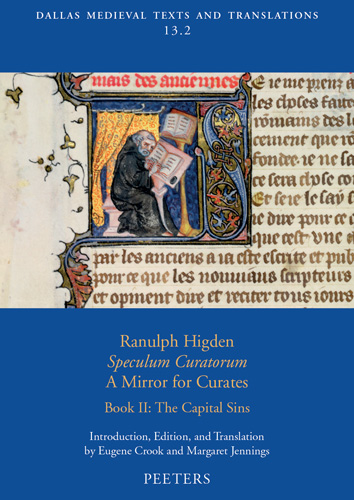
Ranulph Higden’s Speculum curatorum was composed in England about 1350. Book II treats the types and originating circumstances of all sin, but mostly focuses on the seven capital sins: pride, avarice, lust, anger, gluttony, envy, and sloth. Each is discussed with a thoroughness appropriate to the text’s function as a manual of instruction for parish clergy. None of the sins is treated lightly, as any one of them could prevent the soul from achieving its eternal goal. The length of each discussion is also indicative of the sin’s effect on Church life and discipline. Avarice–together with its worrisome components of usury and simony–is of special concern and consequently occupies about a quarter of the total commentary. Higden’s exploration of the capital sins differs in format and purpose from earlier books on the same topic. The libri poenitentiales of the sixth through twelfth centuries usually just matched a sin with its recommended punishment; the summae confessorum of the thirteenth and fourteenth centuries were mostly oriented to helping a confessor understand how contrition, confession, and satisfaction were necessary components of the sacrament of penance. Higden wants both clerics and lay people to come face to face with all of the destructive aspects of sin. At times, as in the chapter on drunkenness, he weaves the psychological and pastoral dimensions of a certain sin into his painstaking analysis. The manual’s fifty-one chapters aim to assist both priest and people to know the blandishments of sin thoroughly and, because of this knowledge, to avoid them.
Ranulph Higden’s Speculum curatorum was composed in England about 1350. Book II treats the types and originating circumstances of all sin, but mostly focuses on the seven capital sins: pride, avarice, lust, anger, gluttony, envy, and sloth. Each is discussed with a thoroughness appropriate to the text’s function as a manual of instruction for parish clergy. None of the sins is treated lightly, as any one of them could prevent the soul from achieving its eternal goal. The length of each discussion is also indicative of the sin’s effect on Church life and discipline. Avarice–together with its worrisome components of usury and simony–is of special concern and consequently occupies about a quarter of the total commentary. Higden’s exploration of the capital sins differs in format and purpose from earlier books on the same topic. The libri poenitentiales of the sixth through twelfth centuries usually just matched a sin with its recommended punishment; the summae confessorum of the thirteenth and fourteenth centuries were mostly oriented to helping a confessor understand how contrition, confession, and satisfaction were necessary components of the sacrament of penance. Higden wants both clerics and lay people to come face to face with all of the destructive aspects of sin. At times, as in the chapter on drunkenness, he weaves the psychological and pastoral dimensions of a certain sin into his painstaking analysis. The manual’s fifty-one chapters aim to assist both priest and people to know the blandishments of sin thoroughly and, because of this knowledge, to avoid them.
- By (author) E. Crook
- By (author) M. Jennings
Other Titles in this Series

 The Notory Art of Shorthand (Ars notoria notarie)
A Curious Chapter in the History of Writing in the West
Volume 20



 Education of Nuns, Feast of Fools, Letters of Love
Medieval Religious Life in Twelfth-Century Lyric Anthologies from Regensburg, Ripoll, and Chartres
Volume 26


 Robert Grosseteste at Munich
The Abbreviatio by Frater Andreas, O.F.M., of the Commentaries by Robert Grosseteste on the Pseudo-Dionysius
Volume 14


 A Thirteenth-Century Textbook of Mystical Theology at the University of Paris
The «Mystical Theology» of Dionysius the Aeropagite in Eriugena's Latin Translation with the Scholia translated by Anastasius the Librarian and Excerpts from Eriugena's «Periphyseon»
Volume 4









Similar Books
 «Solazoxa festa, stradolze e stracomplia»
Festschrift für Raymund Wilhelm zum 65. Geburtstag mit Beiträgen zu Diskurstraditionen und mittelalterlicher Philologie
Volume 249

 A Collaborative Tapestry in Honour of Shirley Ann Brown / Une fresque brodée en l’honneur de Shirley Ann Brown
The Bayeux Tapestry Seen by her Colleagues and Friends / La Tapisserie de Bayeux vue par ses collègues et amis
 A Companion to Christianity and Sport in Europe and North America (19th-21st centuries)
Volume 1: Western and Eastern Europe
 A Connecting Polemic in the Medieval Mediterranean
The Correspondence of Leo III and ʿUmar II
Volume 6








 Ars Prophetica
Theology in the Poetry of Twentieth-Century Hebrew Poets Avraham Halfi, Shin Shalom, Amir Gilboa, and T. Carmi
 As Messianism Turns to Heresy
The Regenstein Chair Lectures On Lurianic Kabbalah and Shabbatai Tzevi at Hebrew Union College - Cincinnati


 Behind the Scenes of Medieval Roofs
An Overview of the Roofing Systems of Italian Churches
Volume 90


 Cahiers de recherches médiévales et humanistes – Journal of Medieval and Humanistic Studies
Volume 51



 Creating the Woman in Antiquity
Proceedings of the 16th Melammu Workshop, Innsbruck, 2–3 June 2022
Volume 13
 Cultic Kisses
Fruitful Encounters Between Deities and Humans. Festschrift for Angelika Berlejung on the Occasion of Her 65th Birthday