
Pseudo-Arnald of Villanova, Alchemical Treatises
By (author) A. Rabin
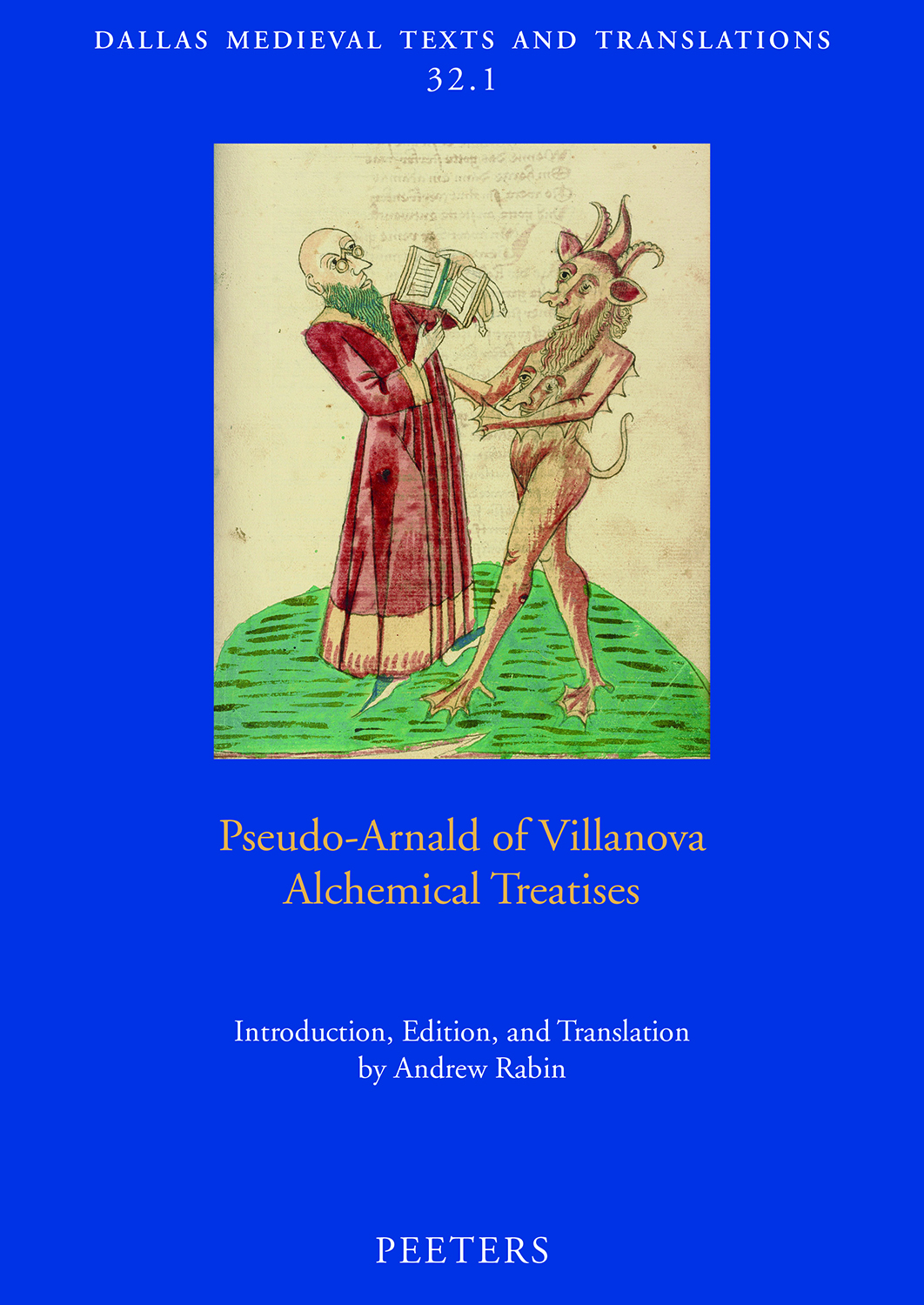
This book is the first in a three-volume set designed to make available some of the most influential alchemical manuals of the later Middle Ages. The past few decades have witnessed the growing realization of the central role played by alchemy in the intellectual history of medieval Europe. The study of alchemy inspired such authors as Geoffrey Chaucer and John Gower, shaped the work of scientists such as Paracelsus and Isaac Newton, motivated some of the earliest translations of Islamic scientific and medical texts for Christian readers, and influenced the development of experimental methods underlying the modern fields of chemistry, physics, and biology.<br/>
<br/>
The texts in this volume have been attributed—albeit inaccurately—to the prominent physician and theologian Arnald of Villanova (c. 1240–1311). The <i>Rosarius alchemiae</i>’s detailed instructions for the making of the philosophers’ stone provide one of the earliest accounts of the titration of mercury and sulfur as well as a valuable discussion of the experimental methods of medieval alchemists. <i>De secretis naturae</i> is a dialogue between a master and student which situates the pursuit of the philosophers’ stone within a broader philosophical and theological framework. Of greatest influence was this text’s extended comparison between the making of the philosophers’ stone and the death and resurrection of Christ.<br/>
<br/>
Accompanying the editions and translations are a historical introduction, catalogue of manuscripts, glossary of alchemical terms, and detailed textual and explanatory notes.
- By (author) A. Rabin
Other Titles in this Series
 Education of Nuns, Feast of Fools, Letters of Love
Medieval Religious Life in Twelfth-Century Lyric Anthologies from Regensburg, Ripoll, and Chartres
Volume 26




 Robert Grosseteste at Munich
The Abbreviatio by Frater Andreas, O.F.M., of the Commentaries by Robert Grosseteste on the Pseudo-Dionysius
Volume 14


 A Thirteenth-Century Textbook of Mystical Theology at the University of Paris
The «Mystical Theology» of Dionysius the Aeropagite in Eriugena's Latin Translation with the Scholia translated by Anastasius the Librarian and Excerpts from Eriugena's «Periphyseon»
Volume 4








 Paul of Venice, ‘Logica magna’: The Treatise on Insolubles
Edited with an Introduction, English Translation, and Commentary
Volume 27




Similar Books
 «Solazoxa festa, stradolze e stracomplia»
Festschrift für Raymund Wilhelm zum 65. Geburtstag mit Beiträgen zu Diskurstraditionen und mittelalterlicher Philologie
Volume 249
 A Collaborative Tapestry in Honour of Shirley Ann Brown / Une fresque brodée en l’honneur de Shirley Ann Brown
The Bayeux Tapestry Seen by her Colleagues and Friends / La Tapisserie de Bayeux vue par ses collègues et amis

 Behind the Scenes of Medieval Roofs
An Overview of the Roofing Systems of Italian Churches
Volume 90

 Cahiers de recherches médiévales et humanistes – Journal of Medieval and Humanistic Studies
Volume 51








 Innovation and Medieval Communities
The Circulation of Ideas and Practices in and out of the Town (1200-1500)
Volume 63
 John Dunstaple Reading Boethius
John Dunstaple’s Annotations to Boethius’s “De institutione musica” in the Manuscript Oxford, Corpus Christi College Library, MS 118

 Medieval Debates on Foreknowledge: Future Contingents, Prophecy, and Divination
Acts of the XXVII Annual Colloquium of the SIEPM, Trento 12-15 September 2023
Volume 31

 Medieval Yeghegis, Armenia
History, Archaeology, Society. Local Multiplicities and Global Connections of a Rural Centre on the Silk Road(s)
 Nicholas of Lyra’s Commentaries on the Gospels of Matthew and Luke
Franciscan Exegesis in a Time of Crisis



 Power and Women in Southeast and Central Europe in Late Medieval and Early Modern Period (1300-1600)
Volume 10




 The Anglo-Norman Bible’s Books of Kings, a Critical Edition
(BL Royal 1 C III, fols 234r-274v)
Volume 37
