
Education of Nuns, Feast of Fools, Letters of Love
Medieval Religious Life in Twelfth-Century Lyric Anthologies from Regensburg, Ripoll, and Chartres
By (author) D.A. Traill By (author) J. Haynes
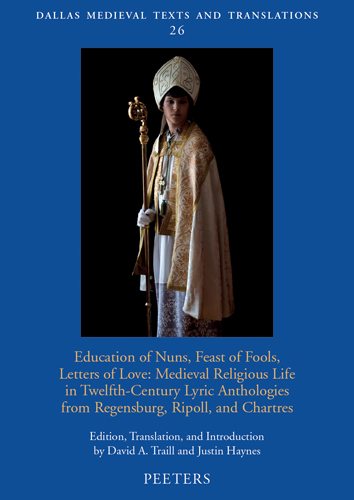
These three anthologies are all relatively unknown, particularly in the English-speaking world, outside of professional medieval Latinist circles. Though excerpts from the Regensburg and Ripoll poems have been published in English translation, only the Ripoll poems have been translated completely, and only into Spanish and French. Making these anthologies available in a bilingual edition with commentary will make the insight they provide into several aspects of medieval life accessible to medieval historians as well as the more general public. The Regensburg poems take the form of epistolary exchanges in Leonine hexameters, mainly between a male teacher and his female students, who appear to have been nuns. Some of the sixty-eight short poems imply an erotic relationship between teacher and student. The poems afford us rare glimpses into the education of women at this time. The Ripoll poems are a collection of twenty love poems, probably written in Lorraine around 1150 and copied in Ripoll. All twenty poems were written by a single unknown poet, except for one, a misogynistic poem also found in other manuscripts. The Chartres poems comprise seven performed at the post-Christmas festivities in Chartres around 1180, when the world was turned upside down in a carnivalesque suspension of the normal social order. This collection offers unique insight into the kind of poems performed during these “feasts of fools.” The last four poems are by two of the most famous medieval Latin poets, Walter of Chytillon and Peter of Blois, the canonist.
These three anthologies are all relatively unknown, particularly in the English-speaking world, outside of professional medieval Latinist circles. Though excerpts from the Regensburg and Ripoll poems have been published in English translation, only the Ripoll poems have been translated completely, and only into Spanish and French. Making these anthologies available in a bilingual edition with commentary will make the insight they provide into several aspects of medieval life accessible to medieval historians as well as the more general public. The Regensburg poems take the form of epistolary exchanges in Leonine hexameters, mainly between a male teacher and his female students, who appear to have been nuns. Some of the sixty-eight short poems imply an erotic relationship between teacher and student. The poems afford us rare glimpses into the education of women at this time. The Ripoll poems are a collection of twenty love poems, probably written in Lorraine around 1150 and copied in Ripoll. All twenty poems were written by a single unknown poet, except for one, a misogynistic poem also found in other manuscripts. The Chartres poems comprise seven performed at the post-Christmas festivities in Chartres around 1180, when the world was turned upside down in a carnivalesque suspension of the normal social order. This collection offers unique insight into the kind of poems performed during these “feasts of fools.” The last four poems are by two of the most famous medieval Latin poets, Walter of Chytillon and Peter of Blois, the canonist.
- By (author) D.A. Traill
- By (author) J. Haynes
Other Titles in this Series






 Paul of Venice, ‘Logica magna’: The Treatise on Insolubles
Edited with an Introduction, English Translation, and Commentary
Volume 27


 The Notory Art of Shorthand (Ars notoria notarie)
A Curious Chapter in the History of Writing in the West
Volume 20





 Robert Grosseteste at Munich
The Abbreviatio by Frater Andreas, O.F.M., of the Commentaries by Robert Grosseteste on the Pseudo-Dionysius
Volume 14


 A Thirteenth-Century Textbook of Mystical Theology at the University of Paris
The «Mystical Theology» of Dionysius the Aeropagite in Eriugena's Latin Translation with the Scholia translated by Anastasius the Librarian and Excerpts from Eriugena's «Periphyseon»
Volume 4


Similar Books
 «Solazoxa festa, stradolze e stracomplia»
Festschrift für Raymund Wilhelm zum 65. Geburtstag mit Beiträgen zu Diskurstraditionen und mittelalterlicher Philologie
Volume 249
 A Collaborative Tapestry in Honour of Shirley Ann Brown / Une fresque brodée en l’honneur de Shirley Ann Brown
The Bayeux Tapestry Seen by her Colleagues and Friends / La Tapisserie de Bayeux vue par ses collègues et amis

 Behind the Scenes of Medieval Roofs
An Overview of the Roofing Systems of Italian Churches
Volume 90

 Cahiers de recherches médiévales et humanistes – Journal of Medieval and Humanistic Studies
Volume 51








 Innovation and Medieval Communities
The Circulation of Ideas and Practices in and out of the Town (1200-1500)
Volume 63
 John Dunstaple Reading Boethius
John Dunstaple’s Annotations to Boethius’s “De institutione musica” in the Manuscript Oxford, Corpus Christi College Library, MS 118

 Medieval Debates on Foreknowledge: Future Contingents, Prophecy, and Divination
Acts of the XXVII Annual Colloquium of the SIEPM, Trento 12-15 September 2023
Volume 31

 Medieval Yeghegis, Armenia
History, Archaeology, Society. Local Multiplicities and Global Connections of a Rural Centre on the Silk Road(s)

 Nicholas of Lyra’s Commentaries on the Gospels of Matthew and Luke
Franciscan Exegesis in a Time of Crisis



 Power and Women in Southeast and Central Europe in Late Medieval and Early Modern Period (1300-1600)
Volume 10




 The Anglo-Norman Bible’s Books of Kings, a Critical Edition
(BL Royal 1 C III, fols 234r-274v)
Volume 37
