
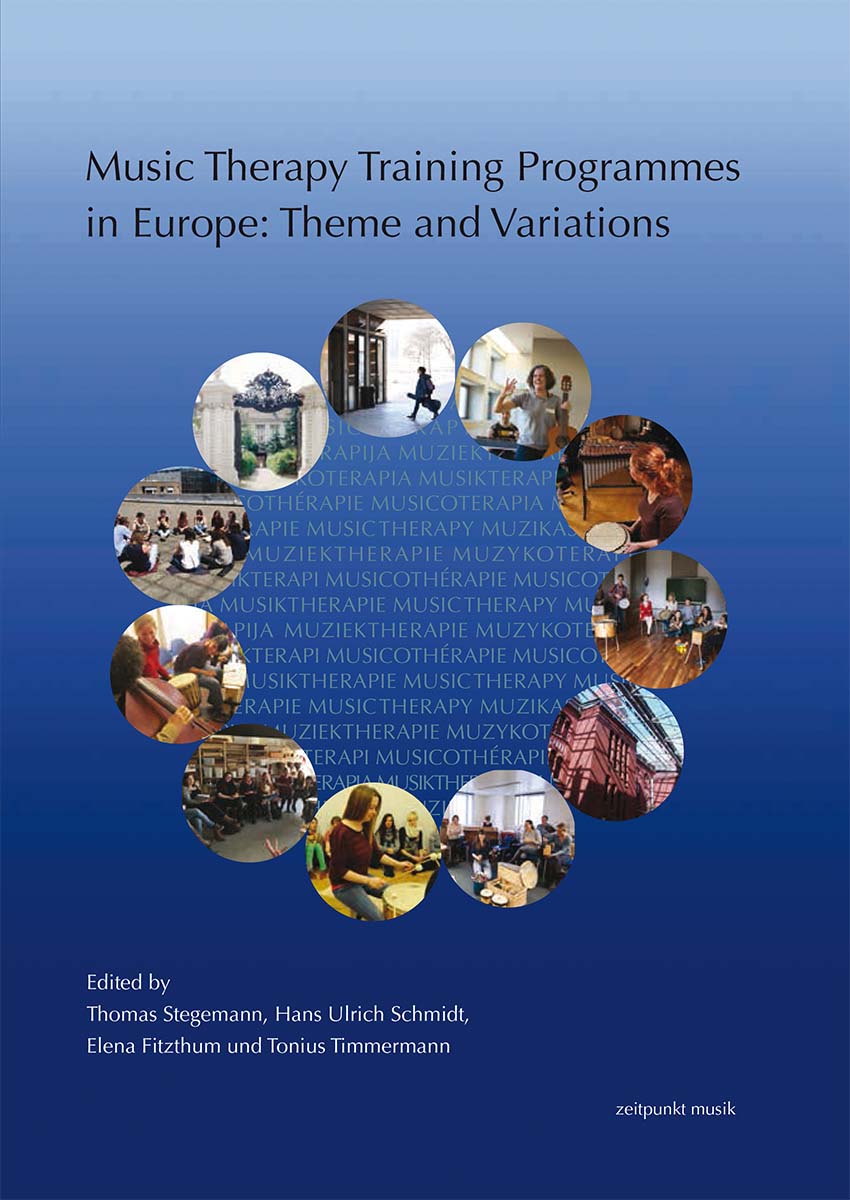
Music Therapy Training Programmes in Europe: Theme and Variations
Edited by Thomas Stegemann Edited by Hans Ulrich Schmidt Edited by Elena Fitzthum Edited by Tonius Timmermann
Paperback (Published)
(June 2016)
ISBN: 9783954901791
6.69 x 9.49 inches
Price: $20.00
In stock
This book provides an overview of all 119 European music therapy training programmes as well as a detailed portrait of 10 selected music therapy training courses from various countries, reflecting different music therapy backgrounds, approaches, phases of institutional developments, etc. It gives insights into the theoretical background, admission procedures, and the structure and content of each training programme, focusing especially on clinical training and internships, musical training, experiential learning and music therapy self-experience, as well as the evaluation procedures concerning the quality of teaching.
The aim of this book was not only to provide an overview of the current situation of music therapy training programmes in Europe, but to also give detailed insights into the structure and the content of music therapy training courses in different European countries. Thus, it literally draws a map of all 119 European music therapy training programmes, including a detailed table in the appendix of the book with facts from tuition fees to internet links of every training course. The detailed portrait of ten selected music therapy training programmes encompasses the following: Vienna, Austria, Leuven, Belgium, Aalborg, Denmark, Paris, France, Augsburg, Germany, Ferrara, Italy, Liepaja, Latvia, Katowice, Poland, Barcelona, Spain, and Roehampton, United Kingdom. The rationale for the selection was to portray degree programmes from various countries, covering the three European regions according to EMTC’s organisational structure: North, Middle and South of Europe. In addition, we strived to include different music therapy backgrounds, approaches, phases of institutional developments, different healthcare systems, different status of legal recognition of music therapy, and so on. Following a common framework, each chapter gives insights into the theoretical background, admission procedures, and the structure and content of the particular training programme, focusing especially on clinical training and internships, musical training, experiential learning and music therapy self-experience, as well as the evaluation procedures concerning the quality of teaching. The last part of the book then offers a conclusion and an outlook by the editors, summing up and commenting on the synopsis of curricula depicted in the previous chapters.
Stegemann, Thomas, Univ.-Prof. Dr. med. Dr. sc. mus. (*1972)<br/>Thomas Stegemann studied guitar (Los Angeles, USA), medicine, and music therapy. He is a child and adolescent psychiatrist, a licensed music therapist, and a family therapist. Since 2011 he serves as Professor of Music Therapy and Head of the Department of Music Therapy at the University of Music and Performing Arts in Vienna, Austria. Main research areas: Music therapy and neurobiology, receptive music therapy with children and adolescents, music therapy with families<br/><br/>Schmidt, Hans Ulrich, Prof. Dr. (*1958)<br/>Study of music pedagogics (Hamburg), music therapy (Hamburg, Vienna), medicine (Hamburg). Doctor for psychosomatic medicine at Hamburg University Hospital. Director of MA programme and Research Centre for Music and Health, Leopold Mozart-Centre, University of Augsburg. Private therapeutical practice in Hamburg. Member of scientific committee of dmtg. Publishing: Books, articles.<br/><br/>Fitzthum, Elena, Dr. sc. mus. (*1954)<br/>Music therapist, psychotherapist and supervisor with over 30 years of experience in a variety of clinical settings. Elena Fitzhum is chair of the Viennese Institute of Music Therapy (WIM) and co-editor of WIM´s book series Viennese Contributions to Music Therapy and member of the EMTC Board. She is a lecturer at the University of Music and Performing Arts Vienna and at the Zurich University of the Arts. Her theoretical work is focussed on the history and development of music therapy.<br/><br/>Timmermann, Tonius, Prof. Dr. (*1950)<br/>Study of paedagogy in Münster and music therapy in Vienna. Trainings in breath therapy and systemic constellations. Clinical practice: psychiatry, psychotherapy and psychosomatics. Research and graduation (Dr.rer.biol.hum.) at the University of Ulm, Department for Psychotherapy. Professor at the University of Augsburg. Head of the Master training in Music Therapy and the Research Center for Music and Health (2003 – 2015). Private therapeutical practice in Munich. Publishing: books, articles and music.
- Edited by Thomas Stegemann
- Edited by Hans Ulrich Schmidt
- Edited by Elena Fitzthum
- Edited by Tonius Timmermann
„Overall this text is an excellent and timely resource as music therapy continues to develope not only as an art but also as a science, and the foundation that clinicians and researchers work from is created and informed by the educational process.“<br/><br/>Von: Amy Clements-Cortes<br/>In: Music & Medicine, 2017, Volume 9, Issue 2, pp. 145-146.
—
Other Titles in this Series
 Dem Leben eine Stimme geben
Zur Bedeutung der Stimme in der Musiktherapie mit behinderten und krebskranken Kindern


 Musik in Therapie und Medizin
25. Musiktherapie Tagung am Freien Musikzentrum München e. V. (4.–5. März 2017)
 Was macht wirklich satt? – Musiktherapeutische Ansätze in der Behandlung von Essstörungen
23. Musiktherapietagung am Freien Musikzentrum München e. V. (28. Februar bis 1. März 2015)


 »Schläft ein Lied in allen Dingen…«
Musikwahrnehmung und Spiellieder bei Schwerhörigkeit und Gehörlosigkeit
 Spielräume für Musik und Sprache
Musikpädagogische und therapeutische Arbeit an einer Förderschule Sprache


 Verschmerzen
Musiktherapie mit krebserkrankten Frauen und Männern im Spannungsfeld von kurativer und palliativer Behandlung

 Schöpferische Psychosynthese und Logotherapie
Julius Bahle (1903–1986) und Viktor Frankl (1905–1997): Eine Gegenüberstellung zweier Psychotherapiemethoden

 Zur Idee des therapeutischen Nachnährens – was kann Musiktherapie leisten?
Beiträge der 10. Musiktherapie Tagung 2002, März 2002

 Polaritätsverhältnisse in der Improvisation
Systematik einer musikalisch-psychologischen Benennung der musiktherapeutischen Improvisation
 Musiktherapie in der Palliativ- und Hospiz-Arbeit
21. Musiktherapietagung am Freien Musikzentrum München e. V. (2. bis 3. März 2013)
 Wege zum Lebenssinn
Religiöse und philosophische Orientierung in Zeiten lebensbedrohlicher Krankheit. Für Betroffene und Angehörige
 Elementare Beziehungen
Das pädagogische Instrument zur Einschätzung der Beziehungsqualität (EBQ-P-Instrument) und seine Anwendung im inklusiven Musik- und Tanzunterricht Band 1: Das EBQ-P-Instrument Praxis: Grundlagen, Merkmallisten, Anwendungshinweise
 Fokus Musiktherapeut –Von der Sorge für sich selbst
26. Musiktherapie-Tagung am Freien Musikzentrum München e. V. (3.–4. März 2018)


 Musiktherapie als Psychotherapie für Menschen mit Intelligenzminderung oder fehlender Sprache
30. Musiktherapie-Tagung am Freien Musikzentrum München e. V. (5.–6. März 2022)

Similar Books

 As Messianism Turns to Heresy
The Regenstein Chair Lectures On Lurianic Kabbalah and Shabbatai Tzevi at Hebrew Union College - Cincinnati
 Attics and Basements
The Evocative, Expressive and Embracing Functions of Homes and Other Human Dwellings

 Beyond Sovereign Courts
Agents and Practices in Early Modern Spanish and Habsburg Diplomacy
Volume 3









 Food Security under Armed Conflict
Global Knowledge Landscape and Public Attention to Social, Economic, and Humanitarian Dimensions




 Innovationes Lovanienses: Arts, Law and Theology at the University of Louvain (1425–1797)
Studium Lovaniense: Learning across Borders, 2
Volume 18

 John Dunstaple Reading Boethius
John Dunstaple’s Annotations to Boethius’s “De institutione musica” in the Manuscript Oxford, Corpus Christi College Library, MS 118
