
Miniature Forms as Transformative Thresholds
Faience Figurines in Middle Bronze Age Egypt, Nubia and the Levant (2100-1550 BC)
By (author) G. Miniaci

This volume is the first of two complementary volumes that explore the world of faience figurines in Egypt and its adjacent areas (the Levant and Nubia) in the Middle Bronze Age (2100-1550 BC). Its companion is published as Faience Figurines in their Archaeological and Museological Contexts (BMPES 19). This volume analyses Middle Kingdom Egyptian figurines made in faience, a lustrous and intensely blue glaze paste, skilfully manufactured with a high degree of accuracy. They represent one of the most iconic and signature categories of artefacts in ancient Egypt. The research especially focuses on the manufacture, iconography and distribution (spatial and chronological) of this type of figurines. Particular attention is given to the study of the archaeological contexts and their ‘life cycle’ in ancient Egyptian society. Indeed, the tangibility and proximity (given the reduced scale) of the figurines engender intimacy, making them more involved in human interactions, in contrast to larger statues that are far less accessible. As a result, faience figurines represent one of the best artefacts for exploring the ‘social narrative’ of ancient Egyptian society. They were used to express concepts, ideas, feelings, and visions that were specific to certain communities and cultures. Therefore, figurines inevitably encapsulate fragments of human stories and customs of the society. An extensive Iconographic Appendix provides a detailed analysis of the wide range of subjects represented by these figurines: hippopotami, lions, baboons, cats, dogs, hedgehogs, as well as humans, dwarfs or grotesque creatures, females (with truncated legs), vessels, vegetables, and a limited number of hybrid creatures, such as Aha/Bes and Ipy/Taweret.
This volume is the first of two complementary volumes that explore the world of faience figurines in Egypt and its adjacent areas (the Levant and Nubia) in the Middle Bronze Age (2100-1550 BC). Its companion is published as Faience Figurines in their Archaeological and Museological Contexts (BMPES 19). This volume analyses Middle Kingdom Egyptian figurines made in faience, a lustrous and intensely blue glaze paste, skilfully manufactured with a high degree of accuracy. They represent one of the most iconic and signature categories of artefacts in ancient Egypt. The research especially focuses on the manufacture, iconography and distribution (spatial and chronological) of this type of figurines. Particular attention is given to the study of the archaeological contexts and their ‘life cycle’ in ancient Egyptian society. Indeed, the tangibility and proximity (given the reduced scale) of the figurines engender intimacy, making them more involved in human interactions, in contrast to larger statues that are far less accessible. As a result, faience figurines represent one of the best artefacts for exploring the ‘social narrative’ of ancient Egyptian society. They were used to express concepts, ideas, feelings, and visions that were specific to certain communities and cultures. Therefore, figurines inevitably encapsulate fragments of human stories and customs of the society. An extensive Iconographic Appendix provides a detailed analysis of the wide range of subjects represented by these figurines: hippopotami, lions, baboons, cats, dogs, hedgehogs, as well as humans, dwarfs or grotesque creatures, females (with truncated legs), vessels, vegetables, and a limited number of hybrid creatures, such as Aha/Bes and Ipy/Taweret.
- By (author) G. Miniaci
Other Titles in this Series




 The Fourth Cataract and Beyond
Proceedings of the 12th International Conference for Nubian Studies
Volume 1

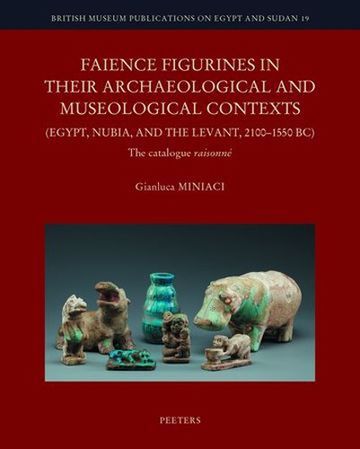 Faience Figurines in their Archaeological and Museological Contexts (Egypt, Nubia, and the Levant, 2100-1550 BC)
The Catalogue Raisonné
Volume 19



Similar Books




 The Western Nile Delta
ARCE Fieldwork in the Region of Kom Firin and Naukratis (1977-1983) Revisited
 Archaeological Discoveries at the Temple of Ramesses II in Abydos
Vol. 2: Old Kingdom Wall, Papyri, Ostraca, and Leather Remains



 The Southern Room of Amun in the Temple of Hatshepsut
Volume 2: Studies on Decoration and Ritual Function
Volume 11

 Die Ägyptenworte im Ezechielbuch
Eine literarhistorische und religionsgeschichtliche Analyse von Ez 29–32
 Du côté de chez Zeus
Fouilles de la Mission archéologique française du désert Oriental à Abû Qurayya (Dios) et Bi’r Bayza (y inclus O.Dios I 1-67)
Volume 98
 La littérature de l’Égypte ancienne. Volume V
Nouvel Empire : XVIIIe dynastie. Eulogies et narrations royales, contes, enseignements et littérature d’idée
 Lehrreiche Literatur
Die didaktische Gestaltung von Plutarchs Quaestiones Graecae und Romanae und Gellius' Noctes Atticae

 Nouvelles perspectives sur le Traité anonyme du Codex Bruce. New Perspectives on the Untitled Treatise of the Bruce Codex
(Colloque international, Québec, Université Laval, 13 avril 2018)
Volume 11


 Ägypten und Levante XXXIV / Egypt and the Levant XXXIV (2024)
Internationale Zeitschrift für ägyptische Archäologie und deren Nachbargebiete / International Journal for Egyptian Archaeology and Related Disciplines

 Ancient Egypt in 50 Discoveries
Highlights from the first century of the Egypt Exploration Society
Volume 8
 Archaeological Discoveries at the Temple of Ramesses II in Abydos
Vol. 1: Magazines, Animal Burials, and Miscellanea
 Building an 18th Dynasty Tomb at Thebes
Construction Records from Mery's Funerary Complex (TT 95) in Context
Volume 4

 Current Research in Egyptology 2024
Proceedings of the Twenty-Fourth Annual Symposium, Jointly Organised by the University of Liverpool, Swansea University, University of Birmingham, University of Oxford, and University of Wales Trinity Saint David, 2–6 September 2024


 From Egypt to the Levant and Beyond
African Individuals and Groupsain Cuneiform Texts from the Late Bronze Age
Volume 133
 Kom al-Ahmer — Kom Wasit III
The Archaeology of Two Ptolemaic Districts in the Western Nile Delta, Egypt