
Gott und Gewalt gegen Kinder im Alten Testament
by Andreas Michel

English summary: Children are often the victims of violence in the Old Testament, and in most instances God bears the responsibility for these acts of violence. In this work, Andreas Michel demonstrates that there are parallels between today’s attitude regarding these acts and the attitude of the Greek translators of the Old Testament who, because they could not bear the thought of God permitting these acts of violence, simply omitted some of these incidents from their bible. In order to present proof of this, the author evaluates for the first time all those negative verbs which are related to violence and which have God as their subject. In doing so, he is guided by the presentation of the so-called countertestimony in Walter Brueggemann’s Theology of the Old Testament from 1997. In a discussion of Psalm 137 and Genesis 22, two texts which pertain particularly to violence against children, and of texts concerning cannibalism of children, the author reaches the conclusion that the biblical image of God, as repulsive as it may seem, must be taken seriously. German description: Kinder sind im alttestamentlichen Kontext in einem erschreckend hohen Ausmass Opfer tatsachlicher oder angekundigter korperlicher Gewalt. Dabei verblufft die starke negative Involvierung der Gottesfigur in diese Gewaltszenarien. Andreas Michel vergleicht die hebraischen und griechischen Fassungen der Gewalt-gegen-Kinder-Texte textkritisch mit denjenigen Texten, in denen negative, gewaltnahe Verben mit gottlichem Subjekt verbunden werden. Eine eindruckliche Sammlung dieser Verben aus dem biblischen countertestimony (Brueggemann 1997) wird hier erstmals prasentiert. Es zeigt sich, dass die Verbindung von eGott’ und eGewalt’ schon seit fruhesten Zeiten als problematisch empfunden worden ist, freilich nicht so sehr wegen der Opfer, den Kindern, sondern wegen des Taters, Gott. In exemplarischen Durchgangen werden drei besonders exponierte Gewalt-gegen-Kinder-Kontexte im Blick auf das Gottesbild beleuchtet, und zwar Psalm 137 (Kinder zerschlagen), die Kinder-Kannibalismus-Texte (Kinder essen) und Genesis 22 (Kinder opfern). Der Autor pladiert dafur, sich auch mit der als abstossend empfundenen Abgrundigkeit des biblischen Gottes auseinander zu setzen.
- By (author) Andreas Michel
Other Titles in this Series
 Grundfragen der historischen Exegese
Methodologische, philologische und hermeneutische Beitrage zum Alten Testament
Volume 95
 Schriftgelehrte Traditionsliteratur
Fallstudien zur innerbiblischen Schriftauslegung im Alten Testament
Volume 77
 Bet-El – Erinnerungen an eine Stadt
Perspektiven der alttestamentlichen Bet-El-Überlieferung
Volume 49
 Das Wort Gottes im Kontext alttestamentlicher Hermeneutik
Untersuchungen zum Wort Gottes und zum Gottesbild im Alten Testament
Volume 166


 The Exodus-Conquest Narrative
The Composition of the Non-Priestly Narratives in Exodus-Joshua
Volume 115


 Reading Prophetic Books
Form, Intertextuality, and Reception in Prophetic and Post-Biblical Literature
Volume 89


 Elephantine in Context
Studies on the History, Religion and Literature of the Judeans in Persian Period Egypt
Volume 155
Similar Books


 Athanasius of Alexandria, Epistula ad episcopos Aegypti et Libyae
Old Slavonic Version and English Translation
Volume 261


 Cyril of Alexandria’s Christological Exegesis
Explorations of Partitive Exegesis in the Dialogues on the Trinity
Volume 70


 Epiphanies of the Divine in the Septuagint and the New Testament
Fifth International Symposium of the Corpus Judaeo-Hellenisticum Novi Testamenti (CJHNT), 14-17 May 2015, Nottingham

 Extracanonical Traditions and the Holy Land
Texts, Rituals, and Material Culture in Late Antique Palestine
 From Joseph to Jesus
The Joseph Narrative as a Compositional Template from Old Greek Esther to the Gospel of Luke
Volume 125


 Paradise Lost in Transmission
The Return to Eden in the Apocalypse of Peter within Its Ethiopic and Early Christian Contexts



 Punning in Odd or Elegant Constructions in Jeremiah
The Convergence of Linguistics, Rhetoric, and Textuality in the Hebrew Text of Jeremiah

 Shame in the Worlds of the Hebrew Bible and Akkadian Texts
A Linguistic Study and Its Implications
Volume 33

 Tabernacle, Table, Ark, and Text
Richard of Saint Victor on the Interpretation of Scripture
Volume 67
 The Anglo-Norman Bible’s Books of Kings, a Critical Edition
(BL Royal 1 C III, fols 234r-274v)
Volume 37
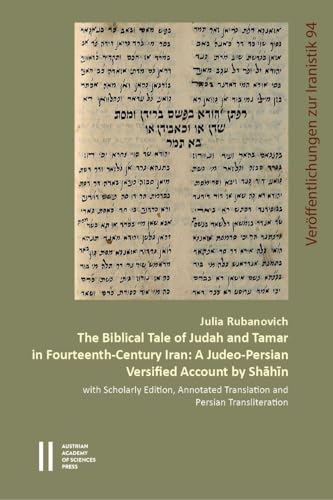 The Biblical Tale of Judah and Tamar in Fourteenth-Century Iran
A Judeo-Persian Versified Account by Shāhīn with Scholarly Edition, Annotated Translation and Persian Transliteration
Volume 94, 951
 The Body
Lived, Cultured, Adorned: Essays on Dress and the Body in the Bible and Ancient Near East in Honor of Nili S. Fox

 The Compositional History of the Book of Kings
An Analysis of the Evaluative Frameworks in 1 Kings 14–2 Kings 25
 The Discourse of Rites
Shaping and Reshaping the (Counter-)Priestly Rituals Conducted Outside the Tabernacle


