
Geistes-, sozial- und kulturwissenschaftlicher Anzeiger – Zeitschrift der philosophisch-historischen Klasse der Osterreichischen Akademie der Wissenschaften, 159. Jahrgang (2024)
edited by Danuta Shanzer

Paperback (Published)
(April 2025)
ISBN: 9783700196976
Price: $98.00
On back order
This issue reacts to Alexander Demandt’s fast-paced account of the rise and eventual fall of the Western Roman Empire, a topic of periodically hot political interest. His focus: Germanic barbarians and the Rhine-Danube limes, invasion, conflict, change, and loss (from the Empire’s perspective). The international contributors, primarily ancient historians and adherents of a more peaceable “transformation school,” respond and refine. The volume offers a study of client kingship as a strategy for making the Alamanni “us” rather than “them”. Next, one of the comparatively neglected Upper Rhine limes, following its less dramatic history as a zone of mixed ethnicities, settled by barbarian foederati that eventually became the Second Burgundian Kingdom of the early Middle Ages. An ancient stereotype is re-examined, and Romans may emerge as even more perfidious than barbarians. The joys and perils of narrative history are discussed, and a view from the Eastern Frontier shows how it differed, and why it held, despite raiding. Included are reflections on literary depictions of boundaries and borders, ancient demography, and the role of Christianity as well as a second look at the Rhine-Danube limes through the eyes of the poet and politician Ausonius, who came home from the Rhine limes and also acted as Gratian’s spin-doctor after Adrianople in 378. Migration into Europe casts its shadow over contemporary Roman historiography, and the CDU leadership in Germany tried (unsuccessfully) to suppress an earlier version of Demandt’s contribution in 2015. The volume thus includes a substantial piece on l’affaire Demandt from a modern legal scholar with expertise in Islam. The direct applicability of Roman concerns to present politics is limited, but modern conditions, will to integration, and the respective expectations of host countries and immigrant communities may augur more difficult transformations for modern Europe than for the Western Roman Empire.
- Edited by Danuta Shanzer
Other Titles in this Series


Similar Books


 Caesar’s Visions and Impact on the Roman Empire
Revisiting the Archaeological and Historical Record of the 40s BC
Volume 2

 Construction Processes in Historical Western Societies (5th c. BC – 10th c. AD)
Case Studies on Techniques, Models, and Costs


 Etruscan and Roman Hellenistic Anatomical ex votos
Reassessing Popular Religious Expressions in Central Italy
Volume 8




 Invisible Labour in Antiquity
Visualizing Obscure Work in the Ancient Mediterannean and West Asia
Volume 1

 Late Antique villae in the Balkans (3rd–7th c. AD): Current Research Questions and Perspectives
HAEMUS Companion to the Late Antique Balkans 1
Volume 4





 Portraying the Individual in the Roman East
Local–Imperial Entanglements in Sculpture, Mosaics, and Paintings (First–Fourth Centuries AD)
Volume 18


 Roman Copies, Collecting, and Culture in the Bay of Naples and Beyond
Papers in Honor of Eugene J. Dwyer
 Small Worlds and Relational Agencies: Local Societies in Early Medieval Iberia
Pequeños mundos y Agencias relacionales: Sociedades locales altomedievales en la Península Ibérica
 SOMA 2023: Proceedings of the 24th Symposium on Mediterranean Archaeology
Ideas that Travelled by the Sea, Udine, 2-4 February, 2023


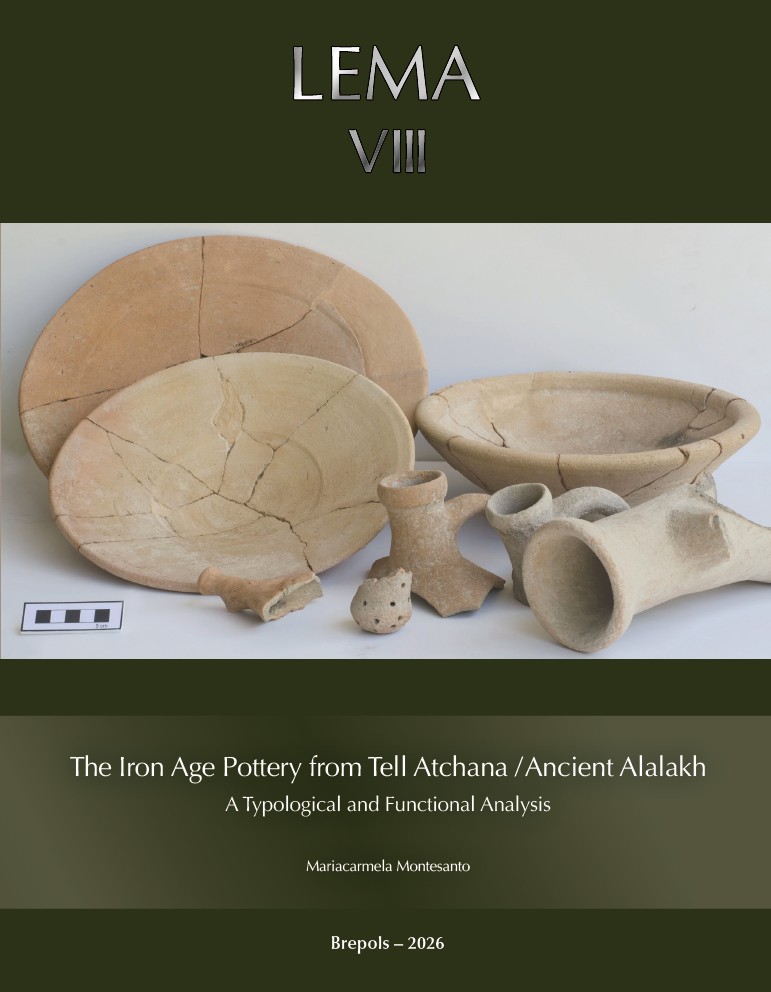 The Iron Age Pottery from Tell Atchana / Ancient Alalakh
A Typological and Functional Analysis
Volume 8


 Writing in the Church of the Nativity in Bethlehem
Inscription and Graffiti in a Multilingual and Multigraphic Perspective
Volume 45
 Zooarchaeology of Ancient Greek Sanctuaries in Southwestern Sicily
Faunal Analysis from Selinus and Akragas as Evidence of Differences in the Treatment of Animals for Ritual Purposes
 Alabaster
An Interdisciplinary Study of the Sources and Uses of Calcite Alabaster in Antiquity
Volume 5

 Echoes from the Past: Traditional Cypriot Pottery
An Exhibition at the Cyprus American Archaeological Research Institute in October 1995