
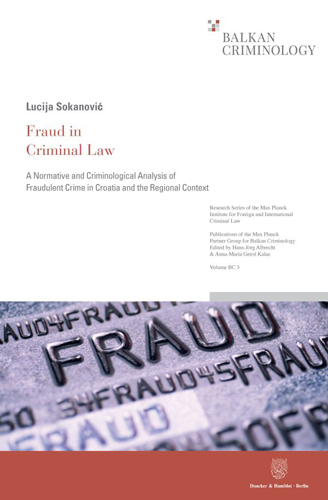
Fraud in Criminal Law.
A Normative and Criminological Analysis of Fraudulent Crime in Croatia and the Regional Context.
By (author) Lucija Sokanović
Paperback (Published)
(May 2020)
ISBN: 9783428157686
5.87 x 8.86 inches
Price: $51.00
In stock
New forms of criminal fraud are constantly emerging and their incidence is increasing. This book provides in-depth analyses of whether, and how exactly, criminal law perceives and adapts to these developments. The main focus of the study are the relevant normative and criminological questions regarding fraud, fraud in economic transactions, subsidy fraud, computer and electoral fraud, and some other forms of fraudulent behaviour. From a comparative perspective, it becomes apparent that a specific group of statutory offences is scattered throughout the criminal codes of Croatia, Germany, Austria and Switzerland and also the neighbouring countries in the Balkan region, all of which fit the same pattern and reveal the same core features of fraud. Criminal law addresses them in the same manner, hence a “fraud-related criminal law” can be identified. This should be of help for developing and applying adequate measures for effective detection and prosecution of this type of offences. Standardization of legal protection against fraud is reflected upon as an instrument that represents the dynamics of the transition and integration of European countries and the globalization of the economy, with their growing intensity of economic cross-border transactions.
Chapter 1: Introductory Remarks
Chapter 2: Fraud
Historical Development – Criminological-Victimological Significance of Fraud – Objective Features – Subjective Features – The Aggravated Forms of Fraud
Chapter 3: Fraud in Economic Transactions
Historical Development – Criminological and Victimological Significance – Objective Features – Sub-jective Features – Typical Cases of Fraud in Economic Transactions
Chapter 4: Subsidy Fraud
Historical Development – Criminological Significance – Objective Features – Subjective Features – Cooperation of National and International Authorities in the Protection of the Financial Interests of the EU
Chapter 5: Computer Fraud
Historical Development – Criminological Significance – Objective Features – Subjective Features
Chapter 6: Electoral Fraud
Historical Development – Criminological Significance – Objective Features – Subjective Features
Chapter 7: Fraud in Other Criminal Offences
Chapter 8: Implications for the Balkan Region
Bosnia and Herzegovina – Serbia – Slovenia – Montenegro – Hungary
Chapter 9: Discussion and Conclusion on the Various Types of Fraud
References
Annexes
Lucija Sokanović is an Assistant Professor at the Chair for Criminal Law at the Faculty of Law, University of Split, Croatia. After graduating from the Split Faculty of Law, she worked at the Municipal Court in Kastel Luksic and at the Commercial Court in Split. She passed her bar exam in 2002. In 2014 she received her Ph.D. degree at the Faculty of Law, University of Zagreb (Doctoral Studies in Criminal Sciences), with the dissertation »Fraud in Criminal Law«. She teaches criminal law, commercial criminal law, criminal protection of the environment, international criminal law and sports criminal law. Her list of publications includes authored and co-authored articles in all these fields of expertise. She was visiting Scholar at the Freie Universität, Berlin, and the Max-Planck-Institut für ausländisches und internationales Strafrecht, Freiburg, Germany. She won the Award for best quality teaching 2015/2016 of the University Department of Forensic Sciences and the Award of the Student Choir of the Faculty of Law of the University of Split 2017.
- By (author) Lucija Sokanović
Other Titles in this Series
 Mapping the Criminological Landscape of the Balkans.
A Survey on Criminology and Crime with an Expedition into the Criminal Landscape of the Balkans.
Volume 1
 Imprisonment for International Crimes.
An Interdisciplinary Analysis of the ICTY Sentence Enforcement Practice.
Volume 5
 Juvenile Delinquency in the Balkans.
A Regional Comparative Analysis Based on the ISRD3 Study Findings.
Volume 6
 Mapping the Victimological Landscape of the Balkans.
A Regional Study of Victimology and Victim Protection with a Critical Analysis of Current Victim Policies
Volume 4

Similar Books

 East Meets West: Justice, Law, and Politics
The 13th Kobe Lecture and the 2nd IVR Japan International Conference, Chiba, September 2023

 False Friends in Comparative Law
Advantages and Risks of Legal Transplants in Civil Law – the Polish-German Perspective


 Kulturelles Erbe und gesellschaftliche Identität
Das Akademienprojekt „Corpus Vitrearum Medii Aevi“ im Einsatz für den Kulturgutschutz in der Ukraine
 Law, Economics, and Inequalities in the Welfare State
Proceedings of the Special Workshops held at the 31st World Congress of the International Association for Philosophy of Law and Social Philosophy in Seoul, Republic of Korea, 2024
 Legal Pluralism and the Tajik Experience of Xinjiang
Between Custom and the Chinese State: An Ethnographic Perspective
 Linguistic and Media Studies Perspectives on Research into Social and Political Polarisation
The Case of Poland
 Liturgia semper reformanda
Adaptations and accommodations in the liturgy in light of canon 838 of the Code of Canon Law


 The EPPO/OLAF Compendium of National Procedures: Estonia
Desktop codes on the procedural law of the Member States with annotations by national experts
 The EPPO/OLAF Compendium of National Procedures: Greece
Desktop codes on the procedural law of the Member States with annotations by national experts
 The EPPO/OLAF Compendium of National Procedures: Italy
Desktop codes on the procedural law of the Member States with annotations by national experts
 The Right to Regulate of Developing Countries in International Investment Law
A Contextual Approach to International Investment Agreements
Volume 11

 (Bloß) symbolische Rechtsetzung
Eine interdisziplinäre Untersuchung der deutschen Glücksspielregulierung auf ihre funktionelle und symbolische Wirkung
 Active Space Debris Removal
Rechte und Pflichten der Staaten im Kontext der aktiven Weltraumabfallbeseitigung
Volume 268

 Annäherungen an das japanische Recht
Festschrift für Heinrich Menkhaus zum 70. Geburtstag
Volume 245

 Artikel 102 AEUV und Nachhaltigkeit
Eine juristisch-ökonomische Analyse der Berücksichtigungsfähigkeit von Nachhaltigkeitsbelangen im Rahmen der Missbrauchsaufsicht
 Ausforschung und Rechtsdurchsetzung im Unionsprivatrecht
Herleitung und Ausgestaltung eines allgemeinen unionsrechtlichen Informationsrechts
 Baťas Menschen
Rationalisierung, social engineering und Differenzierung in der tschechoslowakischen Unternehmensstadt Zlín, 1918–1948
Volume 275


 Coburgs südöstliche Netzwerke – Coburg’s Networks in Southeastern Europe
Bulgarien, Rumänien und Ostmitteleuropa im 19. und 20. Jahrhundert. Hrsg. von Franziska Bartl und Frank-Lothar Kroll mit einem Grußwort Seiner Majestät des Königs der Bulgaren Simeon II.
Volume 39


 Credit Default Swap-Aktivismus
Eine ökonomische Analyse und rechtliche Bewertung der Einflussnahme von Credit Default Swap-Investoren auf Unternehmen
