
Church as Communion
The Gift and Goal of Koinonia
by Philip Kariatlis
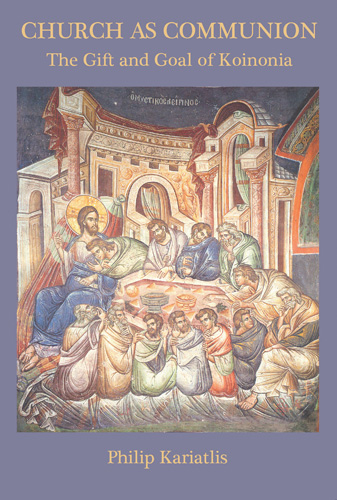
This book innovatively explores the notion of koinonia for understanding the nature and function of the Church. Since the Scriptures assert that the Church is the Church of God, God’s communal mode of existence is looked at namely, God who is a communion of three hypostases relating to one another in an interpenetrating koinonia of infinite love as a way of understanding the very being of the church as communion. Such a notion of koinonia, far from having anything to do with socio-political understandings, suggests that it is a foundational gift bestowed from above to the world as the solution par excellence to the impasse of isolationism. More often than not, however, such an ecclesiology of communion has not taken seriously the historical reality of the Church living within the fallen world along with its ceaseless temptations, divisions and even sins in history. In this way, it becomes apparent that a dialectic needs to be acknowledged in the notion of communion as both foundational gift from God, and yet one still to be fully realised. Accordingly, this work shows that the Church is not only as the gift of God’s miraculous presence here on earth. The Church is also constantly striving to exist epicletically until such time as it will fully experience the final consummation in Gods eschatological kingdom. An examination of this double dimensionality of the Church is undertaken in order to assess if this is in line with the Scriptural witness of the ekklesia. Having established the gift-goal dialectic in the notion of koinonia in the New Testament Church, the study then traces the trajectory of this dynamic approach to koinonia in the Churchs worship and authoritative structures. This promises to cast both a deeper light on, and a more realistic solution to ecclesiological problems within the life of the Church today, allowing for the Churchs constant renewal.
This book innovatively explores the notion of koinonia for understanding the nature and function of the Church. Since the Scriptures assert that the Church is the Church of God, God’s communal mode of existence is looked at namely, God who is a communion of three hypostases relating to one another in an interpenetrating koinonia of infinite love as a way of understanding the very being of the church as communion. Such a notion of koinonia, far from having anything to do with socio-political understandings, suggests that it is a foundational gift bestowed from above to the world as the solution par excellence to the impasse of isolationism. More often than not, however, such an ecclesiology of communion has not taken seriously the historical reality of the Church living within the fallen world along with its ceaseless temptations, divisions and even sins in history. In this way, it becomes apparent that a dialectic needs to be acknowledged in the notion of communion as both foundational gift from God, and yet one still to be fully realised. Accordingly, this work shows that the Church is not only as the gift of God’s miraculous presence here on earth. The Church is also constantly striving to exist epicletically until such time as it will fully experience the final consummation in Gods eschatological kingdom. An examination of this double dimensionality of the Church is undertaken in order to assess if this is in line with the Scriptural witness of the ekklesia. Having established the gift-goal dialectic in the notion of koinonia in the New Testament Church, the study then traces the trajectory of this dynamic approach to koinonia in the Churchs worship and authoritative structures. This promises to cast both a deeper light on, and a more realistic solution to ecclesiological problems within the life of the Church today, allowing for the Churchs constant renewal.
- By (author) Philip Kariatlis
Similar Books

 A Companion to Christianity and Sport in Europe and North America (19th-21st centuries)
Volume 1: Western and Eastern Europe
 A Connecting Polemic in the Medieval Mediterranean
The Correspondence of Leo III and ʿUmar II
Volume 6





 Ars Prophetica
Theology in the Poetry of Twentieth-Century Hebrew Poets Avraham Halfi, Shin Shalom, Amir Gilboa, and T. Carmi
 As Messianism Turns to Heresy
The Regenstein Chair Lectures On Lurianic Kabbalah and Shabbatai Tzevi at Hebrew Union College - Cincinnati


 Creating the Woman in Antiquity
Proceedings of the 16th Melammu Workshop, Innsbruck, 2–3 June 2022
Volume 13
 Cultic Kisses
Fruitful Encounters Between Deities and Humans. Festschrift for Angelika Berlejung on the Occasion of Her 65th Birthday
 De/colonizing Theologies
Glocal Histories, Contemporary Challenges, Theoretical Reflections
Volume 4
 Drunk the Potion, No Whit Charmed
The Doctrine of Pure and Perfect Souls from Iamblichus to Damascius






 Extracanonical Traditions and the Holy Land
Texts, Rituals, and Material Culture in Late Antique Palestine
 Fear, Fear of God, God-Fearers
Philological and Historical Perspectives on the World of Ancient Judaism and Christianity


 Gender and Iconography in Antiquity
Femininities, Masculinities, Ambiguities, and Beyond in the Ancient Levant, Near East, and Mediterranean