
The Hellenistic Court
Monarchic Power and Elite Society from Alexander to Cleopatra
edited by Andrew Erskine, Lloyd Llewellyn-Jones and Shane Wallace
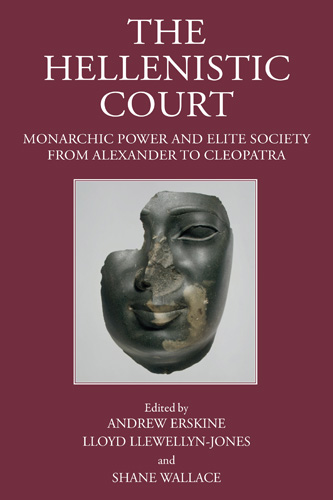
The work demonstrates the complexity and motivations of Hellenistic royal civilization, of courts which governed the transmission of Greek culture to the wider Mediterranean worldand to later ages.
Hellenistic courts were centres of monarchic power, social prestige and high culture in the kingdoms that emerged after the death of Alexander. They were places of refinement, learning and luxury, and also of corruption, rivalry and murder. Surrounded by courtiers of varying loyalty, Hellenistic royal families played roles in a theatre of spectacle and ceremony. Architecture, art, ritual and scholarship were deployed to defend the existence of their dynasties. The present volume, from a team of international experts, examines royal methods and ideologies. It treats the courts of the Ptolemies, Seleucids, Attalids, Antigonids and of lesser dynasties. It also explores the influence, on Greek-speaking courts, of non- Greek culture, of Achaemenid and other Near Eastern royal institutions. It studies the careers of courtesans, concubines and ‘friends’ of royalty, and the intellectual, ceremonial, and artistic world of the Greek monarchies. The work demonstrates the complexity and motivations of Hellenistic royal civilisation, of courts which governed the transmission of Greek culture to the wider Mediterranean world – and to later ages.
- Edited by Andrew Erskine
- Edited by Lloyd Llewellyn-Jones
- Edited by Shane Wallace
Other Titles in this Series
Similar Books


 Archaeological Discoveries at the Temple of Ramesses II in Abydos
Vol. 2: Old Kingdom Wall, Papyri, Ostraca, and Leather Remains

 Connecting the Dots: Counting, Writing, and the Beginnings of Civilization
The Secret Lives of Clay Tokens: A Memoir

 Drunk the Potion, No Whit Charmed
The Doctrine of Pure and Perfect Souls from Iamblichus to Damascius

 Epiphanies of the Divine in the Septuagint and the New Testament
Fifth International Symposium of the Corpus Judaeo-Hellenisticum Novi Testamenti (CJHNT), 14-17 May 2015, Nottingham


 Ḫattušaš utnē išḫameški
Hittite and Other Ancient Near Eastern Studies Presented to Piotr Taracha on the Occasion of His 65th Birthday


 Language and Power in the Roman Empire and Early India
Hierarchy, Ambiguity, and the Art of Reading the Signs in Cosmopolitan Cultures
 Late Antique villae in the Balkans (3rd–7th c. AD): Current Research Questions and Perspectives
HAEMUS Companion to the Late Antique Balkans 1
Volume 4


 New Research on Old Collections in Southwest Asian Archaeology
Proceedings of the Workshop Held at the British Museum, London, 31 July – 2 August, 2023
 Nurturing the Elite
Representations of Drinking, Eating, and Religious Vessels in Palmyrene Funerary Iconography
Volume 13
 Old Aramaic Inscriptions and their Contexts
An Epigraphic, Archaeological, and Historical Synthesis
Volume 63


 Punning in Odd or Elegant Constructions in Jeremiah
The Convergence of Linguistics, Rhetoric, and Textuality in the Hebrew Text of Jeremiah


 Shame in the Worlds of the Hebrew Bible and Akkadian Texts
A Linguistic Study and Its Implications
Volume 33

 Telling Contexts
Archaeological and Textual Studies in Honor of Elizabeth Bloch-Smith and Mark S. Smith
 The Body
Lived, Cultured, Adorned: Essays on Dress and the Body in the Bible and Ancient Near East in Honor of Nili S. Fox
 The Compositional History of the Book of Kings
An Analysis of the Evaluative Frameworks in 1 Kings 14–2 Kings 25
 The Discourse of Rites
Shaping and Reshaping the (Counter-)Priestly Rituals Conducted Outside the Tabernacle

