
The Seleukid Empire 281-222 BC
War Within the Family
edited by Kyle Erickson
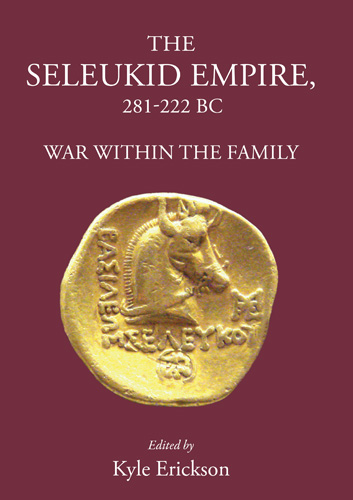
In this book an international team of scholars argues that the Seleukid empire developed flexible structures that successfully bound it together in the face of a series of catastrophes. The strength of the Seleukid realm lay not simply in its vast swathes of territory, but rather in knowing how to tie the new, frequently non-Greek, nobility to the king through mutual recognition of sovereignty.
The Seleukids, the easternmost of the Greek-speaking dynasties which succeeded Alexander the Great, were long portrayed by historians as inherently weak and doomed to decline after the death of their remarkable first king, Seleukos (281 BC). And yet they succeeded in ruling much of the Near and Middle East for over two centuries, overcoming problems of a multi-ethnic empire. In this book an international team of young, established scholars argues that in the decades after Seleukos the empire developed flexible structures that successfully bound it together in the face of a series of catastrophes. The strength of the Seleukid realm lay not simply in its vast swathes of territory, but rather in knowing how to tie the new, frequently non-Greek, nobility to the king through mutual recognition of sovereignty.
Introduction Kyle Erickson 1 Dispelling Seleukid phantoms: Macedonians in Western Asia Minor from Alexander to the Attalids Stephen Mitchell 2 The House of Achaios: reconstructing an early client dynasty of Seleukid Anatolia Alex McAuley 3 Asia Minor and the many shades of a civil war. Observations on Achaios the Younger and his claim to the kingdom of Anatolia Monica D'Agostini 4 Seleukos, Zeus and the dynastic cult at Seleukeia in Pieria Nicholas L. Wright 5 The ideology of Seleukid joint kingship: the case of Seleukos, son of Antiochos I John Russell Holton 6 The coming of the Parthians: crisis and resilience in the reign of Seleukos II Rolf Strootman 7 Rethinking the relationship between Hellenistic Baktria and the Seleukid Empire Richard Wenghofer 8 Iranian identity and Seleukid allegiance: Vahbarz, the Frataraka and early Arsakid coinage David Engels 9 The War of Brothers, the Third Syrian War, and the Battle of Ankyra (246241 BC): a re-appraisal Altay Coskun 10 Antiochos Soter and the Third Syrian War Kyle Erickson Bibliography Index
- Edited by Kyle Erickson
Other Titles in this Series


Similar Books


 Contesting Labeled Identities
The Sociology of Gentilics in Biblical and Northwest Semitic Literature

 Drunk the Potion, No Whit Charmed
The Doctrine of Pure and Perfect Souls from Iamblichus to Damascius

 Epigraphic “Shades” from Hellenistic Thrace
Contextualizing Inscriptions in Greek from Thracian Tombs

 Epiphanies of the Divine in the Septuagint and the New Testament
Fifth International Symposium of the Corpus Judaeo-Hellenisticum Novi Testamenti (CJHNT), 14-17 May 2015, Nottingham


 Gold, Silver and Glass: Power Networks, Cultural Identities, Technology Transfers and Agency across the Old World (7th Century BC – 1st Century AD)
Proceedings of a Conference Held at the British Museum, 16–18 June 2023
 Language and Power in the Roman Empire and Early India
Hierarchy, Ambiguity, and the Art of Reading the Signs in Cosmopolitan Cultures
 Late Antique villae in the Balkans (3rd–7th c. AD): Current Research Questions and Perspectives
HAEMUS Companion to the Late Antique Balkans 1
Volume 4


 Nurturing the Elite
Representations of Drinking, Eating, and Religious Vessels in Palmyrene Funerary Iconography
Volume 13





 Roman Copies, Collecting, and Culture in the Bay of Naples and Beyond
Papers in Honor of Eugene J. Dwyer




 The Compositional History of the Book of Kings
An Analysis of the Evaluative Frameworks in 1 Kings 14–2 Kings 25




 Zooarchaeology of Ancient Greek Sanctuaries in Southwestern Sicily
Faunal Analysis from Selinus and Akragas as Evidence of Differences in the Treatment of Animals for Ritual Purposes