
Many Buddhas, One Buddha
A Study and Translation of Avadānaśataka 1-40
by Naomi Appleton
Paperback (Published)
(March 2020)
ISBN: 9781781798973
6.1 x 9.17 inches
Price: $34.00
On back order
Hardback (Published)
(March 2020)
ISBN: 9781781798966
6.1 x 9.17 inches
Price: $100.00
In stock
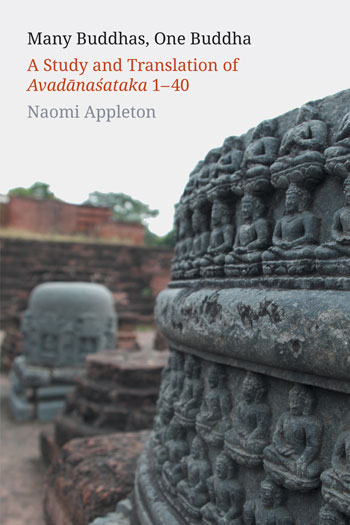
This text introduces and provides a translation of a significant section of the important early Indian Buddhist text, the Avadānaśataka, or “One Hundred Stories”, and explores some of its perspectives on buddhahood and awakening.
Many Buddhas, One Buddha introduces a significant section of the important early Indian Buddhist text known as the Avad ānaśataka, or “One Hundred Stories”, and explores some of its perspectives on buddhahood. This text, composed in Sanskrit and dating to perhaps the third to fifth centuries of the Common Era, is affiliated with the Sarvāstivāda or Mūlasarvāstivāda, and thus provides important evidence of the ideas and literatures of lost non-Mahāyāna schools of Indian Buddhism. The text is a rich literary composition, in mixed prose and verse, and includes some elaborate devotional passages that illuminate early Indian perspectives on the Buddha and on the role of avadāna texts. The book introduces the first four chapters of the Avad ānaśataka through key themes of these stories, such as predictions and vows, preparations for buddhahood, the relationship between Śākyamuni and other buddhas, and the relationship between full buddhahood and pratyekabuddhahood. The study of these stories closes with an argument about the structural design of the text, and what this tells us about attitudes towards different forms of awakening. The second part of the book then presents a full English translation of stories 1-40.
Preface Note on the translation Part A: Study Crossing the flood of rebirth The Avadā
naś
ataka Many buddhas Ś
ā
kyamuni's past lives Independent buddhahood Miracles, offerings, aspirations and predictions And then the Buddha smiled Structure of the Avadā
naś
ataka Many buddhas, many Buddhisms One Buddha, many lessons Part B: Translation First decade (stories 1-10) Second decade (stories 11-20) Third decade (stories 21-30) Fourth decade (stories 31-40) Glossary,
Table of Contents
Preface vii-x
Part A: Study
1. Crossing the Flood of Rebirth 2-4
2. The Avadānaśataka 5-9
3. Many Buddhas 10-21
4. Śākyamuni’s Past Lives 21-29
5. Independent Buddhahood 29-37
6. Miracles, Offerings, Aspirations and Predictions 37-41
7. And Then the Buddha Smiled 41-45
8. Structure of the Avadānaśataka 45-51
9. Many Buddhas, Many Buddhisms 52-53
10. One Buddha, Many Lessons 54
Part A Notes 55-62
Part B: Translation
Note on the translation 64-65
First Decade (Stories 1-10) 66-96
Second Decade (Stories 11-20) 97-142
Third Decade (Stories 21-30) 143-166
Fourth Decade (Stories 31-40) 167-215
Part B Notes 216-222
End Matter
Glossary 223-234
Bibliography 235-238
Index 239-24
- By (author) Naomi Appleton
Similar Books

 Exploring Himalayan Cultural and Textual Heritage
The Legacy and Impact of René Nebesky-Wojkowitz
Volume 35

 Seeking Wisdom, Embracing Compassion
A Philokalic Commentary on Tsong kha pa’s ‘Great Treatise’
Volume 11


 A Sogdian Version of the Mahāyāna-Mahāparinirvāṇasūtra in Pustaka Format
Fragments from the Berlin Turfan Collection and the Ōtani Collection Kyōto
Volume 53
 Economic Trends in China During the Age of Confucius (1000–250 BC)
The Archaeological Evidence
Volume 10


 Jugend- und Lebensreform-Bewegungen global
Studien zu Vergleich und Transfer im 19. und 20. Jahrhundert


 Gender in Gandharan Art
Representations and Interactions in the Buddhist Context (1st-4th centuries CE)

 Kings of Cities and Rulers of the Steppes
Representations of Kingship in Pre-Islamic Central Asia
Volume 22
 Liberating the Repressed Self among Contemporary Chinese
A Theoretical Study Involving Tu Weiming and Jürgen Moltmann
Volume 41


 Reflection on the Word and Meaning
A Critical Edition and Translation of Ratnasrijnana's Sabdarthacinta with his Sabdarthacintavivrti 1.16-2.47
Volume 11



 The Lizhi 荔枝 (Lychee) in Chinese Literature
Translation of Chinese Sources by Michael J. Hagerty. With an introduction and edited by Hartmut Walravens
Volume 66




 Der altorientalische Mensch in seiner Umwelt
11. Internationales Colloquium der Deutschen Orientgesellschaft, 16.-19. Juni 2022 in Leipzig
Volume 11