
The Practice of Agnosticism
Overcoming False Dualities across Human Thought (Volume VI)
By (author) Robert M. Ellis
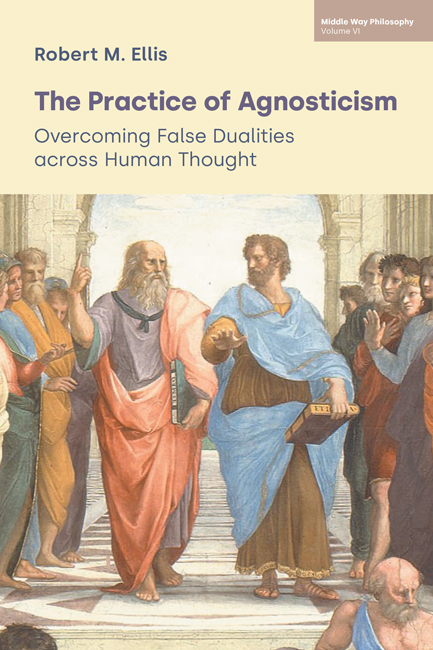
Paperback (Forthcoming)
(November 2026)
ISBN: 9781800508958
6.14 x 9.21 inches
Price: $32.00
On back order
Hardback (Forthcoming)
(November 2026)
ISBN: 9781800508941
6.14 x 9.21 inches
Price: $100.00
On back order
This book argues for agnosticism as a practice: one which, contrary to its popular image, demands courage, and is not just about God. Agnostics defy the entrenched weight of opposing false dualities, where traditional thinking presents us with the unnecessarily restricted framing of only two options. Instead, we can reframe: applying provisionality and incrementality as an alternative to opposing positive and negative metaphysical absolutes. In addition to the debate about God, agnosticism gives an alternative to other metaphysical dualities, such as realism v idealism, mind v body, and freewill v determinism.
The Middle Way Philosophy series, of which this forms a part, has built up a case for the Middle Way as an alternative to absolutized thinking in human judgement, drawing on Buddhist practice, embodied meaning, systems, psychology and neuroscience as well as philosophy. This book then applies the Middle Way more fully to resolving the range of metaphysical dualities that have entrenched absolute thinking in philosophy – not by opposing negative metaphysical claims (like atheism or idealism) to positive ones, but by offering a genuinely practical alternative supported by evidence from a range of disciplines.
Robert M Ellis has a Ph.D. in Philosophy and a Cambridge BA in Oriental Studies and Theology. Originally from a Christian background, he spent about 20 years practising Buddhism, including as a member of the Triratna Order. However, he now describes himself as a Middle Way practitioner without exclusive loyalty to any one religious tradition. Over the last 20 years he has developed Middle Way Philosophy, initially in his Ph.D. thesis. This is best described as a practical and integrative philosophical approach, incorporating many elements not only from Buddhism but also from psychology, neuroscience, and other aspects of Western thought. In 2013 he founded the Middle Way Society (www.middlewaysociety.org) to develop and apply Middle Way Philosophy beyond the limitations of the Buddhist tradition, both in theory and practice.
- By (author) Robert M. Ellis
Other Titles in this Series
 A Systemic History of the Middle Way
Its Biological, Psycho-developmental and Cultural Conditions
Volume 3
 Embodied Meaning and Integration
Overcoming the Abstracted Grip on Meaning in Theory and Practice (Volume IV)

Similar Books

 ‘For You I Study, For You I Work, For You I Live, For You I Am Ready To Even Give My Life’
Essays in Honour of Francis (Frank) J Moloney, SDB


 A Connecting Polemic in the Medieval Mediterranean
The Correspondence of Leo III and ʿUmar II
Volume 6





 Alabaster
An Interdisciplinary Study of the Sources and Uses of Calcite Alabaster in Antiquity
Volume 5









 Apocrypha, Magic, Liturgy
The Multiple Identities of Coptic Prayers in Late Antique and Early Islamic Egypt

