
Die geometrische Keramik von Kap Kolonna
by Veronika Jarosch-Reinholdt

The Protogeometric and Geometric pottery presented in this volume was mainly found on the Colonna Hill, a cape protruding into the sea in front of the island of Aegina, bearing a settlement from Neolithic times onwards. The high quantities of Protogeometric pottery indicate that the acropolis of Cape Colonna, which was abandoned during the Late Mycaenean times, was resettled in the 10th century B.C. It is apparent that the inhabitants of Aegina had close relations with Athens from the beginning, independent of their transmitted Doric descent, as the decorated ceramic fine wares have been almost exclusively imported from there. The shapes are typical of drinking and dining equipment, such as cups, drinking and mixing vessels, oinochoai and amphorae for the delivery and storage of wine. For more than two hundred years the people of Aegina had been using Attic vessels when celebrating their common drinking rituals, taking place under the patronage of local rulers and-or a phratry, which are very likely to be an early form of the cult of Apollon. From the middle of the 8th century B.C. onwards the Athenian monopoly was broken first of all by the increasing importance of the Corinthian ceramic products and later by Argive and Cycladic pottery. Additionally in the pottery of this time we can see a differentiation in society which did not exist before. Different social groups participated in the rituals, some less privileged but also a new aristocratic class which is evidenced by the refinement of dining customs. Printed with the support of the Fund for the Promotion of Academic Research.
- By (author) Veronika Janosch-Reinholdt
- Edited by Florens Felten
Other Titles in this Series

 Sea Peoples’ Up-to-Date
New Research on Transformation in the Eastern Mediterranean in 13th-11th Centuries BCE
Volume 81

Similar Books


 Caesar’s Visions and Impact on the Roman Empire
Revisiting the Archaeological and Historical Record of the 40s BC
Volume 2

 Construction Processes in Historical Western Societies (5th c. BC – 10th c. AD)
Case Studies on Techniques, Models, and Costs


 Etruscan and Roman Hellenistic Anatomical ex votos
Reassessing Popular Religious Expressions in Central Italy
Volume 8




 Invisible Labour in Antiquity
Visualizing Obscure Work in the Ancient Mediterannean and West Asia
Volume 1

 Late Antique villae in the Balkans (3rd–7th c. AD): Current Research Questions and Perspectives
HAEMUS Companion to the Late Antique Balkans 1
Volume 4





 Portraying the Individual in the Roman East
Local–Imperial Entanglements in Sculpture, Mosaics, and Paintings (First–Fourth Centuries AD)
Volume 18


 Roman Copies, Collecting, and Culture in the Bay of Naples and Beyond
Papers in Honor of Eugene J. Dwyer
 Small Worlds and Relational Agencies: Local Societies in Early Medieval Iberia
Pequeños mundos y Agencias relacionales: Sociedades locales altomedievales en la Península Ibérica
 SOMA 2023: Proceedings of the 24th Symposium on Mediterranean Archaeology
Ideas that Travelled by the Sea, Udine, 2-4 February, 2023


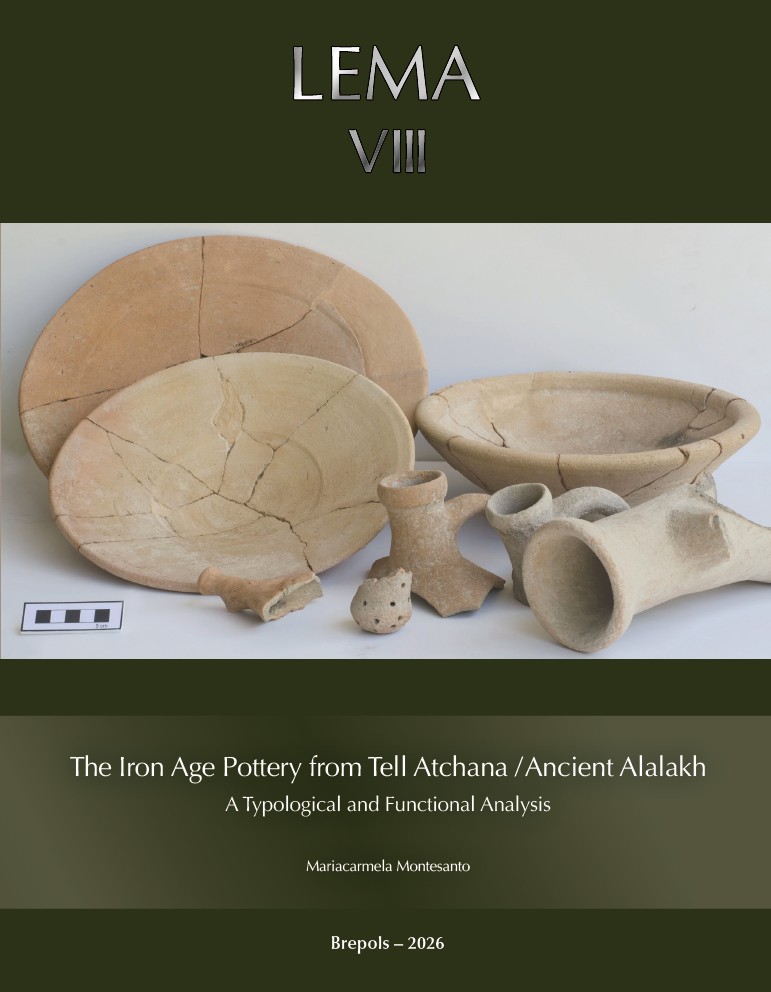 The Iron Age Pottery from Tell Atchana / Ancient Alalakh
A Typological and Functional Analysis
Volume 8


 Writing in the Church of the Nativity in Bethlehem
Inscription and Graffiti in a Multilingual and Multigraphic Perspective
Volume 45
 Zooarchaeology of Ancient Greek Sanctuaries in Southwestern Sicily
Faunal Analysis from Selinus and Akragas as Evidence of Differences in the Treatment of Animals for Ritual Purposes
 Alabaster
An Interdisciplinary Study of the Sources and Uses of Calcite Alabaster in Antiquity
Volume 5

 Echoes from the Past: Traditional Cypriot Pottery
An Exhibition at the Cyprus American Archaeological Research Institute in October 1995