
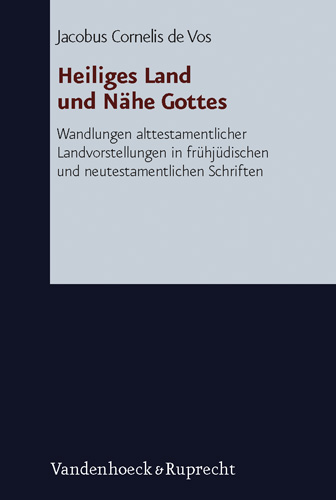
Heiliges Land und Nähe Gottes
Wandlungen alttestamentlicher Landvorstellungen in frühjüdischen und neutestamentlichen Schriften
By (author) Cornelis de Vos
Hardback (Published)
(June 2012)
ISBN: 9783525535837
6.34 x 9.33 inches
Price: $163.00
In stock
English summary: In early Jewish and New Testament texts, land pertains hardly ever isolated to the Land of Israel, but almost always to land in relation to God and the own people. Consequently, the inhabitants of a certain space are a people in relation to their God. Within the triad God / people / land, land is the space in which nearness of God to the people can occur. It can be the Land of Israel itself with the Temple as place par excellence for the postulated presence of God. It can also be space elsewhere or space that exists only or mainly in the mind. Concepts of land influence the image of the actual land and vice versa. The land can be idealised or mythicized. It can also be extended or relocated into an actual space outside the Land of Israel, into heaven, or into the future. German description: In allen fruhjudischen und neutestamentlichen Schriften bleibt die aus dem Alten Testament bekannte enge Verbundenheit von Gott, Volk und Land zumindest als Motiv erhalten. In den untersuchten Texten geht es bei Land allerdings in den wenigsten Fallen isoliert um das Land Israel, sondern fast immer um Land im Verhaltnis zu Gott und dem Volk, das auch wieder in Beziehung zu seinem Gott steht. Land versteht sich hierbei als ein Raum, in dem sich die Nahe Gottes ereignen kann. Es kann das Land Israel sein mit dem Tempel als Ort par excellence fur die postulierte Gottesgegenwart. Es kann aber auch ein Raum andernorts sein oder eben ein Raum, der nur oder hauptsachlich in der Vorstellung existiert. Vorstellungen vom Land beeinflussen die Sicht auf das konkrete Land und umgekehrt. Das Land kann dabei idealisiert oder mythisiert werden oder in den aktuellen Wohnort ausserhalb des Landes Israel, den Himmel oder in die Zukunft ausgedehnt werden oder gar umziehen. Raum und Volk konnen unterschiedlich erscheinen, doch das Streben nach der Nahe Gottes ist den Texten beider Glaubensrichtungen gemein. Entsprechend ist jeder Raum der Gottesprasenz auch ein sozialer Raum, ein Identitatsraum fur das Volk, das sich seinem Gott zugehorig fuhlt. Somit geht es bei dem Begriff Land bzw. bei der Kennzeichnung adas Land im religiosen und theologischen Kontext um eine Ausrichtung auf seine heilige Mitte, die Gott ist. Jeder Raum dieser Funktion, ob konkret oder mental, wird damit in gewissem Sinn zu einem heiligen Land fur seine Bewohner.
Dr. J. Cornelis de Vos ist Vertretungsprofessor für Neues Testament an der Universität Münster und Projektleiter im Exzellenzcluster Religion und Politik.
- By (author) Cornelis de Vos
Other Titles in this Series
 „Wie die Verwundeten ‒ derer du nicht mehr gedenkst”
Zur Phänomenologie des Traumas in den Psalmen 22, 88, 107 und 137
 The Spirit World in the Letters of Paul the Apostle
A Critical Examination of the Role of Spiritual Beings in the Authentic Pauline Epistles
 Die Ortsangaben im Buch Genesis
Ein historisch-topographischer und literarisch-topographischer Kommentar
 »Blickt auf Abraham, euren Vater«
Abraham als Identifikationsfigur des Judentums in der Zeit des Exils und des Zweiten Tempels

 Die himmlische Bürgerschaft
Untersuchungen zu einem urchristlichen Sprachmotiv im Spannungsfeld von religiöser Integration und Abgrenzung im 1. und 2. Jahrhundert




 Divine Substitution
Humanity as the Manifestation of Deity in the Hebrew Bible and the Ancient Near East


 Der eine Gott Israels und die Mächte der Welt
Der Weg Gottes im Alten Testament vom Herrn seines Volkes zum Herrn der ganzen Welt


Similar Books


 Apocrypha, Magic, Liturgy
The Multiple Identities of Coptic Prayers in Late Antique and Early Islamic Egypt
 Athanasius of Alexandria, Epistula ad episcopos Aegypti et Libyae
Old Slavonic Version and English Translation
Volume 261



 Contesting Labeled Identities
The Sociology of Gentilics in Biblical and Northwest Semitic Literature
 Cyril of Alexandria’s Christological Exegesis
Explorations of Partitive Exegesis in the Dialogues on the Trinity
Volume 70

 Epiphanies of the Divine in the Septuagint and the New Testament
Fifth International Symposium of the Corpus Judaeo-Hellenisticum Novi Testamenti (CJHNT), 14-17 May 2015, Nottingham


 Extracanonical Traditions and the Holy Land
Texts, Rituals, and Material Culture in Late Antique Palestine
 From Joseph to Jesus
The Joseph Narrative as a Compositional Template from Old Greek Esther to the Gospel of Luke
Volume 125





 Nicholas of Lyra’s Commentaries on the Gospels of Matthew and Luke
Franciscan Exegesis in a Time of Crisis
 Paradise Lost in Transmission
The Return to Eden in the Apocalypse of Peter within Its Ethiopic and Early Christian Contexts



 Punning in Odd or Elegant Constructions in Jeremiah
The Convergence of Linguistics, Rhetoric, and Textuality in the Hebrew Text of Jeremiah

 Reformed Covenantal Eudaimonism
Wilhelmus à Brakel (1635–1711) on Highest Good, Virtue, and Law
Volume 87