
The Powerless Church and Other Selected Writings, 1955- 1985
By (author) Ivan Illich Compiled by Valentina Borremans Compiled by Sajay Samuel
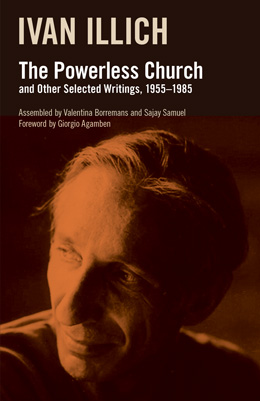
Paperback (Published)
(April 2026)
ISBN: 9781800507494
5.51 x 8.5 inches
Price: $32.00
In stock
Dalmatian-Austrian philosopher, Roman Catholic priest, and radical cultural critic Ivan Illich is best known for polemical writings such as Deschooling Society and Tools for Conviviality which decried Western institutions of the 1970s. This collection brings together Illich’s shorter writings from his early publications through the rise of his remarkable intellectual career, making available works that had fallen into undue obscurity.
A fervent critic of Western Catholicism, Illich also addressed contemporary practices in fields from education and medicine to labor and socioeconomic development. At the heart of his work is his opposition to the imperialistic nature of state- and Church-sponsored missionary activities. His deep understanding of Church history, particularly the institutions of the thirteenth century, lent a historian’s perspective to his critique of the Church and other twentieth-century institutions.
The Powerless Church and Other Selected Writings, 1955–1985 comprises some of Illich’s most salient and influential short works as well as a foreword by philosopher Giorgio Agamben. Featuring writings that had previously appeared in now-defunct publications, this volume is an indispensable resource for readers of Illich’s longer works and for scholars of philosophy, religion, and cultural critique.
Ivan Illich (1926-2002) was one of the most original social and religious thinkers of the 20 th Century. Ordained a Roman Catholic priest in 1951, he became an advocate of a “new Church” and a critic of the existing form of the Roman Church which he called “a giant that begins to totter before it collapses.” The novelty of his ideas antagonized conservative forces in the Church, and he ended the controversy his advocacy had stirred up at the Vatican by announcing in 1969 that he would suspend the exercise of his priesthood and proceed, in future, “as a simple faithful Christian.” There followed a sequence of five books, beginning with 1970’s Celebration of Awareness, calling for “institutional revolution,” or sometimes “cultural revolution.” Industrial institutions, from education (Deschooling Society) to medicine (Limits to Medicine), Illich wrote, were crossing a threshold into “counter-productivity,” a condition in which they would get in their own way and defeat their own purposes He also suggested that crucial personal and cultural competencies were being lost to growing professional and institutional predominance.
When the institutional revolution Illich proposed did not take place, he turned to the study of history in an attempt to unearth the roots of the “certainties” that had prevented reform. In books like Shadow Work, Gender and In the Vineyard of the Text, he explored how modern civilization took shape and tried, as he once said, to “observe the emergence of those assumptions which, by going unexamined, have turned into today’s certainties.” (Ivan Illich in Conversation, pp. 134-135). In his last years, Illich also began to speak and write about the role of the Christian Church in the formation of the modern West, putting forward the idea that the unique features of modernity are only explainable as a perverse mutation of Christian inspiration. “When I look for the roots of modernity,” he said, “I find them in the attempts of the churches to institutionalize, legitimize and manage Christian vocation” (The Rivers North of the Future, p. 48).
- By (author) Ivan Illich
- Compiled by Valentina Borremans
- Compiled by Sajay Samuel
“Ivan Illich was one of the most interesting thinkers of the twentieth century, profound and incapable of being pigeonholed. In this collection of writings one can trace the connection between Illich’s radical critiques of bureaucratic, managerial modes of production in both church and state and his deep spiritual sense that vulnerability to God and to other people is necessary for a life that is truly alive. Illich’s thought and spirit remain surprisingly relevant in the current cultural context.”—William T. Cavanaugh, author of The Myth of Religious Violence: Secular Ideology and the Roots of Modern Conflict
“Ivan Illich breaks through the haze of contemporary humanism and unabashedly affirms ‘the autonomy of the ludicrous in face of the useful’ and the ‘spontaneous as opposed to the rationalized and planned.’ Carefully read these idiosyncratic essays: they are a bracing antidote to your cherished ways of seeing—and living.”—Jerry Brown, former governor of California
“We tend to normalize the teaching of the Gospels, but then someone like Ivan Illich comes along and shows us how radical it is. This collection offers a series of reminders of Illich’s ability to surprise us and wrench us out of the ruts that our thinking easily slides into. Whether it is about the Kingdom, virginity, or death, and whether we agree or not, Illich’s insights open up new avenues of understanding.”—Charles Taylor, author of Multiculturalism and “The Politics of Recognition”
“This collection is full of such sage wisdom, and not only about death. It is assembled by the competent and committed hands of Valentina Borremans and Sajay Samuel, and sharply addresses the shortcomings of the Catholic Church to which Illich remained committed, and the church’s complicated cultural embeddedness and expansion in the 20th century. It develops prophetic-like analyses of how the church can regain, especially in Latin America, its sense of pride in a radical balance of independence and unity.”—Jason W. Alvis, Reading Religion
—
Similar Books

 A Companion to Christianity and Sport in Europe and North America (19th-21st centuries)
Volume 1: Western and Eastern Europe
 A Connecting Polemic in the Medieval Mediterranean
The Correspondence of Leo III and ʿUmar II
Volume 6





 Ars Prophetica
Theology in the Poetry of Twentieth-Century Hebrew Poets Avraham Halfi, Shin Shalom, Amir Gilboa, and T. Carmi
 As Messianism Turns to Heresy
The Regenstein Chair Lectures On Lurianic Kabbalah and Shabbatai Tzevi at Hebrew Union College - Cincinnati




 Creating the Woman in Antiquity
Proceedings of the 16th Melammu Workshop, Innsbruck, 2–3 June 2022
Volume 13
 Cultic Kisses
Fruitful Encounters Between Deities and Humans. Festschrift for Angelika Berlejung on the Occasion of Her 65th Birthday
 De/colonizing Theologies
Glocal Histories, Contemporary Challenges, Theoretical Reflections
Volume 4
 Drunk the Potion, No Whit Charmed
The Doctrine of Pure and Perfect Souls from Iamblichus to Damascius






 Extracanonical Traditions and the Holy Land
Texts, Rituals, and Material Culture in Late Antique Palestine
 Fear, Fear of God, God-Fearers
Philological and Historical Perspectives on the World of Ancient Judaism and Christianity

