The Leuven Collegium Trilingue 1517-1797
Erasmus, Humanist Educational Practice and the New Language Institute Latin-Greek-Hebrew
edited by J. Papy
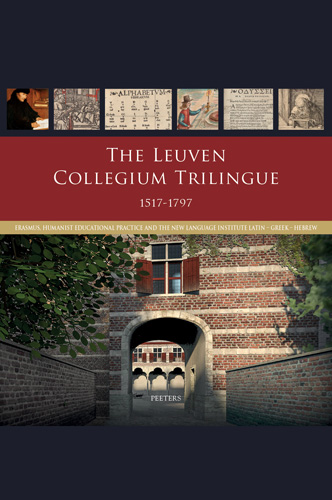
The Louvain Collegium Trilingue: an appealing story of courageous vision and an unseen international success. Thanks to the legacy of Hieronymus Busleyden, counsellor at the Great Council in Mechelen, Erasmus launched the foundation of a new college where international experts would teach Latin, Greek and Hebrew for free, and where bursaries would live together with their professors. The foundation at the Louvain Fish Market, however, met with strong opposition in a dramatic period of political and religious tensions. At the same time, it conquered the whole of Europe alike. Hundreds of students from various countries travelled to the Three-Language College, renowned professors worked and taught there until the institute was closed down during the French Revolution. In this book the secret ‘Erasmian’ recipe used in this humanist language education is analyzed and contextualized by specialists in the field. Moreover, it appears that these new didactics in language and literature also initiated an inspiring new scientific method.
- Edited by J Papy
"Jan Papy of KU Leuven has compiled a book of seven chapters, replete with illustrations of treasures preserved in special collections in Belgium and entertaining anecdotes from the 280 years of the Leuven Collegium Trilingue's life and beyond. It also contains new historical and theological contributions from several specialists in the contemporary Catholic University of Leuven, and meaningful didactic advice for the study of (modern, classical, ancient and 'holy') language. . . .This volume will be appreciated not only by medieval and early modern scholars interested in languages and linguistics, Erasmus, or the history of language institutions, but also by the contemporary teacher and student of languages for its numerous prescriptions for educational practice, and even more broadly, by readers who are seeking to learn of the history and culture of the city of Leuven." --Andrea Hugill, University of Saint Paul in the University of Ottawa, Bryn Mawr Classical Review, 2019.07.41
—
Similar Books


 As Messianism Turns to Heresy
The Regenstein Chair Lectures On Lurianic Kabbalah and Shabbatai Tzevi at Hebrew Union College - Cincinnati
 Balthasar Caymox of Nuremberg
Early Modern German Print Publishers: Popular Prints of the Seventeenth Century


 Beyond Sovereign Courts
Agents and Practices in Early Modern Spanish and Habsburg Diplomacy
Volume 3
 Cahiers de lexicologie
Particules floues — Nouvelles études sur le français et l'espagnol
Volume 128


 Circulation, Use, Impact
The Consumption of Architectural Books in the Early Modern Eastern Adriatic
Volume 1


 Councils, Conflicts, Correspondence
Urban Diplomacy in Reval (Tallinn) and Lübeck (c. 1470–1570)
Volume 67

 Des mots aux actes
Traduction épistémique et littéraire. Nouvelles tendances en histoire et didactique
Volume 15


 Deutsch als Fremdsprache nach Englisch an chinesischen Hochschulen
Eine empirische Forschung über Lernstrategien zum Wortschatzlernen


 Food Security under Armed Conflict
Global Knowledge Landscape and Public Attention to Social, Economic, and Humanitarian Dimensions


 Homo-Politicus in the Balkans
Early Modern Southeast European History in Imperial and Regional Context

 Innovationes Lovanienses: Arts, Law and Theology at the University of Louvain (1425–1797)
Studium Lovaniense: Learning across Borders, 2
Volume 18