
Syene III. Untersuchungen zur romischen Keramik und weiteren Funden aus Syene / Assuan (1.-7. Jahrhundert AD). Grabungen 2001 2004
by Stefanie Martin-Kilcher and Jacqueline Wininger, with contributions by Sylvia Funfschilling, Daniel Keller and Johanna Sigl
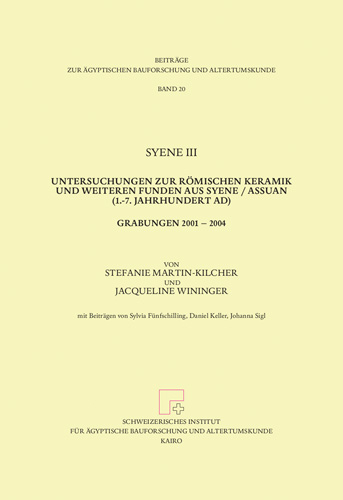
Syene (Aswan) was the southernmost town of the Roman Empire. Since the year 2000, systematic rescue excavations have been carried out by the Swiss Institute, in cooperation with the Ministry of Antiquities. The pottery studied in this volume comes from stratigraphically well-observed archaeological structures of the excavations from the 1st to 4th campaigns and was analyzed atf the University of Berne. The work is divided into four parts, with a substantial summary in English. For the first time for Upper Egypt, characteristic, chronologically valid contexts of pottery can now be observed. Furthermore, from the later 1st century BC up until the 7th century AD a typological development for many forms can be traced. Finally, the analysis of the pottery yields results and perspectives on trade and cultural developments.
Syene (Aswan) was the southern-most town of the Roman Empire. Since the year 2000, systematic rescue excavations have been carried out by the Swiss Institute of Architectural and Archaeological Research on Ancient Egypt in Cairo, in cooperation with the Ministry of Antiquities. The pottery studied in this volume comes from stratigraphically well-observed archaeological structures of the excavations from the 1st to 4th campaigns and was analysed within the framework of a project of the University of Berne, Institut fur Archaologische Wissenschaften, Archaologie der Romischen Provinzen. The work is divided into four parts A-D, with a substantial summary in English: Part A: structures, contexts, catalogue of pottery and plates. Part B: pottery, relative and absolute chronology; types; synthesis. Part C: glass, metal and bone artefacts, animal bones. Part D: annex (pottery): bibliography, typological series; color plates. For the first time for Upper Egypt, characteristic, chronologically valid contexts of pottery can now be observed. Furthermore, from the later 1st century BC up until the 7th century AD a typological development for many forms can be traced. Finally, the analysis of the pottery yields results and perspectives on trade and cultural developments.
- By (author) Stefanie Martin-Kilcher
- By (author) Jacqueline Wininger
- Contributions by Sylvia Funfschilling
- Contributions by Daniel Keller
- Contributions by Johanna Sigl
Other Titles in this Series

 Syene IV. Die ptolemaische und romische Keramik aus den Arealen 2 und 13c.
Typochronologie und weiterfuhrende Studien
Volume 22

 Syene II. Die Tierfunde aus den Grabungen von 2000 – 2009
Ein Beitrag zur Umwelt- und Kulturgeschichte einer oberagyptischen Stadt von der pharaonischen Spat- bis in die Mameluckenzeit
Volume 19
Similar Books

 Archaeological Discoveries at the Temple of Ramesses II in Abydos
Vol. 2: Old Kingdom Wall, Papyri, Ostraca, and Leather Remains
 Caesar’s Visions and Impact on the Roman Empire
Revisiting the Archaeological and Historical Record of the 40s BC
Volume 2




 Drunk the Potion, No Whit Charmed
The Doctrine of Pure and Perfect Souls from Iamblichus to Damascius

 Epiphanies of the Divine in the Septuagint and the New Testament
Fifth International Symposium of the Corpus Judaeo-Hellenisticum Novi Testamenti (CJHNT), 14-17 May 2015, Nottingham


 Etruscan and Roman Hellenistic Anatomical ex votos
Reassessing Popular Religious Expressions in Central Italy
Volume 8





 Invisible Labour in Antiquity
Visualizing Obscure Work in the Ancient Mediterannean and West Asia
Volume 1

 Language and Power in the Roman Empire and Early India
Hierarchy, Ambiguity, and the Art of Reading the Signs in Cosmopolitan Cultures
 Late Antique villae in the Balkans (3rd–7th c. AD): Current Research Questions and Perspectives
HAEMUS Companion to the Late Antique Balkans 1
Volume 4


 Nurturing the Elite
Representations of Drinking, Eating, and Religious Vessels in Palmyrene Funerary Iconography
Volume 13


 Portraying the Individual in the Roman East
Local–Imperial Entanglements in Sculpture, Mosaics, and Paintings (First–Fourth Centuries AD)
Volume 18


 Small Worlds and Relational Agencies: Local Societies in Early Medieval Iberia
Pequeños mundos y Agencias relacionales: Sociedades locales altomedievales en la Península Ibérica
 The Compositional History of the Book of Kings
An Analysis of the Evaluative Frameworks in 1 Kings 14–2 Kings 25

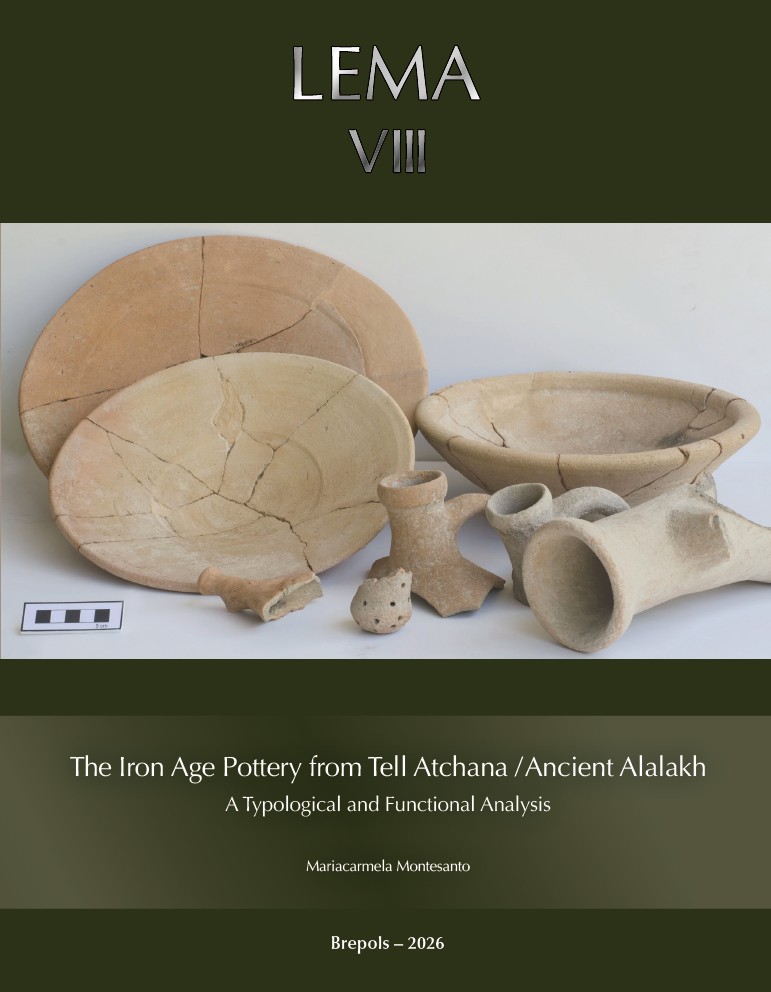 The Iron Age Pottery from Tell Atchana / Ancient Alalakh
A Typological and Functional Analysis
Volume 8