
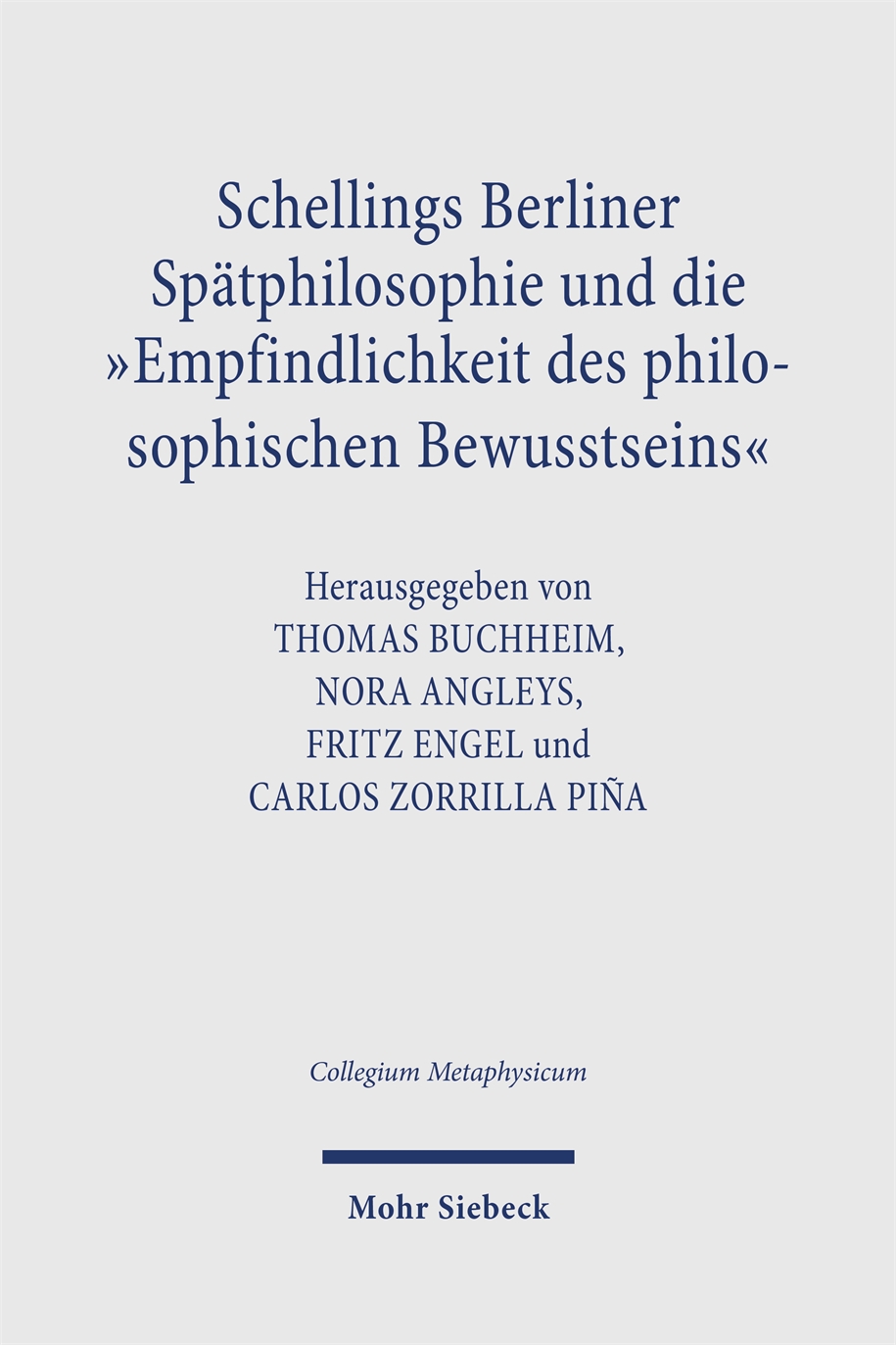
Schellings Berliner Spätphilosophie und die “Empfindlichkeit des philosophischen Bewusstseins”
Edited by Thomas Buchheim Edited by Nora Angleys Edited by Fritz Engel Edited by Carlos Zorrilla Piña
Hardback (Forthcoming)
(October 2026)
ISBN: 9783162002068
6.1 x 9.13 inches
Price: $225.00
On back order
The contributions in this volume address Schelling’s final and thoroughly revised late philosophy. From the mid-1840s onward, Schelling subjected his philosophy to a fundamental revision that, through strikingly modern philosophical methods, aims at a genuinely critically-compliant metaphysics.
The contributions collected in this volume address a phase in Schelling’s philosophical thought that has so far received little scholarly attention, despite its considerable philosophical significance: his final and thoroughly revised late philosophy from 1846 onward – that is, well after the Berlin lectures on the Philosophy of Revelation (1841-44). Based solely on the latter, contemporary critics had already concluded that Schelling’s late philosophy constituted a relapse into a philosophical system that fell short of the critical standards for permissible metaphysics established by Kant.
In contrast, this volume turns its attention squarely to Schelling’s final working period and retraces the clearly structured revision that is his final philosophy, a revision aimed at a metaphysics that is genuinely critically-compliant, but also finds the methodological justification to advance beyond Kant. The defining text of and for this last phase of Schelling’s work is the Presentation of the Purely Rational Philosophy, which accordingly stands at the center of this volume.
The contributions to this volume retrace certain strands of this philosophical revision across three central themes: (1) the relief of reason from its epistemological responsibility pertaining to God, (2) the treatment of metaphysical questions grounded in a historical human consciousness, and (3) the philosophical-scientific treatment of religion as an independent line of development of human consciousness. In addition, (4) the volume presents a previously unpublished letter – the »Vermächtnisbrief« – in which Schelling conveys to his son (and editor) the decisive philosophical commitments of his final philosophy. The »Vermächtnisbrief« is published for the first time and explored in its philosophical potential.
I. KRITIK UND KRISIS: SELBSTKRITISCHE PHILOSOPHIE ALS SYSTEMATISCHE METAPHYSIK
Thomas Buchheim: Schellings Systemverständnis in seiner spätesten Philosophie - Markus Gabriel: Der Kontrast von negativer und positiver Philosophie - Henning Tegtmeyer: Zum Status der Metaphysik in Schellings Spätphilosophie - Marcela García-Romero: Crisis as Method in Schelling's Darstellung der reinrationalen Philosophie - Alexandra Roux: Science, Nescience and Dialectics in Schelling's later philosophy - Carlos Zorrilla-Piña: The Latest Schelling and the Expansion of Philosophical Theory
II. PHILOSOPHISCHE KRISIS UND GESCHICHTLICHES BEWUSSTSEIN Gesa Wellmann: Geschichtsphilosophie und Geschichte in Schellings Darstellung der reinrationalen Philosophie - Christopher Arnold: Der Staat bis in Schellings Berliner Zeit. Versuch einer werkgeschichtlichen Rekonstruktion - Christoph Binkelmann: Über das Zugrundegehen des Staates: Schellings Begriff des Staates in seiner (späten) Entwicklung
III. PHILOSOPHISCHE KRISIS UND RELIGION
Christian Danz: Krisis der Mystik. Religion und Gott in Schellings Philosophie der Offenbarung - Tommaso Mauri: Krise der Metaphysik, Anfang der Religion. Unterbrechung und Polarität beim späten Schelling - Kyla Bruff: The Law and Its Limits: State, Morality, Religion, and Community in Schelling's Late Philosophy - Ludovica Neri: Vom Allgemeinen zur Persönlichkeit: Schellings Kritik an Kants Postulatenlehre im Übergang zur positiven Philosophie
IV. SCHELLINGS VERMÄCHTNIS FÜR EINE SELBSTKRITISCH REVIDIERTE METAPHYSIK
Nora Angleys und Fritz Engel: Schellings »Vermächtnisbrief« von 1854 - Nora Angleys: Die Gültigkeit des religiösen Diskurses - tautegorische Lesart - Fritz Engel: „Die Wichtigkeit" des Namens in Schellings spätester Philosophie
Thomas Buchheim (Herausgegeben von)
Born 1957; 1984 Doctorate, University of Munich; 1991 Habilitation, University of Munich; 1994 Appointment as Professor in Mainz; Full Professor of Philosophy, with a focus on Metaphysics and Ontology, in Munich.
Nora Angleys (Herausgegeben von)
Born 1986; doctoral candidate and researcher in the DFG project “Schelling’s Unfinished System”.
Fritz Engel (Herausgegeben von)
Born 1996; doctoral candidate and researcher in the DFG project “Schelling’s Unfinished System”.
Carlos Zorrilla Piña (Herausgegeben von)
Born 1987; 2021 PhD from Emory University; 2020-25 researcher in the DFG project “Schelling’s Unfinished System”; assistant professor for history of philosophy at the Catholic Private University of Linz.
- Edited by Thomas Buchheim
- Edited by Nora Angleys
- Edited by Fritz Engel
- Edited by Carlos Zorrilla Piña
Other Titles in this Series


 Der Herr der Zeit
Ein Ewigkeitsmodell im Anschluss an Schellings Spatphilosophie und physikalische Modelle
Volume 18
 Die metaphysische Grundlage der Kontroverse um den Kraftbegriff zwischen Descartes und Leibniz
Volume 9


 Teilhabe-Ontologie und interreligioser Dialog im Platonismus und Christentum
Gott ist Richter mitten unter den Gottern' (Ps 82,1b). Monotheismus, Polytheismus und Teilhabe-Ontologie im Platonismus und Christentum, die Henaden bei Proklos und der interreligiose Dialog bei Nikolaus von Kues
Volume 19
 Zeichenhafte Wirklichkeit
Realitat als Ausdruck der kommunikativen Prasenz Gottes in der Theologie George Berkeleys
Volume 2
 Grundfragen der Metaphysik
Eine Einfuhrung in Geschichte und Gestalten metaphysischen Denkens
Volume 32
 Radikale Selbstbestimmung
Eine Untersuchung zum Freiheitsverstandnis bei Harry G. Frankfurt, Galen Strawson und Martin Luther
Volume 12
 “Genesis” – der theologische Sinn des kosmologischen Standardmodells der Physik
Gezeigt an St. Weinbergs Klassiker "Die ersten drei Minuten"


 Schopfung, Zufall oder viele Universen?
Ein teleologisches Argument aus der Feinabstimmung der Naturkonstanten
Volume 21




 Unendlich gebildet
Schleiermachers kritischer Religionsbegriff und seine inklusivistische Religionstheologie anhand der Erstauflage der Reden

Similar Books

 A Companion to Christianity and Sport in Europe and North America (19th-21st centuries)
Volume 1: Western and Eastern Europe
 A Connecting Polemic in the Medieval Mediterranean
The Correspondence of Leo III and ʿUmar II
Volume 6





 Ars Prophetica
Theology in the Poetry of Twentieth-Century Hebrew Poets Avraham Halfi, Shin Shalom, Amir Gilboa, and T. Carmi
 As Messianism Turns to Heresy
The Regenstein Chair Lectures On Lurianic Kabbalah and Shabbatai Tzevi at Hebrew Union College - Cincinnati


 Creating the Woman in Antiquity
Proceedings of the 16th Melammu Workshop, Innsbruck, 2–3 June 2022
Volume 13
 Cultic Kisses
Fruitful Encounters Between Deities and Humans. Festschrift for Angelika Berlejung on the Occasion of Her 65th Birthday
 De/colonizing Theologies
Glocal Histories, Contemporary Challenges, Theoretical Reflections
Volume 4
 Drunk the Potion, No Whit Charmed
The Doctrine of Pure and Perfect Souls from Iamblichus to Damascius






 Extracanonical Traditions and the Holy Land
Texts, Rituals, and Material Culture in Late Antique Palestine
 Fear, Fear of God, God-Fearers
Philological and Historical Perspectives on the World of Ancient Judaism and Christianity


 Gender and Iconography in Antiquity
Femininities, Masculinities, Ambiguities, and Beyond in the Ancient Levant, Near East, and Mediterranean