
Roman Glass
Reflections of Everyday Life
By (author) Stuart J Fleming

Paperback (Published)
(January 1997)
ISBN: 9780924171512
8.46 x 10.98 inches
Price: $15.95
In stock
This lavishly illustrated book places glass in its social setting within the Roman household. The volume was written to accompany the traveling exhibition Roman Glass: Reflections on Cultural Change. Through a series of vignettes, the author tells the story of the development of the glass industry in the Roman Empire and the role of glass in the daily routines of the ancient Romans.
This lavishly illustrated book places glass in its social setting within the Roman household. The volume was written to accompany the traveling exhibition Roman Glass: Reflections on Cultural Change. Through a series of vignettes, the author tells the story of the development of the glass industry in the Roman Empire and the role of glass in the daily routines of the ancient Romans. During the reign of Rome’s first emperor, Augustus (27 B.C.-A.D. 14), as several well-established industries such as pottery- and textile-making were being expanded, the craft of glassmaking was adopted from the East, turned into an industry, and adapted to Roman taste. By the mid-first century A.D. glass rivaled pottery in the domestic marketplace. It was used for tableware and storage containers to hold everything from preserved fish to fine perfumes. Glass featured strongly in the Roman daily routine, from the early morning, when maids would apply perfumed lotions to their mistress in preparation for her social rounds, to the late afternoon, when slaves would bring platters of food, bowls of fruit, and jugs of wine-all of glass-to the supper table. And there was a place for glass even in Roman funerary ritual, because it was custom to include all manner of domestic items among the grave furnishings, to add comfort to the afterlife.
- By (author) Stuart J Fleming
Similar Books
 A Collaborative Tapestry in Honour of Shirley Ann Brown / Une fresque brodée en l’honneur de Shirley Ann Brown
The Bayeux Tapestry Seen by her Colleagues and Friends / La Tapisserie de Bayeux vue par ses collègues et amis


 Balthasar Caymox of Nuremberg
Early Modern German Print Publishers: Popular Prints of the Seventeenth Century
 Caesar’s Visions and Impact on the Roman Empire
Revisiting the Archaeological and Historical Record of the 40s BC
Volume 2


 Etruscan and Roman Hellenistic Anatomical ex votos
Reassessing Popular Religious Expressions in Central Italy
Volume 8




 Invisible Labour in Antiquity
Visualizing Obscure Work in the Ancient Mediterannean and West Asia
Volume 1
 Late Antique villae in the Balkans (3rd–7th c. AD): Current Research Questions and Perspectives
HAEMUS Companion to the Late Antique Balkans 1
Volume 4
 Legal Visuality
Exegesis, Ambiguity, and Dissimulation of the Donation of Constantine in the Early Modern Period

 Monastic Manuscripts from the Eastern Mediterranean (Sinai, Jerusalem, Antioch)
Production, Use, and Contexts
 Naples as Laboratory / Laboratorium Neapel
Style Options, Artistic Rivalry and Self Fashioning in Neapolitan Baroque Painting / Plurale Stilbildung, Kunstlerkonkurrenz und Self Fashioning in der neapolitanischen Barockmalerei
 Nurturing the Elite
Representations of Drinking, Eating, and Religious Vessels in Palmyrene Funerary Iconography
Volume 13


 Portraying the Individual in the Roman East
Local–Imperial Entanglements in Sculpture, Mosaics, and Paintings (First–Fourth Centuries AD)
Volume 18


 Small Worlds and Relational Agencies: Local Societies in Early Medieval Iberia
Pequeños mundos y Agencias relacionales: Sociedades locales altomedievales en la Península Ibérica

 Technical Studies of Asian Art
Proceedings of the Seventh Forbes Symposium at the Freer Gallery of Art


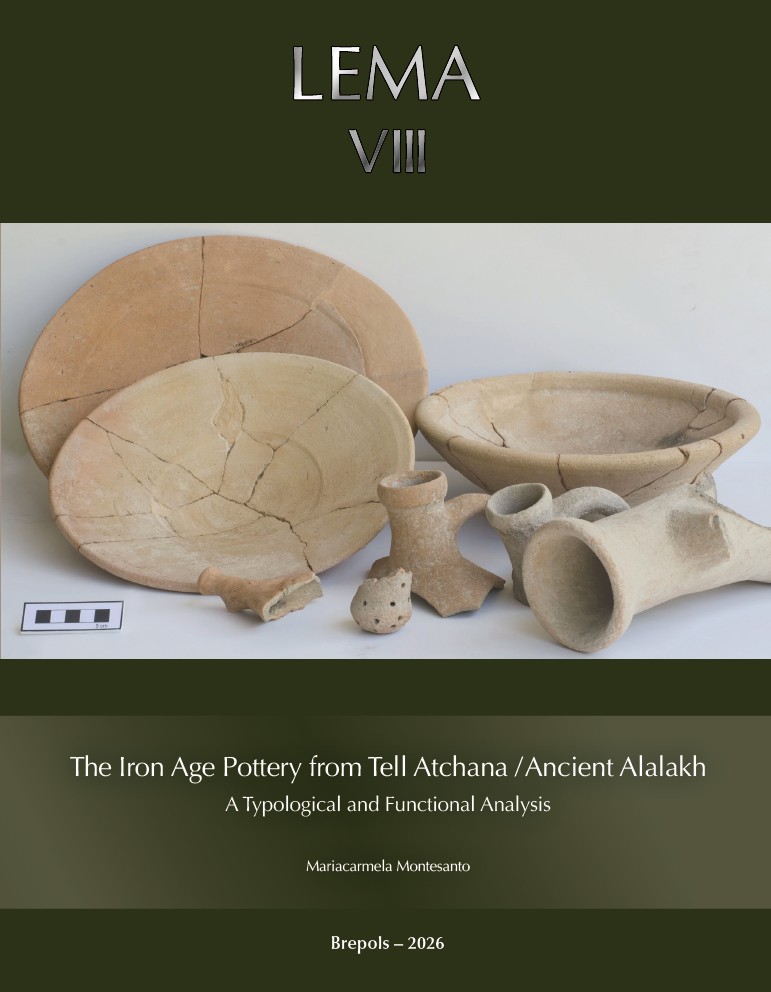 The Iron Age Pottery from Tell Atchana / Ancient Alalakh
A Typological and Functional Analysis
Volume 8