
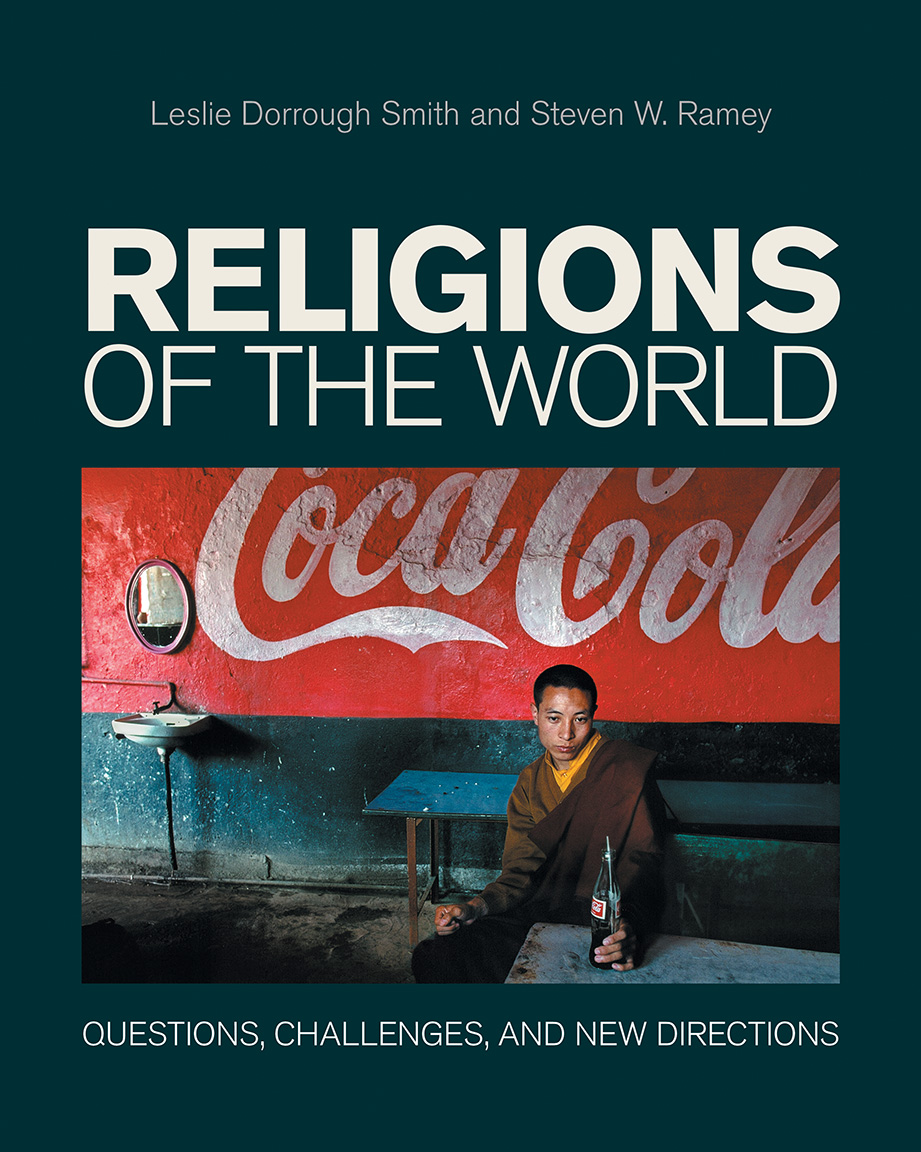
Religions of the World
Questions, Challenges, and New Directions
by Leslie Dorrough Smith and Steven W. Ramey
Paperback (Published)
(January 2024)
ISBN: 9781800503762
9.96 x 12.6 inches
Price: $60.00
In stock
Hardback (Published)
(January 2024)
ISBN: 9781800503755
9.96 x 12.6 inches
Price: $115.00
On back order
Religions of the World: Questions, Challenges, and New Directions provides a critical introduction to the social, political, and cultural interests that inform how people describe and identify with religion. One of its goals is to provide a sense of methodological transparency that few, if any, other textbooks today offer. The book opens with an Introduction that discusses contemporary methodological concerns in the study of religion, with special focus on the World Religions Paradigm. This is followed by ten chapters, six (6) of which discuss a distinct religion and four (4) of which discuss regional traditions. This organization is intentional and self-conscious, as the authors discuss how these scholarly categories (distinct tradition vs. regional tradition) shape the ways that both insiders and outsiders discuss, practice, and engage religion in their daily lives. Each chapter introduces four different popular descriptions, or representations, of a particular religion or regional tradition. Following each representation is an analysis of what this representation accomplishes for those who promote it and what (or who) it also leaves out. Following this, a specific case study provides a real-world example of the difficulties in thinking about religion in overly simplistic ways. The text does not attempt to diminish or reconcile the possible contradictions between the different representations so as not to leave the reader with the idea that one representation is more correct or authentic than another, or that all four can be easily stitched together to make a tidy picture. Instead, students take away from each chapter a foundation of knowledge about the practices, issues, and conceptions that are associated with global religious traditions as well as the complexity behind any single representation. The objective is to make more transparent the human activity of constructing religion as well as the contemporary consequences of these representations, as people use them to legitimize identities and negotiate for social, legal, and economic resources. Thus, throughout the text, students are challenged to interrogate who gets to decide on a particular portrayal of a religious tradition as well as the interests informing those decisions. An Afterword also discusses ways that the skills learned in the text have applicability beyond the study of religious discourses.
Religions of the World: Questions, Challenges, and New Directions provides a critical introduction to the social, political, and cultural interests that inform how people describe and identify with religion. One of its goals is to provide a sense of methodological transparency that few, if any, other textbooks today offer. The book opens with an Introduction that discusses contemporary methodological concerns in the study of religion, with special focus on the World Religions Paradigm. This is followed by ten chapters, six (6) of which discuss a distinct religion and four (4) of which discuss regional traditions. This organization is intentional and self-conscious, as the authors discuss how these scholarly categories (distinct tradition vs. regional tradition) shape the ways that both insiders and outsiders discuss, practice, and engage religion in their daily lives. Each chapter introduces four different popular descriptions, or representations, of a particular religion or regional tradition. Following each representation is an analysis of what this representation accomplishes for those who promote it and what (or who) it also leaves out. Following this, a specific case study provides a real-world example of the difficulties in thinking about religion in overly simplistic ways. The text does not attempt to diminish or reconcile the possible contradictions between the different representations so as not to leave the reader with the idea that one representation is more correct or authentic than another, or that all four can be easily stitched together to make a tidy picture. Instead, students take away from each chapter a foundation of knowledge about the practices, issues, and conceptions that are associated with global religious traditions as well as the complexity behind any single representation. The objective is to make more transparent the human activity of constructing religion as well as the contemporary consequences of these representations, as people use them to legitimize identities and negotiate for social, legal, and economic resources. Thus, throughout the text, students are challenged to interrogate who gets to decide on a particular portrayal of a religious tradition as well as the interests informing those decisions. An Afterword also discusses ways that the skills learned in the text have applicability beyond the study of religious discourses.
- By (author) Leslie Dorrough Smith
- By (author) Steven W. Ramey
Similar Books

 A Companion to Christianity and Sport in Europe and North America (19th-21st centuries)
Volume 1: Western and Eastern Europe
 A Connecting Polemic in the Medieval Mediterranean
The Correspondence of Leo III and ʿUmar II
Volume 6





 Ars Prophetica
Theology in the Poetry of Twentieth-Century Hebrew Poets Avraham Halfi, Shin Shalom, Amir Gilboa, and T. Carmi
 As Messianism Turns to Heresy
The Regenstein Chair Lectures On Lurianic Kabbalah and Shabbatai Tzevi at Hebrew Union College - Cincinnati


 Creating the Woman in Antiquity
Proceedings of the 16th Melammu Workshop, Innsbruck, 2–3 June 2022
Volume 13
 Cultic Kisses
Fruitful Encounters Between Deities and Humans. Festschrift for Angelika Berlejung on the Occasion of Her 65th Birthday
 De/colonizing Theologies
Glocal Histories, Contemporary Challenges, Theoretical Reflections
Volume 4
 Drunk the Potion, No Whit Charmed
The Doctrine of Pure and Perfect Souls from Iamblichus to Damascius






 Extracanonical Traditions and the Holy Land
Texts, Rituals, and Material Culture in Late Antique Palestine
 Fear, Fear of God, God-Fearers
Philological and Historical Perspectives on the World of Ancient Judaism and Christianity


 Gender and Iconography in Antiquity
Femininities, Masculinities, Ambiguities, and Beyond in the Ancient Levant, Near East, and Mediterranean