
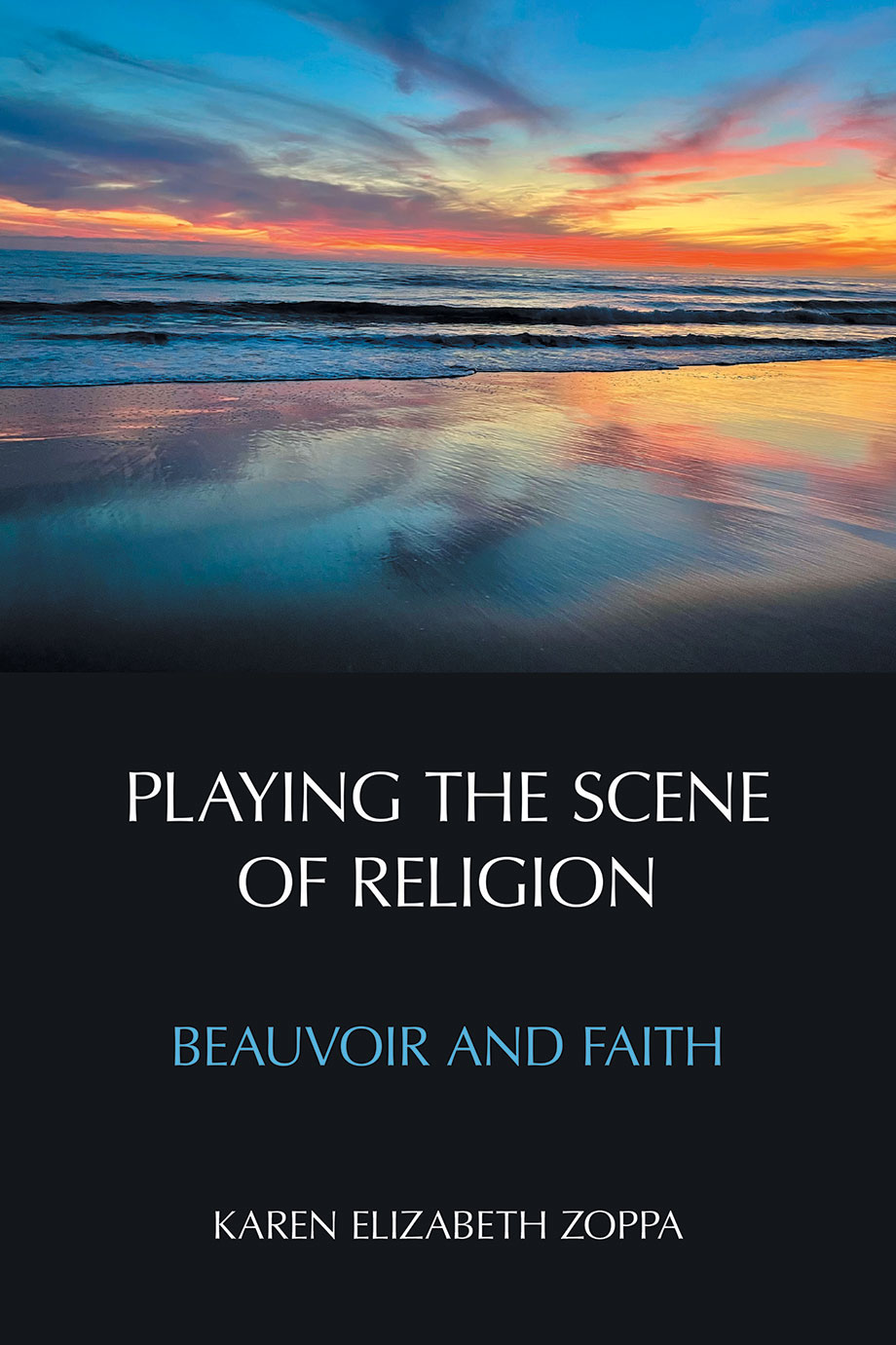
Playing the Scene of Religion
Beauvoir and Faith
by Karen Elizabeth Zoppa
Paperback (Published)
(October 2021)
ISBN: 9781800500624
6.14 x 9.21 inches
Price: $34.95
In stock
Hardback (Published)
(October 2021)
ISBN: 9781800500617
6.14 x 9.21 inches
Price: $80.00
In stock
This study has two agendas: to interrogate popular notions of religion by reading it, out of Derrida and Certeau, as a signifier for a situated historical scene; and to show the existential philosophy of Simone de Beauvoir as a performance of that scene. In particular, it will show how the structure of relationships she presents in her ethics clearly reproduces the rhythms of the scene of religion. One of the implications of this reproduction is that existential philosophy can only emerge in the context of religion, and is necessarily an iteration of religion.
Simone de Beauvoir, one of the most famous existential philosophers of the 20th century, is a confirmed atheist. Despite this, she also engages and reassigns faith, that faith that is usually associated with ‘religion,’ and iterates it in the service of her existential ethics. Beauvoir’s ethic is founded in the axiom that ‘I concern others, and they concern me. There we have an irreducible truth.’ From this assumption, she articulates the principles for living an ethical life which honours above all the freedom of the other in a world fraught with contingency and ambiguity. In so doing, she enjoins us to undertake our efforts in generosity and risk, in faith toward each other, because only by doing so can we achieve the transcendence given in the existential condition. In this movement, Beauvoir confirms and performs a different reading of religion: religion as the scene of the self and other, of the appeal and response, of the holy and the faithful, which constitutes the history of European civilization. Following a certain thread in the discourse on religion given in Jacques Derrida and Michel de Certeau, this study proposes a theoretical apparatus for ‘religion’ which offers a different appreciation of Beauvoir’s ethics. This study has two agendas: to interrogate popular notions of religion by reading it, out of Derrida and Certeau, as a signifier for a situated historical scene; and to show the existential philosophy of Beauvoir as a performance of that scene. In particular, it will show how the structure of relationships she presents in her ethics clearly reproduces the rhythms of the scene of religion. One of the implications of this reproduction is that existential philosophy can only emerge in the context of religion, and is necessarily an iteration of religion. The other implication is that we might reassess how we code the category ‘religion’ in our public and private discourse, with all the disruption that such a different coding might entail.
- By (author) Karen Elizabeth Zoppa
Similar Books

 A Companion to Christianity and Sport in Europe and North America (19th-21st centuries)
Volume 1: Western and Eastern Europe
 A Connecting Polemic in the Medieval Mediterranean
The Correspondence of Leo III and ʿUmar II
Volume 6





 Ars Prophetica
Theology in the Poetry of Twentieth-Century Hebrew Poets Avraham Halfi, Shin Shalom, Amir Gilboa, and T. Carmi
 As Messianism Turns to Heresy
The Regenstein Chair Lectures On Lurianic Kabbalah and Shabbatai Tzevi at Hebrew Union College - Cincinnati


 Creating the Woman in Antiquity
Proceedings of the 16th Melammu Workshop, Innsbruck, 2–3 June 2022
Volume 13
 Cultic Kisses
Fruitful Encounters Between Deities and Humans. Festschrift for Angelika Berlejung on the Occasion of Her 65th Birthday
 De/colonizing Theologies
Glocal Histories, Contemporary Challenges, Theoretical Reflections
Volume 4

 Drunk the Potion, No Whit Charmed
The Doctrine of Pure and Perfect Souls from Iamblichus to Damascius



 Éthique, politique, religions
Superstition (XVIIe - XXIe siècles). Sémantique, histoires et cultures
