
Platon Werke — ubersetzung und Kommentar
VII,1: Grosserer Hippias
edited by Ernst Heitsch, by Platon
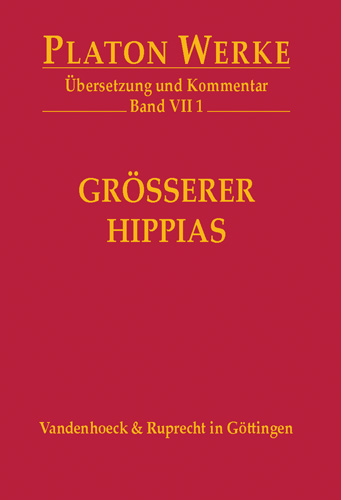
English summary: In this text a member of the Platonic Academy who is influenced by Plato’s early dialogues fabricates a conversation that Socrates has with the renowned sophist Hippias from Elis about the question what beauty is. The author, who evidently could not have known Socrates or Hippias, is dependent in his work on information from Plato, thus giving us a first glimpse, on the one hand, into the Plato reception and, on the other hand, when he has his interlocutors discuss distributive and collective properties, into the intellectual life of the Academy. German description: Das Adjektiv grosser im Titel bezieht sich auf den Umfang, verglichen mit einem kleineren Dialog desselben Namens. Der unbekannte Autor wird Platon (427-347) und Aristoteles (384-322) noch gekannt haben und gewahrt uns mit seiner Schrift einen Blick in das Leben und den Unterrichtsbetrieb der fruhen Akademie. Sokrates und der renommierte Gelehrte Hippias aus Elis fuhren in der ersten Halfte des Dialogs ein Gesprach uber die Frage, was eigentlich das Schone sei: Hier orientiert sich der Autor fur den Gesprachsstil im Wesentlichen an den fruheren Dialogen Platons. Die zweite Halfte, vor allem mit den Ausfuhrungen uber distributive und kollektive Eigenschaften, spiegelt eher die Diskussionen uber Probleme, wie sie seinerzeit in der Akademie aktuell waren.
- By (author) Platon
- Edited by Ernst Heitsch
Other Titles in this Series
Similar Books


 Contesting Labeled Identities
The Sociology of Gentilics in Biblical and Northwest Semitic Literature

 Drunk the Potion, No Whit Charmed
The Doctrine of Pure and Perfect Souls from Iamblichus to Damascius

 Epigraphic “Shades” from Hellenistic Thrace
Contextualizing Inscriptions in Greek from Thracian Tombs

 Epiphanies of the Divine in the Septuagint and the New Testament
Fifth International Symposium of the Corpus Judaeo-Hellenisticum Novi Testamenti (CJHNT), 14-17 May 2015, Nottingham


 Gold, Silver and Glass: Power Networks, Cultural Identities, Technology Transfers and Agency across the Old World (7th Century BC – 1st Century AD)
Proceedings of a Conference Held at the British Museum, 16–18 June 2023
 Language and Power in the Roman Empire and Early India
Hierarchy, Ambiguity, and the Art of Reading the Signs in Cosmopolitan Cultures
 Late Antique villae in the Balkans (3rd–7th c. AD): Current Research Questions and Perspectives
HAEMUS Companion to the Late Antique Balkans 1
Volume 4


 Nurturing the Elite
Representations of Drinking, Eating, and Religious Vessels in Palmyrene Funerary Iconography
Volume 13





 Roman Copies, Collecting, and Culture in the Bay of Naples and Beyond
Papers in Honor of Eugene J. Dwyer




 The Compositional History of the Book of Kings
An Analysis of the Evaluative Frameworks in 1 Kings 14–2 Kings 25




 Zooarchaeology of Ancient Greek Sanctuaries in Southwestern Sicily
Faunal Analysis from Selinus and Akragas as Evidence of Differences in the Treatment of Animals for Ritual Purposes
