
Euthydemos
Ubersetzung und Kommentar
by Platon, edited by Michael Erler
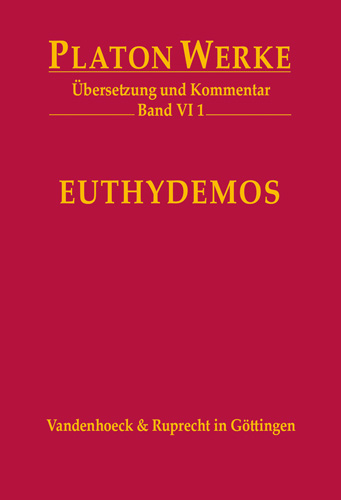
Hardback (Published)
(July 2017)
ISBN: 9783525304136
6.54 x 9.57 inches
Price: $83.00
In stock
English summary: The Euthydemus Dialogue has long been one of the most neglected dialogues of Plato among scholars. The reason for this neglect might rest on the comedic elements in the dialogue, which are deployed in form and content to a significant degree. Gradually, however, as the characters work out their performances, one gets the impression that the performance is clearly a gem of Platonic comedic art. In addition, the character of the staged controversy, the behavior of the two antagonists, and the content of the ostentatious piece are shown as a skillfully developed performance, insofar as they offer, in all seriousness, a negative reflection of the Platonic method, Platonic philosophy and the Platonic philosophers. The relationship between the humorous the serious elements in the dialogue relate to Plato’s view of comedy, which is also acceptable in the philosophical context. In the Euthydemus Dialogue, Plato the author and Plato the philosopher work hand in hand. The goal of this commentary is to provide a more positive assessment of this dialogue. The translation and the commentary, which includes linguistic, content, and philosophical information, shows the reader the close connection between literary form and philosophical message. In other words, the translation and commentary gives the reader access to the form and content of the dialogue. The commentary first provides introductions to the individual sections of the dialogue and go on to provide content information and explanations of language, text-critical problems, and parallels to other dialogues of Plato. German description: Der Dialog Euthydemos gehorte lange zu den von der Forschung vernachlassigten Dialogen Platons. Ursache mogen auch jene komodienhaften Zuge gewesen sein, die ihn in formaler und inhaltlicher Hinsicht in besonderem Masse auszeichnen. Allmahlich hat sich jedoch die Bereitschaft durchgesetzt, im Spielcharakter der vorgefuhrten Schaustucke und ihrer literarischen Gestaltung ein Glanzstuck Platonischer Komodienkunst zu sehen. Zudem erweisen sich der Spielcharakter der vorgefuhrten Streitkunst, das Verhalten der beiden Streitkunstler und der Inhalt der Schaustucke als kunstvoll gestaltet, insofern sie sich als negatives Spiegelbild zum Ernst Platonischer Methode, Platonischer Philosophie und des Platonischen Philosophen erweisen. Der Bezug zwischen spielerischen und ernsten Elementen im Dialog entspricht Platons Auffassung vom Komodienhaften, das auch im philosophischen Kontext akzeptabel ist. Im Euthydemos haben Platon der Autor und Platon der Philosoph Hand in Hand gearbeitet. Der vorliegende Kommentar mochte fur die positivere Sichtweise des Dialoges werben. Ubersetzung und sprachliche, sachliche und philosophische Kommentierung bringen dem Leser den engen Zusammenhang zwischen literarischer Gestaltung und philosophischer Botschaft nahe. Die Ubersetzung eroffnet dem Leser einen Zugang zu Form und Gehalt des Dialoges. Der Kommentar bietet zunachst Einfuhrungen in die einzelnen Abschnitte und liefert fortlaufend einzelne Sachinformationen und Erlauterungen zu Sprache, textkritischen Problemen und Parallelen in anderen Dialogen Platons.
Dr. h.c. Michael Erler ist ordentlicher Professor fur Klassische Philologie (Schwerpunkt Grazistik) an der Julius-Maximilians-Universitat Wurzburg.
- By (author) Platon
- Edited by Michael Erler
Other Titles in this Series
Similar Books


 Contesting Labeled Identities
The Sociology of Gentilics in Biblical and Northwest Semitic Literature

 Drunk the Potion, No Whit Charmed
The Doctrine of Pure and Perfect Souls from Iamblichus to Damascius

 Epigraphic “Shades” from Hellenistic Thrace
Contextualizing Inscriptions in Greek from Thracian Tombs

 Epiphanies of the Divine in the Septuagint and the New Testament
Fifth International Symposium of the Corpus Judaeo-Hellenisticum Novi Testamenti (CJHNT), 14-17 May 2015, Nottingham


 Gold, Silver and Glass: Power Networks, Cultural Identities, Technology Transfers and Agency across the Old World (7th Century BC – 1st Century AD)
Proceedings of a Conference Held at the British Museum, 16–18 June 2023
 Language and Power in the Roman Empire and Early India
Hierarchy, Ambiguity, and the Art of Reading the Signs in Cosmopolitan Cultures
 Late Antique villae in the Balkans (3rd–7th c. AD): Current Research Questions and Perspectives
HAEMUS Companion to the Late Antique Balkans 1
Volume 4


 Nurturing the Elite
Representations of Drinking, Eating, and Religious Vessels in Palmyrene Funerary Iconography
Volume 13





 Roman Copies, Collecting, and Culture in the Bay of Naples and Beyond
Papers in Honor of Eugene J. Dwyer




 The Compositional History of the Book of Kings
An Analysis of the Evaluative Frameworks in 1 Kings 14–2 Kings 25




 Zooarchaeology of Ancient Greek Sanctuaries in Southwestern Sicily
Faunal Analysis from Selinus and Akragas as Evidence of Differences in the Treatment of Animals for Ritual Purposes
