
Pierre Lambert de la Motte
The Unknown Father of the Modern Missions: First Vicar Apostolic of Cochinchina, 1624-1679
by Francoise Fauconnet-Buzelin, translated by Jefferies Foale and edited by Bill McCarthy
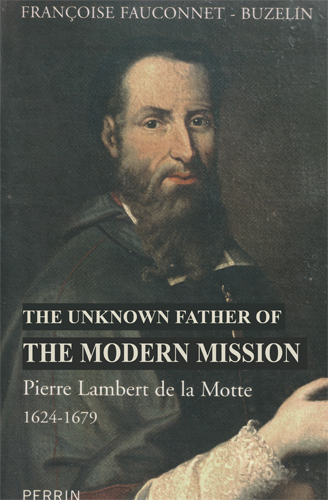
Pierre Lambert de la Motte was born in Normandy in 1624 into a pious noble family. After studying law, and a brief but distinguished career in civil administration, he entered the Congregation of the Assumption, a lay association. In 1657, he volunteered as a missionary in Asia, was appointed Titular Bishop of Beirut and left for Asia in 1660. Arrived in Siam, he made pastoral visits in Cochinchina (Southern Vietnam) and throughout Vietnam, educating and ordaining native priests, giving courage to dispersed communities, trying to settle the many rivalries between missionary orders and to improve tense relations with the authorities, while living the deep spiritual life of a mystic of the Cross. He died in 1679. His work is part of the considerable development of missions in the seventeenth century under the leadership of Pope Gregory XV. In France, Pierre Lambert de la Motte played a key role in the birth of the Paris Foreign Missions Society in 1658, for China and South-East Asia. They were to work tirelessly, following the Roman Instructions of 1659: refusal of secularization and politicization, respect for indigenous cultures, accession of the local Churches to autonomy and consolidation of their link with the Holy See. The author describes the work accomplished by the Paris Foreign Missions Society in this part of Asia, shows the difficulties in developing them, as well as the extraordinary tenacity of an inspired man.
Pierre Lambert de la Motte was born in Normandy in 1624 into a pious noble family. After studying law, and a brief but distinguished career in civil administration, he entered the Congregation of the Assumption, a lay association. In 1657, he volunteered as a missionary in Asia, was appointed Titular Bishop of Beirut and left for Asia in 1660. Arrived in Siam, he made pastoral visits in Cochinchina (Southern Vietnam) and throughout Vietnam, educating and ordaining native priests, giving courage to dispersed communities, trying to settle the many rivalries between missionary orders and to improve tense relations with the authorities, while living the deep spiritual life of a mystic of the Cross. He died in 1679. His work is part of the considerable development of missions in the seventeenth century under the leadership of Pope Gregory XV. In France, Pierre Lambert de la Motte played a key role in the birth of the Paris Foreign Missions Society in 1658, for China and South-East Asia. They were to work tirelessly, following the Roman Instructions of 1659: refusal of secularization and politicization, respect for indigenous cultures, accession of the local Churches to autonomy and consolidation of their link with the Holy See. The author describes the work accomplished by the Paris Foreign Missions Society in this part of Asia, shows the difficulties in developing them, as well as the extraordinary tenacity of an inspired man.
- By (author) Francoise Fauconnet-Buzelin
- Edited by Bill McCarthy
- Translated by Jefferies Foale
Similar Books

 A Companion to Christianity and Sport in Europe and North America (19th-21st centuries)
Volume 1: Western and Eastern Europe
 A Connecting Polemic in the Medieval Mediterranean
The Correspondence of Leo III and ʿUmar II
Volume 6





 Ars Prophetica
Theology in the Poetry of Twentieth-Century Hebrew Poets Avraham Halfi, Shin Shalom, Amir Gilboa, and T. Carmi
 As Messianism Turns to Heresy
The Regenstein Chair Lectures On Lurianic Kabbalah and Shabbatai Tzevi at Hebrew Union College - Cincinnati


 Creating the Woman in Antiquity
Proceedings of the 16th Melammu Workshop, Innsbruck, 2–3 June 2022
Volume 13
 Cultic Kisses
Fruitful Encounters Between Deities and Humans. Festschrift for Angelika Berlejung on the Occasion of Her 65th Birthday
 De/colonizing Theologies
Glocal Histories, Contemporary Challenges, Theoretical Reflections
Volume 4
 Drunk the Potion, No Whit Charmed
The Doctrine of Pure and Perfect Souls from Iamblichus to Damascius






 Extracanonical Traditions and the Holy Land
Texts, Rituals, and Material Culture in Late Antique Palestine
 Fear, Fear of God, God-Fearers
Philological and Historical Perspectives on the World of Ancient Judaism and Christianity


 Gender and Iconography in Antiquity
Femininities, Masculinities, Ambiguities, and Beyond in the Ancient Levant, Near East, and Mediterranean