
Leistungsstörungen durch künstliche Intelligenz
Die Verteilung des Autonomierisikos im Vertragsverhältnis
Paperback (Published)
(October 2026)
ISBN: 9783162008992
6.1 x 9.13 inches
Price: $141.00
The use of artificial intelligence raises novel liability issues in contract law. Christian van Amelsvoort analyses the applicable rules of contract-based liability, questions of proof, contractual allocation of risk through standard terms and conditions, as well as current legislative initiatives of the European Union.
Christian van Amelsvoort examines liability for contractual non-performance resulting from the use of artificial intelligence. To this end, he analyzes performance risk, counter-performance risk, and secondary liability risk, shedding light on their allocation from the perspective of the general law of obligations. The study also takes into account the relevant EU legislative initiatives, namely the AI Act, the withdrawn Proposal for an AI Liability Directive, and the preceding European Parliament proposal for an AI Liability Regulation. Particular attention is paid to strict attribution and evidentiary issues. The first part serves as a kind of general section, defining the autonomy risk of artificial intelligence as the factual subject matter of the inquiry and addressing overarching questions of attribution. It examines not only potential general limits to attribution but also cross-cutting grounds for attributing conduct or outcomes, including expected standards of care in the use of artificial intelligence and approaches to AI-specific strict liability. Of central importance, however, is the guarantee content of a simple promise of performance, which, drawing on the foundational work of Heck, may be described as a standard guarantee (Normalgarantie). The second part analyzes the individual levels of risk allocation on the basis of the relevant legal provisions. Throughout, attention is also devoted to possible evidentiary difficulties, for which broader solutions are discussed at the end, ranging from the reversal of the burden of proof and prima facie evidence to secondary disclosure obligations and a right to information grounded in the principle of good faith. The third part examines, in light of the statutory model developed in the preceding analysis and the specific prohibitions on contractual clauses, the extent to which risk allocation may be modified through standard terms and conditions. The study concludes with a set of summary theses and finds that there is no reason to fear a serious liability gap within the general law of contract.
Other Titles in this Series


 Die Regulierung von OTT-Kommunikationsdiensten
Eine rechtliche Analyse von Over-the-Top-Kommunikationsdiensten unter besonderer Berucksichtigung des sich wandelnden Telekommunikationsrechtsrahmens
Volume 6
 Gewaltenteilung im digitalen Staat
Verfassungsrechtliche Maßgaben an die Digitalisierung der Dritten Gewalt
 Die bilanzrechtliche Abbildung von Blockchain-basierten Zahlungsmitteln
Eine Untersuchung nach Handelsrecht und IFRS
Volume 17


 Legal Tech und das Anwaltsmonopol
Die Zulassigkeit von Rechtsdienstleistungen im nationalen, europaischen und internationalen Kontext
Volume 7
 Der personalisiert angebahnte (unerwünschte) Vertrag
Zivilrechtliche Grenzen von Data Driven Exploitative Advertising


 Das Internationale Privatrecht digitaler Werte
Kollisionsrechtliche Interessen bei der Digitalisierung von Vermogenswerten
Volume 29


 Decentralised Autonomous Organisation (DAO) Regulation
Principles and Perspectives for the Future
Volume 30

 Die Durchsetzungslast im Privatrecht
Steuerungsmöglichkeiten und Auswirkungen zivilrechtlicher Technikregulierung


 Bitcoin-Eigentum
Zur Notwendigkeit rechtlicher Zuweisung ausser-rechtlicher ausser-subjektiver Vermogenspositionen durch subjektive Rechte
Volume 9


 Die Regulierung des Crowdinvestings
Der Rechtsrahmen in Deutschland, der Europäischen Union, den Vereinigten Staaten und dem Vereinigten Königreich
 Digitales Bargeld
Eine rechtliche Untersuchung zur Einfuhrung einer Retail Central Bank Digital Currency im Euroraum
Volume 22
 Autonome Systeme und deliktische Haftung
Verschulden als Instrument adaquater Haftungsallokation?
Volume 1
Similar Books


 Balthasar Caymox of Nuremberg
Early Modern German Print Publishers: Popular Prints of the Seventeenth Century
 Constitutional Conflict as Judicial Civil Disobedience and Conscientious Objection
Reconceptualising National Constitutional Court Rulings in the European Union Legal Space

 East Meets West: Justice, Law, and Politics
The 13th Kobe Lecture and the 2nd IVR Japan International Conference, Chiba, September 2023


 False Friends in Comparative Law
Advantages and Risks of Legal Transplants in Civil Law – the Polish-German Perspective
 Formulary apportionment in international tax law
An allocation method for the age of globalization and digitalization
Volume 210


 Hofmann oder Vorkämpfer der „philosophes“?
Deutsche Voltaire-Bildnisse und -Imaginationen im Zeitalter der Aufklärung


 Law, Economics, and Inequalities in the Welfare State
Proceedings of the Special Workshops held at the 31st World Congress of the International Association for Philosophy of Law and Social Philosophy in Seoul, Republic of Korea, 2024
 Legal Pluralism and the Tajik Experience of Xinjiang
Between Custom and the Chinese State: An Ethnographic Perspective
 Legal Unification through Case Law?
Supreme Courts and the Emergence of Uniform Law in the Modern Era
Volume 242
 Liturgia semper reformanda
Adaptations and accommodations in the liturgy in light of canon 838 of the Code of Canon Law


 The Documentation of Historical Facts in Trial Judgments of the International Criminal Court
A Constitutional Theory of International Criminal Proceedings
Volume 66
 The EPPO/OLAF Compendium of National Procedures: Estonia
Desktop codes on the procedural law of the Member States with annotations by national experts
 The EPPO/OLAF Compendium of National Procedures: Greece
Desktop codes on the procedural law of the Member States with annotations by national experts
 The EPPO/OLAF Compendium of National Procedures: Italy
Desktop codes on the procedural law of the Member States with annotations by national experts

 The Right to Regulate of Developing Countries in International Investment Law
A Contextual Approach to International Investment Agreements
Volume 11


 Linguistic and Cultural Dynamics in a Frontier Society
New Perspectives on Northeastern Bavaria and Western Bohemia in the Early Middle Ages
Volume 9
 The Law of the International Civil Service
Institutional Law and Practice in International Organisations

 “Aktenzeichen XY … ungelöst”, Facebook und Co.
Chancen und Risiken der Einbeziehung der Öffentlichkeit in das strafprozessuale Ermittlungsverfahren
Volume 476
 “Das Grundgesetz ist unsere Leitkultur”
Eine verfassungsrechtliche und -theoretische Annäherung an die Gleichsetzung von Grundgesetz und Leitkultur
Volume 1595
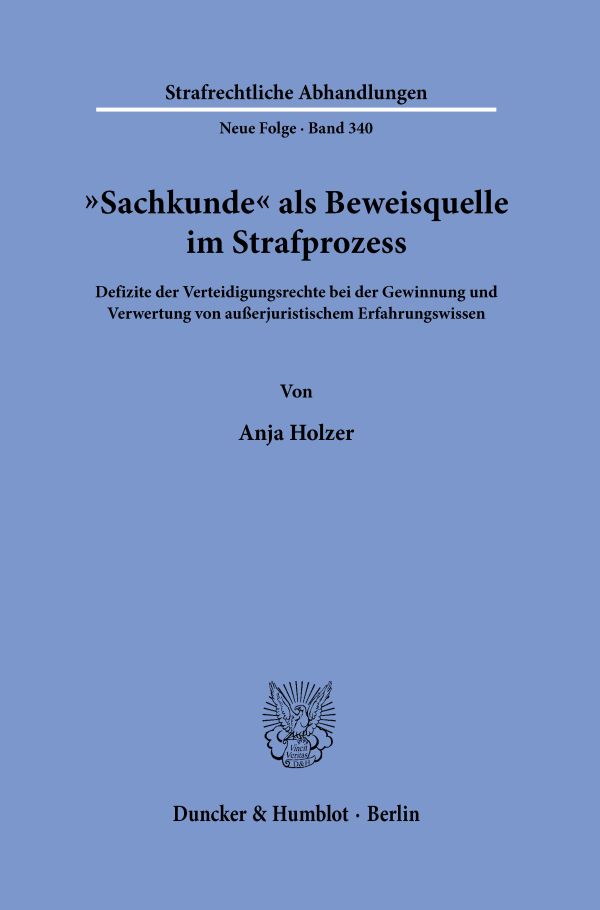 “Sachkunde” als Beweisquelle im Strafprozess
Defizite der Verteidigungsrechte bei der Gewinnung und Verwertung von außerjuristischem Erfahrungswissen
Volume 340
