
Karl Barth
A Future for Postmodern Theology?
edited by Geoff Thompson and Christiaan Mostert
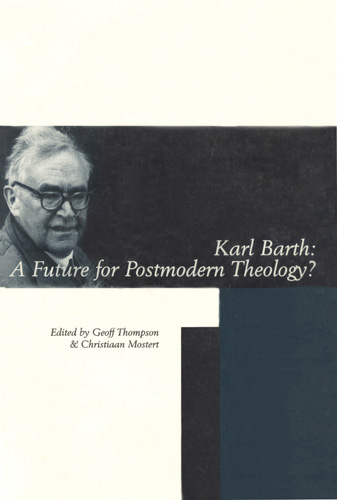
What do the colon and the question mark in the title signify? Does the colon denote relatedness or separation? What is the effect of the question mark? Does the interrogative question the future of Karl Barth’s approach to theology, make a claim for Barth as a postmodern theologian, or challenge the notion of postmodern theology altogether? These papers pose sharply the question of how the name Karl Barth and the term postmodern relate, or, more pointedly, how or whether theology as understood and practised by Barth and self-declared postmodern theology have anything to do with each other at all. From the epilogue by Wes Campbell
What do the colon and the question mark in the title signify? Does the colon denote relatedness or separation? What is the effect of the question mark? Does the interrogative question the future of Karl Barth’s approach to theology, make a claim for Barth as a postmodern theologian, or challenge the notion of postmodern theology altogether? These papers pose sharply the question of how the name Karl Barth and the term postmodern relate, or, more pointedly, how or whether theology as understood and practised by Barth and self-declared postmodern theology have anything to do with each other at all. From the epilogue by Wes Campbell
Abbreviations Contributors Introduction Geoff Thompson and Christiaan Mostert Part One Barth and Postmodern Theology: A Fruitful Confrontation? John Webster 1. Barth, Modernity And Postmodernity 2. The Grand Narrative of Jesus Christ: Barth's Christology 3. Rescuing The Subject: Barth And Postmodern Anthropology Part Two Studying Barth: Persistent Issues 4. Barth and Pannenberg on Method, Revelation and Trinity Christiaan Mostert 5. Joy in the Church Dogmatics? A Neglected Theme John Capper 6. Dialectics of Communion: Dialectical Method and Barth's Defence of Israel Mark Lindsay Part Three Studying Barth in Postmodenity: Emerging Themes 7. Barth's Theology of Work and Vocation for a Postmodern World Gordon Preece 8. The Counterpart of Others: Some Questions for Barth's Doctrine of Reconciliation Nancy Victorin-Vangerud 9. 'Our lines and concepts continually break apart': Language, Mystery and God in Barth Geoff Thompson 10. Barth on Divine Simplicity: Some Implications for Life in a Complex World Stephen Pickard Part Four Theology After Barth & Beyond Modernity 11. Postliberal Theology and the Charge of Incorrigibility: A Misplaced Allegation? Bruce Barber 12. George Lindbeck's 'The Nature of Doctrine': Symptom or Cure? Craig Thompson 13. With and Beyond Barth?: John Milbank's Postmodern Christian Scoialism as an Alternative Modernity Trevor Hogan 14. Milbank and Barth: Comparisons and Contrasts from a Catholic Perspective Neil Ormerod 15. Epilogue Wes Campbell 16. Author Index 17. Subject Index
- Edited by Christiaan Mostert
- Edited by Geoff Thompson
Similar Books

 A Companion to Christianity and Sport in Europe and North America (19th-21st centuries)
Volume 1: Western and Eastern Europe
 A Connecting Polemic in the Medieval Mediterranean
The Correspondence of Leo III and ʿUmar II
Volume 6





 Ars Prophetica
Theology in the Poetry of Twentieth-Century Hebrew Poets Avraham Halfi, Shin Shalom, Amir Gilboa, and T. Carmi
 As Messianism Turns to Heresy
The Regenstein Chair Lectures On Lurianic Kabbalah and Shabbatai Tzevi at Hebrew Union College - Cincinnati


 Creating the Woman in Antiquity
Proceedings of the 16th Melammu Workshop, Innsbruck, 2–3 June 2022
Volume 13
 Cultic Kisses
Fruitful Encounters Between Deities and Humans. Festschrift for Angelika Berlejung on the Occasion of Her 65th Birthday
 De/colonizing Theologies
Glocal Histories, Contemporary Challenges, Theoretical Reflections
Volume 4
 Drunk the Potion, No Whit Charmed
The Doctrine of Pure and Perfect Souls from Iamblichus to Damascius






 Extracanonical Traditions and the Holy Land
Texts, Rituals, and Material Culture in Late Antique Palestine
 Fear, Fear of God, God-Fearers
Philological and Historical Perspectives on the World of Ancient Judaism and Christianity


 Gender and Iconography in Antiquity
Femininities, Masculinities, Ambiguities, and Beyond in the Ancient Levant, Near East, and Mediterranean