
Kant et Platon
Edited by Dimitri El Murr Contributions by Louis Guerpillon Contributions by Christine M Korsgaard Contributions by Elena Partene Edited by Elena Partene Contributions by Jocelyn Benoist Contributions by Pierre-Jean Brunel Contributions by Francois Calori Contributions by Tobias Dangel Contributions by Sylvain Delcomminette Contributions by Dimitri El Murr Contributions by Francesco Fronterotta

Paperback (Published)
(April 2022)
ISBN: 9782711630509
Price: $23.00
On back order
Platon et Kant ont en commun de figurer parmi les grands noms du pantheon philosophique. L’extraordinaire influence qu’ils ont exercee sur l’histoire de la philosophie les rapproche evidemment l’un de l’autre, mais pas seulement, car leurs philosophies respectives, par-dela les siecles et malgre les differences de style et de contexte, dialoguent. Kant a consacre de nombreuses reflexions a Platon et toujours sur des points philosophiquement determinants. Il reconnait parfois une dette a son egard, quand par exemple il defend le concept d’Idee dans la Dialectique transcendantale. Le plus souvent, il le critique, quand il lui reproche son mepris du sensible ou son exaltation (sa Schwarmerei). Pour Kant, Platon est donc a un interlocuteur dont il restitue la position pour mieux la rejeter et specifier la sienne. “Comprendre un philosophe mieux qu’il ne s’est compris lui-meme “. Ce principe celebre, Kant le formule a l’occasion d’une remarque consacree a Platon, et c’est a lui qu’il l’applique. C’est aussi le pari que fait cet ouvrage, qui examine l’usage que Kant fait de Platon, distinguant les vraies trouvailles des mauvais proces, mais qui s’interesse surtout aux parentes conceptuelles qui lient leurs philosophies et qui font qu’elles se repondent sans necessairement le savoir. Il s’agit donc de lire Platon avec Kant et Kant avec Platon, mais aussi de les lire a la lumiere l’un de l’autre, en montrant ce qu’une telle lumiere eclaire des angles inedits, des coins d’ombre et des lignes de fuite infinies qui naissent du rapprochement de ces deux figures monumentales de la philosophie.
- Edited by Dimitri El Murr
- Contributions by Louis Guerpillon
- Contributions by Christine M Korsgaard
- Contributions by Elena Partene
- Edited by Elena Partene
- Contributions by Jocelyn Benoist
- Contributions by Pierre-Jean Brunel
- Contributions by Francois Calori
- Contributions by Tobias Dangel
- Contributions by Sylvain Delcomminette
- Contributions by Dimitri El Murr
- Contributions by Francesco Fronterotta
Other Titles in this Series


 Vers une ontologie indirecte
Sources et enjeux critiques de l'appel a l'ontologie chez Merleau-Ponty


Similar Books


 Balthasar Caymox of Nuremberg
Early Modern German Print Publishers: Popular Prints of the Seventeenth Century
 Beyond Sovereign Courts
Agents and Practices in Early Modern Spanish and Habsburg Diplomacy
Volume 3


 Circulation, Use, Impact
The Consumption of Architectural Books in the Early Modern Eastern Adriatic
Volume 1



 Councils, Conflicts, Correspondence
Urban Diplomacy in Reval (Tallinn) and Lübeck (c. 1470–1570)
Volume 67


 Drunk the Potion, No Whit Charmed
The Doctrine of Pure and Perfect Souls from Iamblichus to Damascius


 Epiphanies of the Divine in the Septuagint and the New Testament
Fifth International Symposium of the Corpus Judaeo-Hellenisticum Novi Testamenti (CJHNT), 14-17 May 2015, Nottingham


 Innovationes Lovanienses: Arts, Law and Theology at the University of Louvain (1425–1797)
Studium Lovaniense: Learning across Borders, 2
Volume 18
 Language and Power in the Roman Empire and Early India
Hierarchy, Ambiguity, and the Art of Reading the Signs in Cosmopolitan Cultures
 Late Antique villae in the Balkans (3rd–7th c. AD): Current Research Questions and Perspectives
HAEMUS Companion to the Late Antique Balkans 1
Volume 4
 Legal Visuality
Exegesis, Ambiguity, and Dissimulation of the Donation of Constantine in the Early Modern Period
 Libertinage et philosophie à l’époque classique (XVIe-XVIIIe siècle)
Athéisme, Modernité et Sécularisation / Atheism, Modernity and Secularization
Volume 23

 Naples as Laboratory / Laboratorium Neapel
Style Options, Artistic Rivalry and Self Fashioning in Neapolitan Baroque Painting / Plurale Stilbildung, Kunstlerkonkurrenz und Self Fashioning in der neapolitanischen Barockmalerei
 Nurturing the Elite
Representations of Drinking, Eating, and Religious Vessels in Palmyrene Funerary Iconography
Volume 13


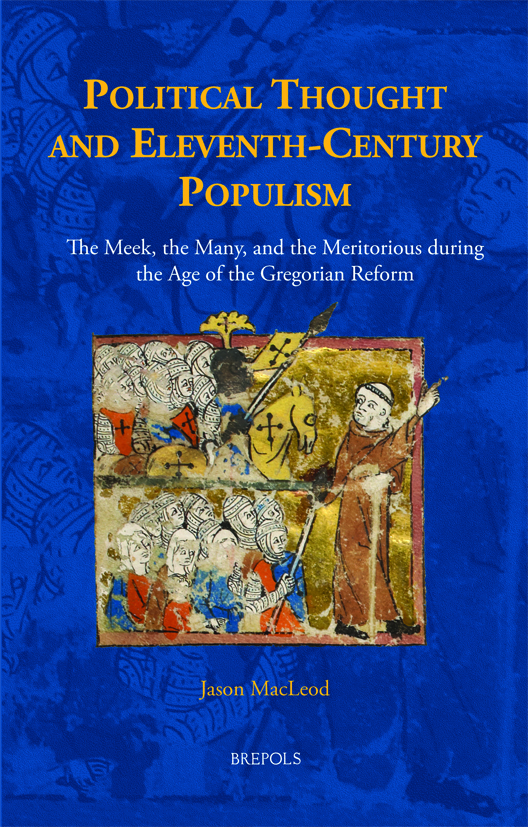 Political Thought and Eleventh-Century Populism
The Meek, the Many, and the Meritorious during the Age of the Gregorian Reform
Volume 38


