
Jews in the Realm of the Sultans
Ottoman Jewish Society in the Seventeenth Century
by Yaron Ben-Naeh

Jewish society in the Ottoman Empire has not been the subject of systematic research. The seventeenth century is the main object of this study, since it was a formative era. For Ottoman Jews, the ‘Ottoman century’ constituted an era of gradual acculturation to changing reality, parallel to the changing character of the Ottoman state. Continuous changes and developments shaped anew the character of this Jewry, the core of what would later become known as ‘Sephardi Jewry’.Yaron Ben-Naeh draws from primary and secondary Hebrew, Ottoman, and European sources, the image of Jewish society in the Ottoman Empire. In the chapters he leads the reader from the overall urban framework to individual aspects. Beginning with the physical environment, he moves on to discuss their relationships with the majority society, followed by a description and analysis of the congregation, its organization and structure, and from there to the character of Ottoman Jewish society and its nuclear cell – the family. Special emphasis is placed throughout the work on the interaction with Muslim society and the resulting acculturation that affected all aspects and all levels of Jewish life in the Empire. In this, the author challenges the widespread view that sees this community as being stagnant and self-segregated, as well as the accepted concept of a traditional Jewish society under Islam.
Yaron Ben-Naeh, Born 1965; 2000 PhD; taught at the TelAviv University, 2002-2005 post-doctoral Mandel Scholar at the Scholion Interdisciplinary Center, The Hebrew University, Jerusalem; spring 2007 fellow in the Center for Advanced Judaic Studies, Penn University, Philadelphia; currently tenured senior lecturer for the history of the Jews in Islamic countries in the early modern and modern period at The Hebrew University, Jerusalem.
- By (author) Yaron Ben-Naeh
Other Titles in this Series


 Jewish Reception of Greek Bible Versions
Studies in Their Use in Late Antiquity and the Middle Ages
Volume 23

 Islamische Geschichte in judischen Chroniken
Hebraische Historiographie des 16. und 17. Jahrhunderts
Volume 18


 Konigspsalmen und karaische Messiaserwartung
Jefet ben Elis Auslegung von Ps 2.72.89.110.132 im Vergleich mit Saadja Gaons Deutung
Volume 17


 Karaite Exegesis in Medieval Jerusalem
The Judeo-Arabic Pentateuch Commentary of Yusuf ibn Nuh and Abu al-Faraj Harun
Volume 26

Similar Books


 Ars Prophetica
Theology in the Poetry of Twentieth-Century Hebrew Poets Avraham Halfi, Shin Shalom, Amir Gilboa, and T. Carmi
 As Messianism Turns to Heresy
The Regenstein Chair Lectures On Lurianic Kabbalah and Shabbatai Tzevi at Hebrew Union College - Cincinnati


 Extracanonical Traditions and the Holy Land
Texts, Rituals, and Material Culture in Late Antique Palestine

 Lobbying for Equality
Jacques Godard and the Struggle for Jewish Equality during the French Revolution


 The Biblical Tale of Judah and Tamar in Fourteenth-Century Iran
A Judeo-Persian Versified Account by Shāhīn with Scholarly Edition, Annotated Translation and Persian Transliteration
Volume 94, 951


 The Therapeutae as the Best Paradigm for the Contemplative Life
A Contextual Reading of Philo of Alexandria's De Vita Contemplativa


 Tradition, Interpretation, and Change
Developments in the Liturgy of Medieval and Early Modern Ashkenaz

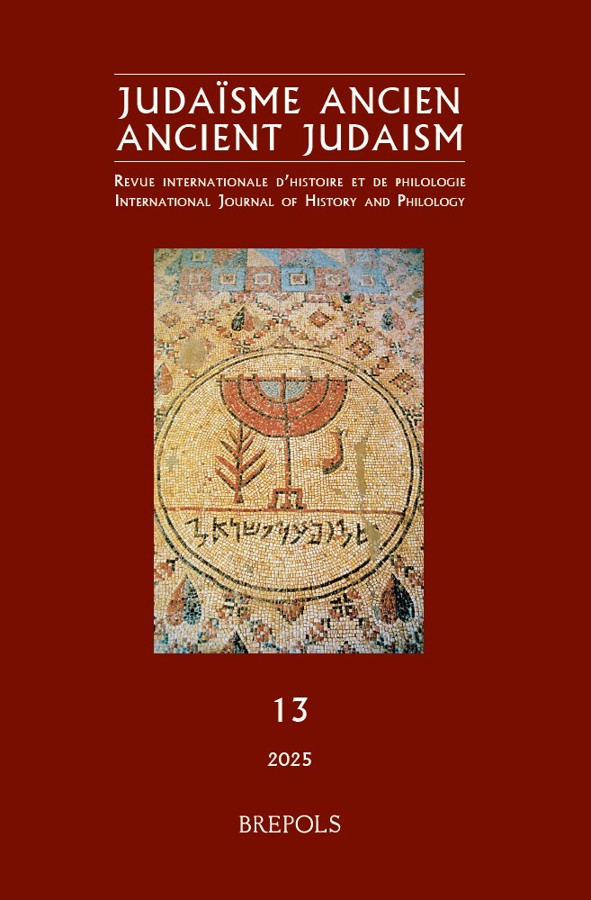 Judaïsme ancien – Ancient Judaism, 13, 2025
Daniel Boyarin et la notion de judaïsme dans l’histoire / Daniel Boyarin and the Notion of Judaism in History (Judaism: The Genealogy of the Modern Notion)
 Christlich-jüdische Beziehungen in Aschkenas während des 13. und 14. Jahrhunderts
Neue Einsichten in die vielfältige Quellenüberlieferung
 Das Weisheitsbuch Ben Sira / Jesus Sirach
Synopse der hebräischen, griechischen, lateinischen und syrischen Texttraditionen mit deutscher Übersetzung

 Der anwesende Abwesende
Das Verhältnis Judentum-Christentum in Schulbuch und Unterricht der Fächer Religion und Ethik


 Essen
Ethische Perspektiven zum Speisen in Antike und Gegenwart. Kontexte und Normen neutestamentlicher Ethik XV

