
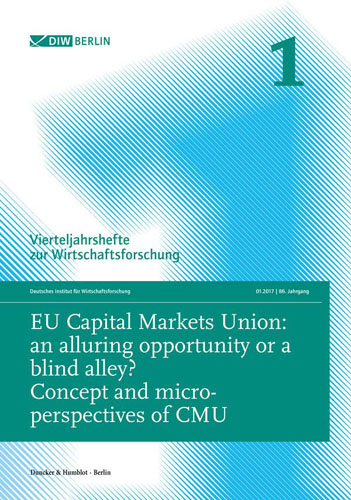
EU Capital Markets Union: an alluring opportunity or a blind alley?
Concept and micro-perspectives of CMU. Vierteljahrshefte zur Wirtschaftsforschung. Heft 1, 86. Jahrgang (2017).
Other direction by
Paperback (Published)
(November 2017)
ISBN: 9783428153596
6.93 x 9.84 inches
Price: $124.00
On back order
On September 30, 2015, the European Commission adopted an action plan to create a European Capital Markets Union (CMU). The chief purpose was to ease the access of small and medium-sized companies as well as start-ups to fund. CMU should also create an environment conducive to long-term, sustainable investment, including in infrastructure.
This proposal for deep structural change in national financial markets rests on two explicit diagnoses: (1) Europe is too bank-dependent, which impedes growth. And, (2) an integrated (de-segmented) capital market allows for more cross-regional risk sharing, as appropriate in a monetary union.
Upon its launching, the CMU initiative touched off controversial debates. Proponents hold that CMU can reduce financial fragmentation in Europe, support cross-border financial flows and foster access to finance, especially for SMEs. In contrast, critics consider CMU as an initiative ignoring analytical as well as practical lessons taught by the Great Financial Crisis, and resuming the financial deregulation efforts, betting again on the wrong set of institutions and instruments.
In two issues of the Vierteljahrshefte zur Wirtschaftsforschung, we address the major aspects, having a bearing on this decisive policy matter. Issue 1 focusses on the EU Capital Markets Union’s concept and its consequences from a micro-perspective. Issue 2 takes a macroeconomic or systemic angle, analyzing inter alia corollaries for monetary policy and risk-sharing across the Euro Area.
On September 30, 2015, the European Commission adopted an action plan to create a European Capital Markets Union (CMU). The chief purpose was to ease the access of small and mediumsized companies as well as start-ups to funds, in particular through raising funds in public capital markets. CMU should also create an environment conducive to long-term, sustainable investment, including in infrastructure. Concurrently, CMU should produce a more market-based and unified financing system within the European Union. This proposal for deep structural change in national financial markets rests on two explicit diagnoses: (1) Europe is too bank-dependent, which impedes growth. And, (2) an integrated (de-segmented) capital market allows for more cross-regional risk sharing, as appropriate in a monetary union. The core goals of the proposed CMU are (1) promoting the securitization of bank loans to SMEs; and (2) the channeling of private savings directly (without involvement of banks) into capital market products. In its green paper, “Building a Capital Markets Union”, the European Commission holds that, “stronger capital markets would complement banks as a source of financing, and would unlock more investment for all companies, especially SMEs, and for infrastructure projects.” In addition, a CMU would “attract more investment into the EU from the rest of the world; and make the financial system more stable by opening up a wider range of funding sources.” This, of course, begs the question, and raises a policy issue at the same time: Are current plans for implementing a European CMU capable of turning these promises into reality? Upon its launching, the CMU initiative touched off controversial debates. Proponents hold that CMU can reduce financial fragmentation in Europe, support cross-border financial flows and foster access to finance, especially for SMEs. In contrast, critics consider CMU as an initiative ignoring analytical as well as practical lessons taught by the Great Financial Crisis, and resuming the financial deregulation efforts, betting again on the wrong set of institutions and instruments. In two issues of the Vierteljahrsheft zur Wirtschaftsforschung, we address the major aspects, having a bearing on this decisive policy matter. Issue 1 focusses on the EU Capital Markets Union’s concept and its consequences from a micro-perspective. Issue 2 takes a macroeconomic or systemic angle, analyzing inter alia corollaries for monetary policy and risk-sharing across the Euro Area.
Hans-Helmut Kotz and Dorothea Schäfer
EU Capital Markets Union: an alluring opportunity or a blind alley? Concept and micro-perspectives of CMU
Michael Thiel
A methodological perspective on the Capital Markets Union: using economics to derive effective policy measures
Grégory Levieuge and Jean-Paul Pollin
Ambitions and limits of financial disintermediation in the Euro Area
Andreas Bley and Jan Philip Weber
Capital Markets Union: deepening the Single Market makes sense, but don't expect too much
Markus Demary
Challenges for the European Capital Markets Union: reviving financial integration and safeguarding financial stability
Karl-Peter Schackmann-Fallis and Sonja Scheffler
Aligning financial systems to meet the needs of citizens and enterprises
Horst Gischer and Christian Ilchmann
CMU – a threat to the German banking sector?
Helmut Kraemer-Eis and Frank Lang
Access to funds: how could CMU support SME financing?
Peter Cornelius
The structure and integration of the European buyout industry
Dorothea Schäfer and Andreas Stephan
Innovation and Investment Funding in the post-crisis period: have financing patterns and financial constraints of German firms changed?
Authors
- Other direction by
Other Titles in this Series
 Epochenbruch – Politikanpassungen und systemische Risiken
Vierteljahrshefte zur Wirtschaftsforschung. Heft 4, 91. Jahrgang (2022).
 Konjunkturanalyse in der Globalisierung.
Vierteljahrshefte zur Wirtschaftsforschung. Heft 4, 76. Jahrgang (2007).
 European banking landscape between diversity, competition and concentration.
Vierteljahrshefte zur Wirtschaftsforschung. Heft 4, 87. Jahrgang (2018).
 Zukunft des deutschen Bankensektors.
Vierteljahrshefte zur Wirtschaftsforschung. Heft 4, 75. Jahrgang (2006).
 Unsere Alterssicherungspolitik.
Gesetzliche Rentenversicherung: Sicherung des Lebensstandards oder nur Vermeidung von Altersarmut? Vierteljahrshefte zur Wirtschaftsforschung. Heft 2, 83. Jahrgang (2014).
 Epochenbruch – Wiedergeburt der Inflation?
Vierteljahrshefte zur Wirtschaftsforschung. Heft 2, 91. Jahrgang (2022).
 Firmendaten: Nützlich für die wissenschaftliche Politikberatung?
Vierteljahrshefte zur Wirtschaftsforschung. Heft 3, 76. Jahrgang (2007).
 Zukunft der kapitalgedeckten Alterssicherung in Deutschland – zwischen Staatsfonds und individuellem Vermögenskonto.
Vierteljahrshefte zur Wirtschaftsforschung. Heft 1, 88. Jahrgang (2019).
 Die Energiepolitik zwischen Wettbewerbsfähigkeit, Versorgungssicherheit und Nachhaltigkeit.
Vierteljahrshefte zur Wirtschaftsforschung. Heft 1, 76. Jahrgang (2007).
 Unsere Alterssicherungspolitik.
Private und betriebliche Altersvorsorge: Ist die Rentenlücke ohne grundlegende Reformen zu schließen? Vierteljahrshefte zur Wirtschaftsforschung. Heft 3, 83. Jahrgang (2014).
 Sustainable Finance im Schatten klimatischer Kipppunkte: Finanzwende oder Greenwashing?
Vierteljahrshefte zur Wirtschaftsforschung. Heft 1, 92. Jahrgang (2023).
 Green Finance: The Macro Perspective.
Vierteljahrshefte zur Wirtschaftsforschung. Heft 2, 88. Jahrgang (2019).
 Reform der Unternehmensbesteuerung 2008.
Vierteljahrshefte zur Wirtschaftsforschung. Heft 2, 76. Jahrgang (2007).
 Ernährungssicherung und Lebensmittelqualität: Herausforderungen für Agrarmärkte.
Vierteljahrshefte zur Wirtschaftsforschung. Heft 4, 81. Jahrgang (2012).
 Förderbanken – nicht nur in der Corona-Krise wichtig.
Vierteljahrshefte zur Wirtschaftsforschung. Heft 2, 89. Jahrgang (2020).
 Nationale Innovationssysteme im Vergleich.
Vierteljahrshefte zur Wirtschaftsforschung. Heft 2, 77. Jahrgang (2008).
 Green Finance: Case Studies.
Vierteljahrshefte zur Wirtschaftsforschung. Heft 3, 88. Jahrgang (2019).
 Nach der Zinswende – Aktuelle Herausforderungen der Geldpolitik.
Vierteljahrshefte zur Wirtschaftsforschung. Heft 2, 92. Jahrgang (2023).
 Verkehr und Nachhaltigkeit.
Vierteljahrshefte zur Wirtschaftsforschung. Heft 2, 79. Jahrgang (2010).
 Development Banks – not only important in times of Covid-19.
Vierteljahrshefte zur Wirtschaftsforschung. Heft 3, 89. Jahrgang (2020).
 25 Wellen Sozio-oekonomisches Panel.
Vierteljahrshefte zur Wirtschaftsforschung. Heft 3, 77. Jahrgang (2008).
 Schulden – Segen oder Fluch?
Vierteljahrshefte zur Wirtschaftsforschung. Heft 4, 88. Jahrgang (2019).
 Aktuelle Herausforderungen der Regulierungspolitik im Finanzsektor.
Vierteljahrshefte zur Wirtschaftsforschung. Heft 3, 92. Jahrgang (2023).
 Frühkindliche Bildung und Betreuung: Hintergründe und Bewertungen aus ökonomischer Vergleich.
Vierteljahrshefte zur Wirtschaftsforschung. Heft 3, 79. Jahrgang (2010).
 Libra, Bitcoin & Co – Determinants of Non-cash Payments and Alternative Money.
Vierteljahrshefte zur Wirtschaftsforschung. Heft 4, 89. Jahrgang (2020).
 Stürme, Fluten, Erdbeben – Wie sich Europa gegen Naturkatastrophen versichern kann.
Vierteljahrshefte zur Wirtschaftsforschung. Heft 4, 77. Jahrgang (2008).

 Sozialpartnerschaft – Chancen und Herausforderungen.
Vierteljahrshefte zur Wirtschaftsforschung. Heft 4, 92. Jahrgang (2023).
 Europäische und internationale Finanzmärkte im Zeichen der Krise.
Vierteljahrshefte zur Wirtschaftsforschung. Heft 4, 79. Jahrgang (2010).
Similar Books



 European Review of Service Economics and Management
De nouveaux horizons pour l’innovation dans les services ? IA, inclusion et responsabilité
Volume 21
 Friedlicher Handel oder umkämpfte Geschäfte?
Handel und Handelsrecht in der Vormoderne zwischen Krieg und Frieden

 Global Gulf
Geo-Economic, Geo-Political, and Geo-Technological Transformation in Saudi Arabia, the United Arab Emirates, and Qatar
 Invisible Labour in Antiquity
Visualizing Obscure Work in the Ancient Mediterannean and West Asia
Volume 1

 Socio-économie du travail
La dégradation du travail au XXIe siècle ? Lectures contemporaines de Harry Braverman
Volume 17
 Socio-économie du travail
Le sens du travail, concept scientifique ou instrument du capitalisme ? Volume 1
Volume 18




 Obsidian and the Sea
Evidence, Concepts and Social Implications of its Maritime Transportation
Volume 22

 Socio-économie du travail
Le sens du travail, concept scientifique ou instrument du capitalisme ? Volume 2
Volume 19


 Décarboner sans détruire les profits
Comment les entreprises peuvent allier performance économique et impact climatique
Volume 3

 Der politische Streik im deutschen Arbeitskampfrecht
Dogmatische Entwicklungslinien von 1869 bis in die 1980er Jahre
Volume 393

 Der Sales-Leadership-Code
Wie du mit Klarheit und Haltung leichter verkaufst und wirksamer führst - Eine Business-Story

 Die 10 Regeln der hocheffektiven Preisgestaltung
Wie Sie Ihr Preismanagement umgestalten und Ihre Gewinne steigern

 Die Konjunkturkomponente des Grundgesetzes
Die konjunkturbedingte Kreditaufnahme im System der Kreditermächtigungen, europarechtlichen und gesamtwirtschaftlichen Verpflichtungen der Finanzverfassung
 Die Masterclass für den Geist
Erfolgreiche Selbstführung mit dem Besten aus westlicher und östlicher Philosophie







 Financial Wellbeing
Wie Sie mit finanzieller Bildung für Ihre Beschäftigten den Unternehmenserfolg steigern