
Echoes of Change in Religious Atmospheres
Exploring Their Dynamics in Antiquity and Beyond
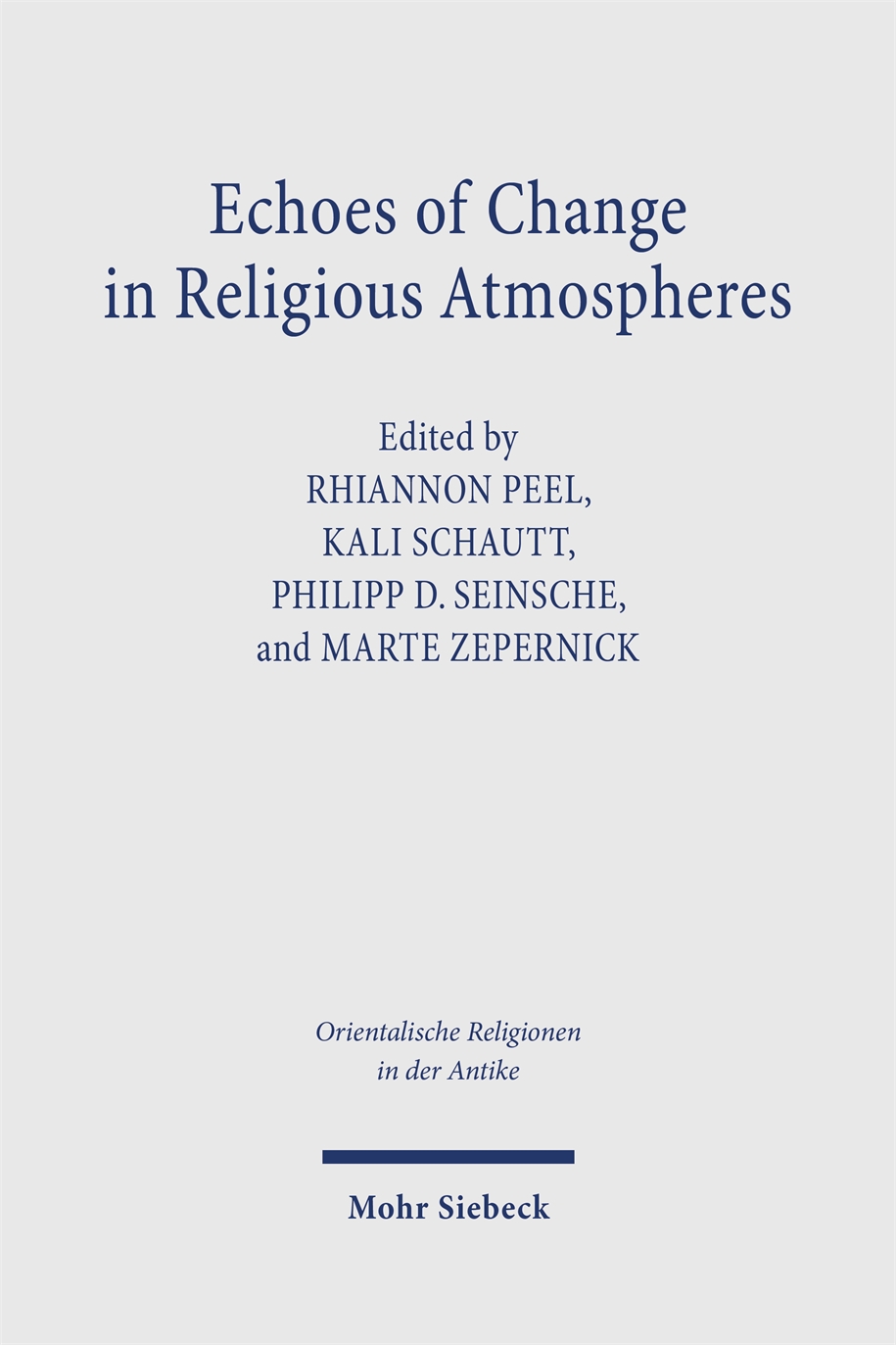
Hardback (Forthcoming)
(January 2027)
ISBN: 9783162009876
6.69 x 9.49 inches
Price: $210.00
Religious atmospheres are usually described as though they simply were there. This volume asks how they arise, shift, and fade – from Mesopotamian processions to a madrasa in nineteenth-century Tehran and a digital game. Change is the moment at which an atmosphere becomes legible.
This volume develops a concept of changes in religious atmospheres as an analytical approach for the study of religions in antiquity and beyond. It brings together contributions dealing with various geographical and cultural contexts, from Tehran to Rome, from ancient Mesopotamian processions to contemporary museum exhibitions. Interweaving space, actors and perception, atmospheres – with their integrative capacity – open new access to the study of religions. Analysing the dynamics of religious atmospheres shifts the focus towards the temporalities of religious phenomena, embracing the indeterminate aspects of atmospheres while bringing culturally specific notions into view. Especially in historical contexts with limited evidence of religious atmospheres as well as in complex contemporary scenarios, changes are a useful entry point for closer examination. This includes both small-scale changes within religious events and large-scale dynamics in a broader time frame. The contributions examine actors and actions, changing conditions, the establishing and curating of atmospheres, and their failure and decline. The case studies assembled here draw on various understandings of religious atmospheres, from an action-made or cognitively-processed approach to phenomenological premises. With texts, images and materialities a broad range of media is taken into account, often shaping the methodological framework. The evidence considered here thus ranges from architecture to digital games, catching echoes of religious atmospheres that resonate through time. Taken together, these perspectives treat religious atmospheres not as states but as processes.
Other Titles in this Series
 Der Priester Pinhas in Jerusalem und auf dem Berg Garizim
Eine intertextuelle Untersuchung und literar-, sozial- und religionsgeschichtliche Einordnung
Volume 51

 Gut und Bose in Mensch und Welt
Philosophische und religiose Konzeptionen vom Alten Orient bis zum fruhen Islam
Volume 10


 Brautpreis und Mitgift
Gedanken zum Eherecht in Ugarit und seiner Umwelt mit einer Rekonstruktion des im Ritual verankerten 'Schlangentext'-Mythos
Volume 18
 Bedeutung und Bewertung von Mazzeben im Alten Testament
Eine exegetische Untersuchung auf der Grundlage einer vergleichenden Analyse stehender Steine im Vorderen Orient und Östlichen Mittelmeerraum

 Crafting for the Gods: Cult, Production, and Technological Identities
Proceedings of the Minerva School Workshop, Israel, 2022. Research on Israel and Aram in Biblical Times X

 Jerusalem and the Coastal Plain in the Iron Age and Persian Periods
New Studies on Jerusalem's Relations with the Southern Coastal Plain of Israel/Palestine (c. 1200-300 BCE). Research on Israel and Aram in Biblical Times IV
Volume 46
 Urbanism in the Iron Age Levant and Beyond
Research on Israel and Aram in Biblical Times VII
Volume 59
 Der Tod von eigener Hand
Studien zum Suizid im Alten Testament, Alten Agypten und Alten Orient
Volume 19
 Enuma eli – Weg zu einer globalen Weltordnung
Pragmatik, Struktur und Semantik des Lieds auf Marduk
Volume 12
 Aschdod und Jerusalem
Eine archaologische und exegetische Untersuchung zu den Beziehungen von sudpalastinischer Kustenebene und judaischem Bergland
Volume 53


 Hiobs Kosmos
Eine Kontextualisierung im Rahmen spatzeitlicher Krisen- und Leidensbewaltigung
Volume 60


 Kollektive Schuld und Haftung
Religions- und rechtsgeschichtliche Studien zum Sundenkuhritus des Deuteronomiums und zu verwandten Texten
Volume 4
 Osiris-Hymnen
Wechselnde Materialisierungen und Kontexte. Untersuchungen anhand der Texte 'C 30' / Tb 181, Tb 183, 'BM 447' / Tb 128 und der 'Athribis'-Hymne
Volume 30
 Entangled Worlds
Religious Confluences between East and West in the Roman Empire: The Cults of Isis, Mithras, and Jupiter Dolichenus
Volume 22
 Magie und Raum
Der magische Schutz ausgewahlter Raume im Alten Agypten nebst einem Vergleich zuangrenzenden Kulturbereichen
Volume 13
 Un YHWH venant du Sud?
De la reception veterotestamentaire des traditions meridionales et du lien entre Madian, le Neguev et l'exode (Ex-Nb ; Jg 5 ; Ps 68 ; Ha 3 ; Dt 33)
Volume 39
 Weltkonstruktionen
Religiose Weltdeutung zwischen Chaos und Kosmos vom Alten Orient bis zum Islam
Volume 5

 Israel, Judah, and Neighboring Groups in the Books of Samuel
Textual and Historical Approaches. Research on Israel and Aram in Biblical Times VIII