
Die liturgischen Werke Amalars von Metz/Trier (ca. 775 – ca. 850)
Aus dem Lateinischen übersetzt. eingeleitet und kommentiert von Andreas Heinz
Translated by Andreas Heinz
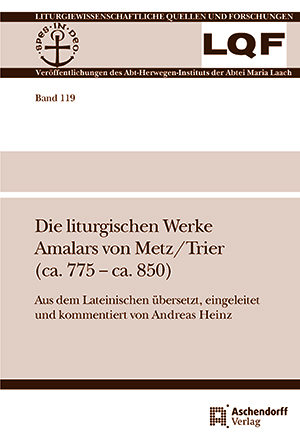
Hardback (Published)
(October 2025)
ISBN: 9783402113004
6.1 x 9.09 inches
Price: $120.00
In stock
Amalarius of Metz/Trier (c. 775–c. 850) is among the most important writers of the Middle Ages. He addressed all aspects of liturgy in detail, explaining and commenting on individual rites, various prayers, church spaces, vessels, vestments, and more.
He employed allegorical interpretation (allegoresis), introducing a new method of explaining liturgy in the West. His texts were widely received throughout the Middle Ages and beyond, influencing later liturgical interpretations and setting a lasting direction. Today, his letters and writings are foundational for understanding medieval liturgical theology.
For liturgical, ecclesiastical, and art-historical study of medieval worship, Amalarius’s texts are a primary source. However, they are written in Latin that is not always easily accessible. To facilitate access, this volume presents, for the first time, a translation of these liturgical writings. It closely follows the Latin text and relevant editions, allowing for parallel use of the original and translation. This translation is an indispensable tool for studying Amalarius as a medieval liturgist.
Amalarius’s Life (Amalars Leben)
Letters (Briefe)
Liber officialis (his major liturgical work)
The Order of the Antiphonary (Die Ordnung des Antiphonars)
Notes on the Ordo Romanus (Eclogae)
Bibliography
Index
Andreas Heinz studied in Trier and Rome (Gregorian University) and was ordained a priest in 1968. He became a professor at Ruhr University Bochum in 1979 and was appointed full professor at the Faculty of Theology in Trier in 1981. He also served as an advisor to the German Bishops’ Conference Liturgical Commission (1982–2001) and headed the research department of the German Liturgical Institute from 1981 to 2007.
- Translated by Andreas Heinz
Other Titles in this Series
 Unitas in pluralitate
Libri ordinarii als Quelle für die Kulturgeschichte/Libri ordinarii as a Source for Culture
Volume 103
 Liturgie, pensée théologique et mentalités religieuses au haut Moyen Âge
Le témoignage des sources liturgiques
Volume 106
 On the Typology of Liturgical Books from the Western Middle Ages
Zur Typologie liturgischer Bücher des westlichen Mittelalters
Volume 115
 Analogie und Differenz: Das dynamische Verhältnis von jüdischer und christlicher Liturgie
Analogy and Difference: The Ever-Changing Relationship of Jewish and Christian Liturgy
Volume 112
 Wilhelm Durandus: Rationale divinorum officiorum
Durandus: Rationale divinorum officiorum
Volume 107
Similar Books
 «Solazoxa festa, stradolze e stracomplia»
Festschrift für Raymund Wilhelm zum 65. Geburtstag mit Beiträgen zu Diskurstraditionen und mittelalterlicher Philologie
Volume 249

 A Collaborative Tapestry in Honour of Shirley Ann Brown / Une fresque brodée en l’honneur de Shirley Ann Brown
The Bayeux Tapestry Seen by her Colleagues and Friends / La Tapisserie de Bayeux vue par ses collègues et amis
 A Companion to Christianity and Sport in Europe and North America (19th-21st centuries)
Volume 1: Western and Eastern Europe
 A Connecting Polemic in the Medieval Mediterranean
The Correspondence of Leo III and ʿUmar II
Volume 6








 Ars Prophetica
Theology in the Poetry of Twentieth-Century Hebrew Poets Avraham Halfi, Shin Shalom, Amir Gilboa, and T. Carmi
 As Messianism Turns to Heresy
The Regenstein Chair Lectures On Lurianic Kabbalah and Shabbatai Tzevi at Hebrew Union College - Cincinnati


 Behind the Scenes of Medieval Roofs
An Overview of the Roofing Systems of Italian Churches
Volume 90


 Cahiers de recherches médiévales et humanistes – Journal of Medieval and Humanistic Studies
Volume 51



 Creating the Woman in Antiquity
Proceedings of the 16th Melammu Workshop, Innsbruck, 2–3 June 2022
Volume 13
 Cultic Kisses
Fruitful Encounters Between Deities and Humans. Festschrift for Angelika Berlejung on the Occasion of Her 65th Birthday
 De/colonizing Theologies
Glocal Histories, Contemporary Challenges, Theoretical Reflections
Volume 4

 Drunk the Potion, No Whit Charmed
The Doctrine of Pure and Perfect Souls from Iamblichus to Damascius

