
Der sogenannte Hadrianstempel an der Kuretenstrasse
by Ursula Quatember

Paperback (Published)
(February 2018)
ISBN: 9783700179948
8.31 x 11.65 inches
Price: $242.00
In stock
The so-called Temple of Hadrian on Curetes Street is one of the best-known monuments of Roman Ephesos. Shortly after its excavation in the 1950s, the small temple was rebuilt, and today its facade dominates Curetes Street, one of the main thoroughfares of the ancient city. The excavator Franz Miltner interpreted the building – presumably in accordance with the building inscription – as the neocorate temple, the official temple for a provincial cult of the emperor Hadrian, which was granted to Ephesus between AD 130 and 132. Miltner’s interpretation received criticism, but no alternative explanation could be established. This publication presents the results of a research project carried out between 2009 and 2012 at the Austrian Archaeological Institute providing evidence for the building phases, the decoration and the inscriptions, and a prosopographic view of the benefactors of the temple. According to the new contextual interpretation, the building, which is called a “temple” or “shrine” in its dedicatory inscription, should be seen in the context of religious processions through the city, originating from and leading to the Temple of Artemis, located outside of the city limits.
The so-called Temple of Hadrian on Curetes Street is one of the best-known monuments of Roman Ephesos. Shortly after its excavation in the 1950s, the small temple was rebuilt, and today its facade dominates Curetes Street, one of the main thoroughfares of the ancient city. The excavator Franz Miltner interpreted the building – presumably in accordance with the building inscription – as the neocorate temple, the official temple for a provincial cult of the emperor Hadrian, which was granted to Ephesus between AD 130 and 132. Miltner’s interpretation received criticism, but no alternative explanation could be established. This publication presents the results of a research project carried out between 2009 and 2012 at the Austrian Archaeological Institute providing evidence for the building phases, the decoration and the inscriptions, and a prosopographic view of the benefactors of the temple. According to the new contextual interpretation, the building, which is called a “temple” or “shrine” in its dedicatory inscription, should be seen in the context of religious processions through the city, originating from and leading to the Temple of Artemis, located outside of the city limits.
- By (author) Ursula Quatember
Other Titles in this Series

 Hanghaus 2 in Ephesos Die Wohneinheit 6 Baubefund, Ausstattung, Funde
Baubefund, Ausstattung, Funde
Volume 45878
 Amber for Artemis
Amber Finds from the Artemision at Ephesos. With Contributions by Silvia Alaura, Laura Ambrosini, Marco Bonechi, Vanora Estridge, Sarjit Kaur, Tripta Kaur, Michael Kerschner, Alessandro Naso, Martina Ott, Caroline Posch, Serena Privitera, Andrea M. P
Volume 12.7
 Das Grabhaus 1/08 in der Hafennekropole von Ephesos
Ergebnisse der anthropologischen und palaopathologischen Untersuchung kaiserzeitlich-spatantiker Kollektivgraber
Volume 1


 Das Mausoleum von Belevi
Archaologische Untersuchungen zu Chronologie, Ausstattung und Stiftung
Volume 45810
Similar Books

 Caesar’s Visions and Impact on the Roman Empire
Revisiting the Archaeological and Historical Record of the 40s BC
Volume 2


 Drunk the Potion, No Whit Charmed
The Doctrine of Pure and Perfect Souls from Iamblichus to Damascius

 Epiphanies of the Divine in the Septuagint and the New Testament
Fifth International Symposium of the Corpus Judaeo-Hellenisticum Novi Testamenti (CJHNT), 14-17 May 2015, Nottingham


 Etruscan and Roman Hellenistic Anatomical ex votos
Reassessing Popular Religious Expressions in Central Italy
Volume 8




 Invisible Labour in Antiquity
Visualizing Obscure Work in the Ancient Mediterannean and West Asia
Volume 1
 Language and Power in the Roman Empire and Early India
Hierarchy, Ambiguity, and the Art of Reading the Signs in Cosmopolitan Cultures
 Late Antique villae in the Balkans (3rd–7th c. AD): Current Research Questions and Perspectives
HAEMUS Companion to the Late Antique Balkans 1
Volume 4

 Nurturing the Elite
Representations of Drinking, Eating, and Religious Vessels in Palmyrene Funerary Iconography
Volume 13


 Portraying the Individual in the Roman East
Local–Imperial Entanglements in Sculpture, Mosaics, and Paintings (First–Fourth Centuries AD)
Volume 18

 Small Worlds and Relational Agencies: Local Societies in Early Medieval Iberia
Pequeños mundos y Agencias relacionales: Sociedades locales altomedievales en la Península Ibérica
 The Compositional History of the Book of Kings
An Analysis of the Evaluative Frameworks in 1 Kings 14–2 Kings 25

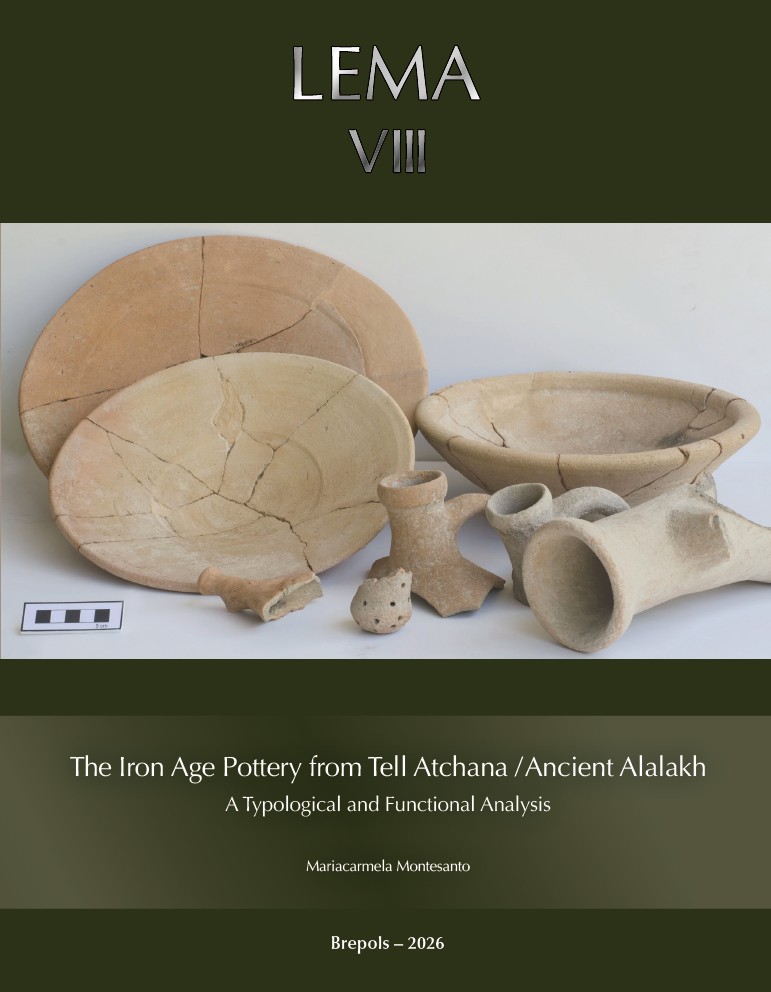 The Iron Age Pottery from Tell Atchana / Ancient Alalakh
A Typological and Functional Analysis
Volume 8


 Writing in the Church of the Nativity in Bethlehem
Inscription and Graffiti in a Multilingual and Multigraphic Perspective
Volume 45
 Contesting Labeled Identities
The Sociology of Gentilics in Biblical and Northwest Semitic Literature


 After Life in Roman Paganism. L’Égypte des astrologues. Les Mages hellénisés
Introductions historiographiques
Volume 7

 Atlante tematico di topografia antica 36-2026
Urbanistica e monumenti, porti, Roma. Ricerche sui monti Aurunci
Volume 36
 Cerámica común romana y ciclo haliéutico
Análisis de los contextos de las cetariae de Iulia Traducta


 Diodor über den ersten Sklavenaufstand auf Sizilien
Ein philologischer und historischer Kommentar
Volume 67