
Der partizipative Staat.
Beteiligung natürlicher Personen an der Ausübung von Staatsgewalt im Verfassungs-, Verwaltungs- und Prozessrecht.
By (author) Dominik Steiger

Hardback (Published)
(September 2023)
ISBN: 9783428182831
6.18 x 9.17 inches
Price: $247.00
On back order
Wann durfen das Volk, die (betroffene) Offentlichkeit und Einzelne an staatlichen Entscheidungen partizipieren und welchen Einfluss durfen sie dabei ausuben? Mit Hilfe des Gewaltenteilungsgrundsatzes entwickelt Dominik Steiger eine (rechtsdogmatische) Theorie der imperativen Partizipation und zeigt auf, wer sich nach dem Grundgesetz unter welchen Voraussetzungen beteiligen darf, wie weit der Einfluss dieser Beteiligung reicht und wie durch das richtige Mass an Partizipation Legitimation erzeugt wird.
English summary: The Participatory State. Participation in Public, Administrative and Procedural Law: More than fifty years have passed since the participation debate began, yet there is no overarching constitutional theory of participation that encompasses all three branches of government. Dominik Steiger fills this lacuna with his theory of imperative participation that is based on the separation of powers doctrine and shows how participation by the people and individuals must be conceptualised to enhance the legitimacy of public authority. German description: Die Bundesrepublik Deutschland ist ein partizipativer Staat. Dieses Buch konzeptualisiert Partizipation unter dem Grundgesetz, zeigt auf, welch vielfaltige Formen von Beteiligung Verfassungs- und Verwaltungsrecht schon heute vorsehen und wo Nachbesserungsbedarf besteht, z.B. durch Einfuhrung der Volksgesetzgebung auf Bundesebene. Dabei geht es nicht um Ausweitung von Beteiligung zu Lasten der reprasentativen Demokratie, sondern um das richtige Mass eines gelungenen Miteinanders. Dieses wird vom Gewaltenteilungsgrundsatz bestimmt: Entscheidungen auf Legislativebene hat das Volk zu treffen. Auf Exekutivebene werden Entscheidungen von den staatlichen Stellen getroffen, allerdings ist die (betroffene) Offentlichkeit zu beteiligen ebenso wie in ihren Rechten betroffene Einzelne. Letzteres gilt auch fur die Judikativebene. Nur Partizipation, die sich an dieser Theorie der imperativen Partizipation orientiert, kann legitimationsstarkend wirken und somit Demokratie und Rechtsstaatlichkeit gleichermassen fordern.
Einleitung
Partizipation und die Krise der Demokratie
1. Theoretische Grundlegung: Partizipation, Gewaltenteilung und die Theorie der imperativen Partizipation
Imperative Partizipation und ihr Verhältnis zu Demokratieprinzip, Rechtsstaatsprinzip und effektivem Funktionalitätsgebot – Die Gewaltenteilung des Grundgesetzes – Die rechtsdogmatische Theorie der imperativen Partizipation – Herleitung, Inhalt und Methodik
2. Der partizipative Staat de lege lata: Partizipation im geltenden Recht
Die Legislative: Ermöglichung von kollektiver Selbstbestimmung durch Partizipation – Die Exekutive: Partizipation im Spannungsbogen von kollektiver und individueller Selbstbestimmung – Die Judikative: Schutz individueller Selbstbestimmung durch Partizipation
3. Der partizipative Staat de lege ferenda: Möglichkeiten, Pflichten und Grenzen des Ausbaus partizipativer Strukturen
Demokratie- und Rechtsstaatsprinzip als Optimierungsgebot – Optimierung der Legislative: Mehr Beteiligung wagen – Optimierung der Exekutive: Mehr und bessere Beteiligung wagen
Fazit und Schluss
Literatur- und Sachverzeichnis
Dominik Steiger holds the chair of Public International Law, European Law and Public Law at Technische Universität Dresden since 2018. Before taking up the position in Dresden, he was a Professor of International Law at KU Leuven. He has been a visiting fellow/professor at the Universities of Stellenbosch and the Western Cape, LUISS (Rome), at Monash University, amongst others, as well as an Emile Noël Fellow at New York University. Since 2019, he is academic director of the Center for International Studies. His research and publications focus inter alia on digitalization and international law, democracy, human rights law, international criminal law, humanitarian law, and United Nations law.
- By (author) Dominik Steiger
Other Titles in this Series
 Entstehung und Fortbildung des Enquête- und Untersuchungsrechts in Deutschland.
Rechtsentwicklungen aus 200 Jahren.
Volume 2
 Unternehmensbezogene Effizienzanforderungen im Öffentlichen Recht.
Unternehmenseffizienz als neue Rechtskategorie.
Volume 1
 Menschenrechtsschutz für juristische Personen in Deutschland, der Schweiz und den Vereinigten Staaten.
Begründungsmodelle der korporativen Menschenrechtsträgerschaft.
Volume 3
Similar Books


 As Messianism Turns to Heresy
The Regenstein Chair Lectures On Lurianic Kabbalah and Shabbatai Tzevi at Hebrew Union College - Cincinnati
 Balthasar Caymox of Nuremberg
Early Modern German Print Publishers: Popular Prints of the Seventeenth Century

 Beyond Sovereign Courts
Agents and Practices in Early Modern Spanish and Habsburg Diplomacy
Volume 3


 Constitutional Conflict as Judicial Civil Disobedience and Conscientious Objection
Reconceptualising National Constitutional Court Rulings in the European Union Legal Space


 East Meets West: Justice, Law, and Politics
The 13th Kobe Lecture and the 2nd IVR Japan International Conference, Chiba, September 2023


 False Friends in Comparative Law
Advantages and Risks of Legal Transplants in Civil Law – the Polish-German Perspective
 Food Security under Armed Conflict
Global Knowledge Landscape and Public Attention to Social, Economic, and Humanitarian Dimensions

 Formulary apportionment in international tax law
An allocation method for the age of globalization and digitalization
Volume 210


 Hofmann oder Vorkämpfer der „philosophes“?
Deutsche Voltaire-Bildnisse und -Imaginationen im Zeitalter der Aufklärung
 Innovationes Lovanienses: Arts, Law and Theology at the University of Louvain (1425–1797)
Studium Lovaniense: Learning across Borders, 2
Volume 18


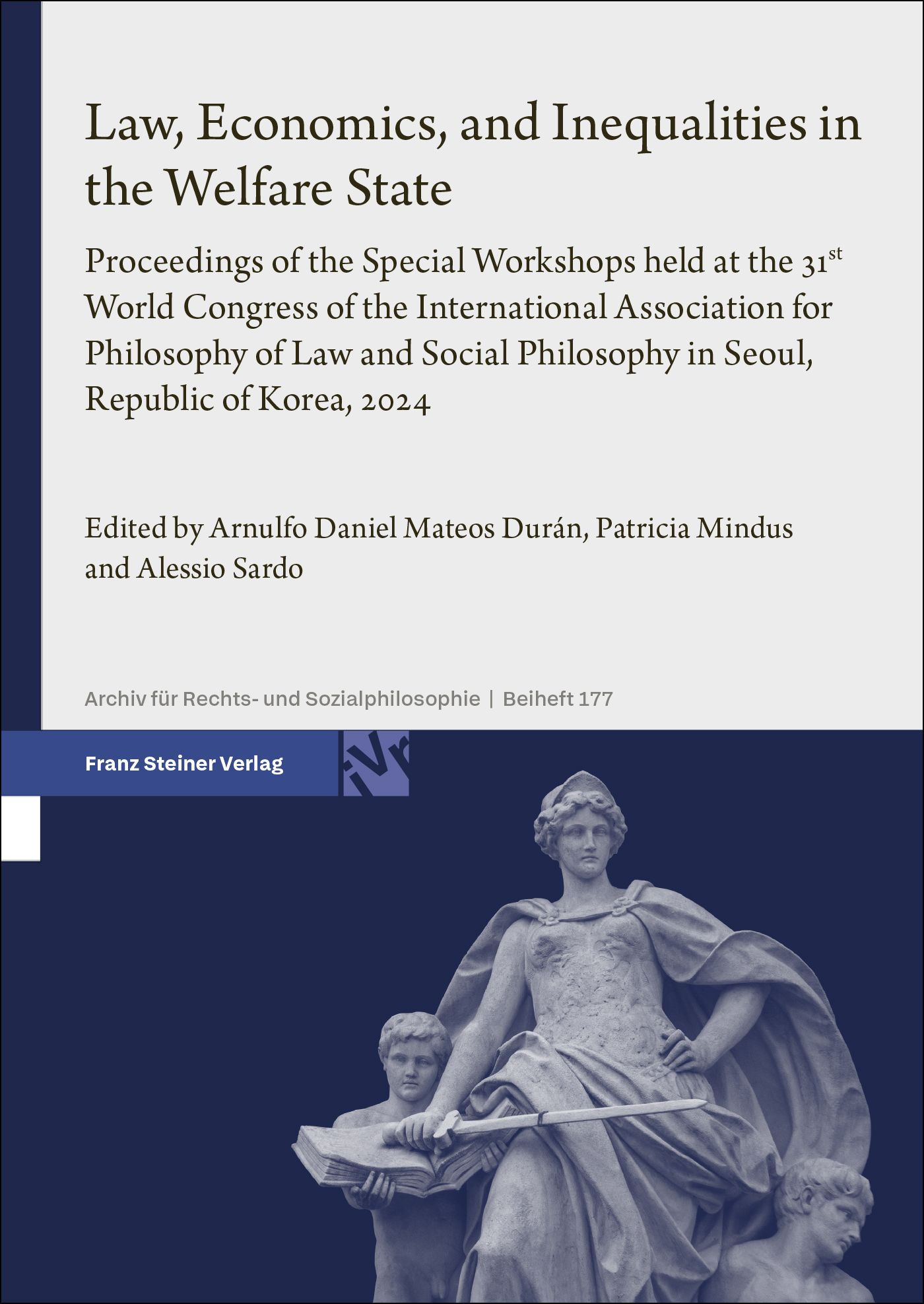 Law, Economics, and Inequalities in the Welfare State
Proceedings of the Special Workshops held at the 31st World Congress of the International Association for Philosophy of Law and Social Philosophy in Seoul, Republic of Korea, 2024
 Legal Pluralism and the Tajik Experience of Xinjiang
Between Custom and the Chinese State: An Ethnographic Perspective
 Legal Unification through Case Law?
Supreme Courts and the Emergence of Uniform Law in the Modern Era
Volume 242
 Liturgia semper reformanda
Adaptations and accommodations in the liturgy in light of canon 838 of the Code of Canon Law


 Myths and Tales of the Inughuit
Erik Holtved's Polar Eskimo Texts Revised and Re-translated into Danish and English
Volume 475, 12


