
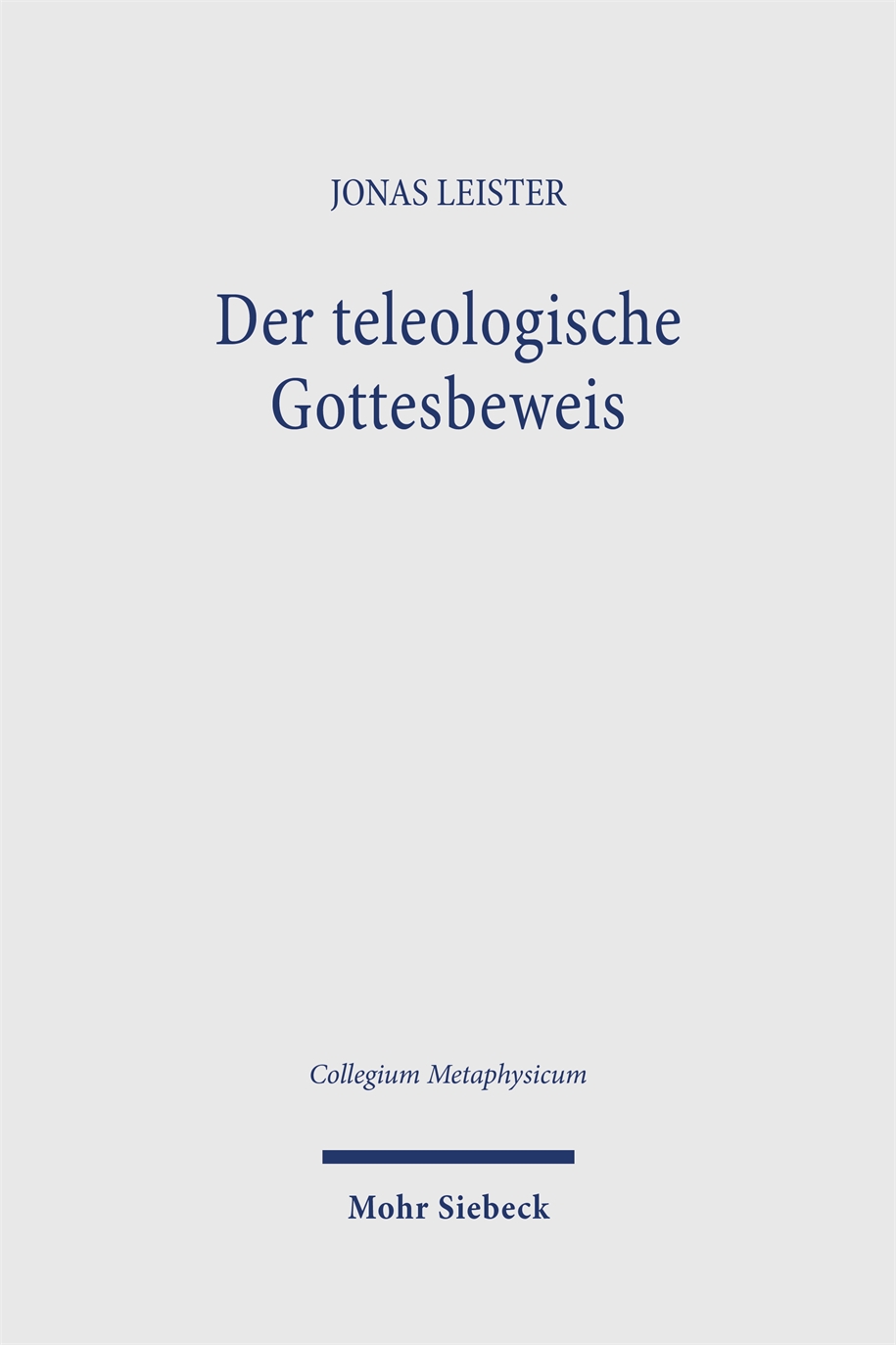
Der teleologische Gottesbeweis
Darstellung und Kritik klassischer Versuche sowie eine Reformulierung anhand der Feinabstimmung der physikalischen Naturkonstanten und kosmologischen Anfangswerte
Paperback (Forthcoming)
(January 2027)
ISBN: 9783162008428
6.1 x 9.13 inches
Price: $195.00
Jonas Leister examines the current state of research in physics and cosmology on the question of fine-tuning. He addresses the questions: Should fine-tuning be taken seriously? Does resolving the phenomenon require further research? Does a multiverse exist? Does a God or designer exist?
Jonas Leister addresses the phenomenon of fine-tuning in a comprehensive scientific, philosophical, and philosophy-of-religion analysis. Drawing on current examples of the fine-tuning of the constants of nature from particle physics and cosmology, he demonstrates with precision, on the basis of Bayesian probability theory, the extent to which this phenomenon calls for explanation. Furthermore, the explanatory demand posed by fine-tuning is defended against contemporary objections, such as the so-called “problem of old evidence,” on the basis of epistemology and Objective Bayesianism.
The subsequent part presents all major explanatory approaches to fine-tuning and offers a detailed assessment of their respective explanatory power. In particular, the explanations provided by the anthropic principle, a theory of everything, a multiverse, and a design hypothesis are systematically introduced and examined. Both the strong and weak versions of the anthropic principle are analysed in detail. The analysis of a final physical theory, or theory of everything, is, for the first time, consistently and comprehensively guided by criteria derived from the philosophy of science, with a high degree of analytical precision. The most extensive treatment is devoted to the multiverse hypothesis. Here, multiverse theories based on string theory and cosmological inflation are examined alongside those derived from big bounce models and from theories of the evolutionary development of black holes. Drawing on the current scholarly literature on multiverse theories, the status of their empirical confirmation is presented and critically assessed. A substantial portion of the study is devoted to the question of what empirical evidence would suffice, from the standpoint of the philosophy of science, to regard a multiverse as confirmed, and whether the current state of research permits an inference from fine-tuning to the existence of a multiverse.
The design hypothesis is analysed in light of the empiricist philosophical tradition, particularly through engagement with David Hume. Against the background of Kant’s critique, the idealism of the later Schelling, and Hegel’s critique of the proofs of God’s existence, a distinctive position is developed that demonstrates the success of the teleological argument. At the same time, it is shown that, given empiricist foundational premises, teleological deism possesses a higher probability than classical theism.
Other Titles in this Series


 Der Herr der Zeit
Ein Ewigkeitsmodell im Anschluss an Schellings Spatphilosophie und physikalische Modelle
Volume 18
 Die metaphysische Grundlage der Kontroverse um den Kraftbegriff zwischen Descartes und Leibniz
Volume 9


 Teilhabe-Ontologie und interreligioser Dialog im Platonismus und Christentum
Gott ist Richter mitten unter den Gottern' (Ps 82,1b). Monotheismus, Polytheismus und Teilhabe-Ontologie im Platonismus und Christentum, die Henaden bei Proklos und der interreligiose Dialog bei Nikolaus von Kues
Volume 19
 Zeichenhafte Wirklichkeit
Realitat als Ausdruck der kommunikativen Prasenz Gottes in der Theologie George Berkeleys
Volume 2
 Grundfragen der Metaphysik
Eine Einfuhrung in Geschichte und Gestalten metaphysischen Denkens
Volume 32
 Radikale Selbstbestimmung
Eine Untersuchung zum Freiheitsverstandnis bei Harry G. Frankfurt, Galen Strawson und Martin Luther
Volume 12
 “Genesis” – der theologische Sinn des kosmologischen Standardmodells der Physik
Gezeigt an St. Weinbergs Klassiker "Die ersten drei Minuten"


 Schopfung, Zufall oder viele Universen?
Ein teleologisches Argument aus der Feinabstimmung der Naturkonstanten
Volume 21




 Unendlich gebildet
Schleiermachers kritischer Religionsbegriff und seine inklusivistische Religionstheologie anhand der Erstauflage der Reden

 Die Objektivitat des Absoluten
Der ontologische Gottesbeweis in Hegels 'Wissenschaft der Logik' im Spiegel der kantischen Kritik
Volume 23
 Ontologie der Selbstbestimmung
Eine operationale Rekonstruktion von Hegels Wissenschaft der Logik
Volume 5
 Gott und Denken
Zeitgenössische und klassische Positionen zu zentralen Fragen ihrer Verhältnisbestimmung. Für Friedrich Hermanni zum 60. Geburtstag
 Der Herrschaftsbereich der logischen Form
Eine Studie zur Metaphysik des deutschen Idealismus
Volume 34
Similar Books

 A Companion to Christianity and Sport in Europe and North America (19th-21st centuries)
Volume 1: Western and Eastern Europe
 A Connecting Polemic in the Medieval Mediterranean
The Correspondence of Leo III and ʿUmar II
Volume 6





 Ars Prophetica
Theology in the Poetry of Twentieth-Century Hebrew Poets Avraham Halfi, Shin Shalom, Amir Gilboa, and T. Carmi
 As Messianism Turns to Heresy
The Regenstein Chair Lectures On Lurianic Kabbalah and Shabbatai Tzevi at Hebrew Union College - Cincinnati





 Creating the Woman in Antiquity
Proceedings of the 16th Melammu Workshop, Innsbruck, 2–3 June 2022
Volume 13
 Cultic Kisses
Fruitful Encounters Between Deities and Humans. Festschrift for Angelika Berlejung on the Occasion of Her 65th Birthday
 De/colonizing Theologies
Glocal Histories, Contemporary Challenges, Theoretical Reflections
Volume 4
 Drunk the Potion, No Whit Charmed
The Doctrine of Pure and Perfect Souls from Iamblichus to Damascius






 Extracanonical Traditions and the Holy Land
Texts, Rituals, and Material Culture in Late Antique Palestine
 Fear, Fear of God, God-Fearers
Philological and Historical Perspectives on the World of Ancient Judaism and Christianity

