
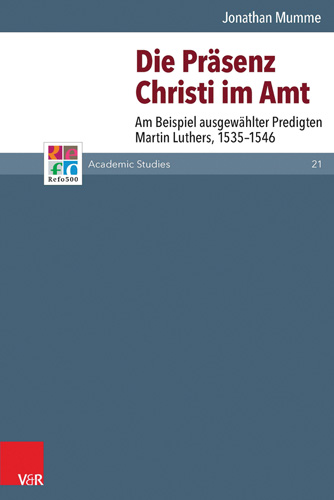
Die Präsenz Christi im Amt
Am Beispiel ausgewählter Predigten Martin Luthers, 1535–1546
By (author) Jonathan Mumme Associate editor Günter Frank Associate editor Ute Lotz-Heumann Associate editor Barbara Mahlmann-Bauer Associate editor Johannes Schilling Associate editor Günther Wassilowsky Associate editor Siegrid Westphal Associate editor Tarald Rasmussen Associate editor Mathijs Lamberigts Associate editor Bruce Gordon Associate editor David M. Whitford
Hardback (Published)
(August 2015)
ISBN: 9783525550809
6.34 x 9.33 inches
Price: $188.00
In stock
How did Luther understand the office of the ministry? For those listening to his sermons after Wittenberg had become a center for regular ordinations the matter looks not nearly so convoluted as the debates of his more modern heirs would lead one to believe. Simply put, the understanding of the office of the ministry homiletically communicated by this mature Luther is anchored in the Christological conviction that Jesus Christ is present in the office of the ministry. This central motif of the presence of Christ exhibits facets of historical and apostolic continuity, mediation, address, certainty, and ecclesiology. From the pulpit of the reformer, conclusions can be drawn about the place of the office of the ministry in his theology, which smack of promise for ecumenical discussions on the ministry. German text.
English summary: How did Luther understand the office of the ministry? For those listening to his sermons after Wittenberg had become a center for regular ordinations the matter looks not nearly so convoluted as the debates of his more modern heirs would lead one to believe. Simply put, the understanding of the office of the ministry homiletically communicated by this mature Luther is anchored in the Christological conviction that Jesus Christ is present in the office of the ministry. This central motif of the presence of Christ exhibits facets of historical and apostolic continuity, mediation, address, certainty, and ecclesiology. From the pulpit of the reformer conclusions can be drawn about the place of the office of the ministry in his theology, which smack of promise for ecumenical discussions on the ministry. German description: Die Predigten Luthers bilden eine nutzliche, aber bislang ubersehene Quelle zur Feststellung seiner Theologie. Diese vorliegende Untersuchung von Predigten aus dem letzten Jahrzehnt seines Lebens zeigt das homiletisch vermittelte Amtsverstandnis des reifen Luthers ab Beginn der regelmassigen Ordinationen in Wittenberg. Im Zentrum dieser Amtstheologie steht die Uberzeugung einer Prasenz Christi im Amt. Dieses Leitmotiv lasst sich von verschiedenen Aspekten betrachten, aus denen wertvolle Feststellungen gewonnen werden konnen: Luther versteht zum Beispiel eine christologische, apostolische und historische Kontinuitat des Amts. Zudem fasst er die Amtstrager als Mittel, Organe und Werkzeuge auf, die der Gemeinde gegenuberstehen. Das Pendant dieses Gegenubers bildet eine zweiseitige Gewissheit bezuglich des mittelbaren Sprechens und Handelns Gottes. Uber diese einzelnen Feststellungen hinaus konnen auch ekklesiologische Schlusse aus den Predigten gezogen werden. Jonathan Mumme zeigt, dass Luthers homiletisch vermitteltes Verstandnis des Amts in systematisch-theologischer Sicht neue Perspektiven auf ein umstrittenes Thema, die auch in der Okumene Frucht tragen konnten.
- By (author) Jonathan Mumme
- Associate editor Günter Frank
- Associate editor Ute Lotz-Heumann
- Associate editor Barbara Mahlmann-Bauer
- Associate editor Johannes Schilling
- Associate editor Günther Wassilowsky
- Associate editor Siegrid Westphal
- Associate editor Tarald Rasmussen
- Associate editor Mathijs Lamberigts
- Associate editor Bruce Gordon
- Associate editor David M. Whitford
Other Titles in this Series




 On Becoming a Theologian of the Cross
Revisiting Luther’s theologus crucis from the Heidelberg Disputation to the Genesis Lectures


 Constantino de la Fuente (San Clemente, 1502–Seville, 1560)
From acclaimed cathedral preacher to condemned "Lutheran" heretic


 Reformation und Konfessionsbildung in Speyer
Von konfessioneller Unentschiedenheit zum nonkonkordistischen Luthertum im Spannungsfeld von Reichspolitik und bürgerlichem Handeln. Mit Edition der archivalischen Quellen

 Arts, Portraits and Representation in the Reformation Era
Proceedings of the Fourth Reformation Research Consortium Conference

 Beyond Devotion
Religious and Literary Communities in the 16th and 17th Century Polish-Lithuanian Commonwealth. Texts and Contexts

 Philip Melanchthon and the Cappadocians
A Reception of Greek Patristic Sources in the Sixteenth Century


 Lutheran Theology and the shaping of society: The Danish Monarchy as Example
The Danish Monarchy as Example

Similar Books

 A Companion to Christianity and Sport in Europe and North America (19th-21st centuries)
Volume 1: Western and Eastern Europe
 A Connecting Polemic in the Medieval Mediterranean
The Correspondence of Leo III and ʿUmar II
Volume 6





 Ars Prophetica
Theology in the Poetry of Twentieth-Century Hebrew Poets Avraham Halfi, Shin Shalom, Amir Gilboa, and T. Carmi
 As Messianism Turns to Heresy
The Regenstein Chair Lectures On Lurianic Kabbalah and Shabbatai Tzevi at Hebrew Union College - Cincinnati


 Creating the Woman in Antiquity
Proceedings of the 16th Melammu Workshop, Innsbruck, 2–3 June 2022
Volume 13
 Cultic Kisses
Fruitful Encounters Between Deities and Humans. Festschrift for Angelika Berlejung on the Occasion of Her 65th Birthday
 De/colonizing Theologies
Glocal Histories, Contemporary Challenges, Theoretical Reflections
Volume 4
 Drunk the Potion, No Whit Charmed
The Doctrine of Pure and Perfect Souls from Iamblichus to Damascius






 Extracanonical Traditions and the Holy Land
Texts, Rituals, and Material Culture in Late Antique Palestine
 Fear, Fear of God, God-Fearers
Philological and Historical Perspectives on the World of Ancient Judaism and Christianity


 Gender and Iconography in Antiquity
Femininities, Masculinities, Ambiguities, and Beyond in the Ancient Levant, Near East, and Mediterranean