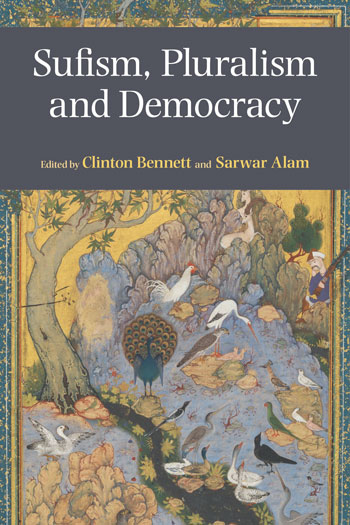
Sufism, Pluralism and Democracy
edited by Clinton Bennett and Sarwar Alam
Paperback (Published)
(August 2017)
ISBN: 9781781792216
6.1 x 9.17 inches
Price: $29.95
In stock
Hardback (Published)
(August 2017)
ISBN: 9781781792209
6.1 x 9.17 inches
Price: $100.00
In stock
This volume provides a composite of contemporary Sufi involvement in politics using a range of approaches and disciplines. It explores the role of Sufi-related parties where they exist or are emerging. It also examines how parties that condemn Sufism have adopted aspects of Sufi organization and practice. Changes in views within the academy on politics and Sufism are discussed. Perspectives on Egypt, Pakistan, Bangladesh and Indonesia are included as are overviews of Sufism’s political dimension across various regions. Contributions in the volume seek answer questions such as: Where Sufi related parties exist, what policies do they propose, and how do they differ from those of Islamist parties? How would “law” be understood? What is the relationship between secular and Sufi ideas about the role of religion in society? How do Sufi views about how to structure the state in Muslim majority space differ from alternatives? Are Sufis more likely to support democracy?
This volume provides a composite of contemporary Sufi involvement in politics using a range of approaches and disciplines. It explores the role of Sufi-related parties where they exist or are emerging. It also examines how parties that condemn Sufism have adopted aspects of Sufi organization and practice. Changes in views within the academy on politics and Sufism are discussed. Perspectives on Egypt, Pakistan, Bangladesh and Indonesia are included as are overviews of Sufism’s political dimension across various regions. Contributions in the volume seek answer questions such as: Where Sufi related parties exist, what policies do they propose, and how do they differ from those of Islamist parties? How would “law” be understood? What is the relationship between secular and Sufi ideas about the role of religion in society? How do Sufi views about how to structure the state in Muslim majority space differ from alternatives? Are Sufis more likely to support democracy?
INTRODUCTION Sufism, Pluralism and Democracy: contexts, comparisons and critiques Clinton Bennett Section One: Multi-contextual 1. Sufis, Saints and Politics in Islam: an historical survey Clinton Bennett Section Two: European/Euro Asian Contexts (Kosovo/Albania & Turkey) 2. Sufism as a Working Spirit in Globalization and Pluralism: The Case of the Hizmet Movement, a Turkey-oriented Global Islamic Network (Turkey) Heon C. Kim, East Stroudsburg University of Pennsylvania 3. A Paradox of Political Mysticism: The Bektashi Sufi Order as an Islamic Esoteric Community and Factor in Albanian National History (Kosova/the Balkans) Stephen Schwartz, Center for Islamic Pluralism, Washington DC Section Three: A Middle Eastern Context (Iran) 4. Sufi Politics in the Contemporary West: The Role and Definition of Sufism in the works of Javad Nurbakhsh (1926-2008) (Iran) Milad Milani, University of Western Sydney Section Four: South Asian Contexts: Bangladesh, Indonesia & Pakistan 5. Anti-saint or anti-shrine? Tracing Deoband's disdain for the Sufi in Pakistan Charles M. Ramsey, Forman Christian College, Lahore, Pakistan 6. Sufis as shapers of pluralist political culture: the examples of Bangladesh and Indonesia Clinton Bennett 7. In Search of God, In Search of Humanity: Vilayat-e-Mutlaqa of Hazrat Delaor Husayn Maizbhandari (Bangladesh) Sarwar Alam Section Five: Literary/Theoretical Underpinnings 8. Two Beloved Sufi poets of the Punjab: A Case of "Hearing Without Listening". Nikky-Guninder Kaur Singh, Colby College, Maine 9. Looking Inside the Heart: The Universal Appeal of God and Humanity as Reflected in Ibn al-'Arabi's Fusus al-Hikam and Maulana Rumi's Mathnawi Manawi Sayed Hassan Akhlaq Hussaini, George Washington University CONCLUSION: "Corporate Islam" v Sufi Islam and the articulation of the present Sarwar Alam
- Edited by Sarwar Alam
- Edited by Clinton Bennett
"Sufism, Pluralism and Democracy succeeds in exploring the often-sidelined political contribution of Sufism. The chapters clearly answer questions such as what role Sufism plays in promoting pluralism, secularism, and democracy. [...]This book works well for those looking to get a basic idea about the political engagement of Sufis in modern democracies." --Shameer Mondongal, Reading Religion, August 7, 2018 "For calling our attention to examples of Sufis in Turkey, Albania, Iran, Pakistan, Bangladesh, and Indonesia who bring the resources of the Sufi tradition to bear on modern questions of governance and social cohesion, Bennett and Alam are to be commended." --Jason Welle, Journal of Church and State, October 2018
—
Similar Books


 As Messianism Turns to Heresy
The Regenstein Chair Lectures On Lurianic Kabbalah and Shabbatai Tzevi at Hebrew Union College - Cincinnati
 Beyond Sovereign Courts
Agents and Practices in Early Modern Spanish and Habsburg Diplomacy
Volume 3
 Cities through Time
Glimpses into Urbanity and Community in Mediaeval to Modern West Asia and Egypt
Volume 1
 Cuneiform Artefacts from Archaeological Contexts: New Research on Ancient Iraq
Proceedings of a Conference Held at the Bavarian Academy of Sciences and Humanities, July 4–5, 2024
Volume 2


 Food Security under Armed Conflict
Global Knowledge Landscape and Public Attention to Social, Economic, and Humanitarian Dimensions
 Global Gulf
Geo-Economic, Geo-Political, and Geo-Technological Transformation in Saudi Arabia, the United Arab Emirates, and Qatar

 Innovationes Lovanienses: Arts, Law and Theology at the University of Louvain (1425–1797)
Studium Lovaniense: Learning across Borders, 2
Volume 18
 Ismail Hakki Bursevi’s translation of and commentary on Fusus al-Hikam By Muhyiddin Ibn ‘Arabi
Volumes 1-4


 Monastic Manuscripts from the Eastern Mediterranean (Sinai, Jerusalem, Antioch)
Production, Use, and Contexts
 Myths and Tales of the Inughuit
Erik Holtved's Polar Eskimo Texts Revised and Re-translated into Danish and English
Volume 475, 12


 Qatar’s Societal Security
Towards the Inclusive National Concept of ‘Baladna’ Identity, Migration and External Threats Since 2017


 Students, Scholars and Their Books at the University of Louvain (1425-1797)
Studium Lovaniense: Learning across Borders, 1
Volume 17


 The Biblical Tale of Judah and Tamar in Fourteenth-Century Iran
A Judeo-Persian Versified Account by Shāhīn with Scholarly Edition, Annotated Translation and Persian Transliteration
Volume 94, 951

 The Discourse of Rites
Shaping and Reshaping the (Counter-)Priestly Rituals Conducted Outside the Tabernacle