
Figure mascherate e maschere comiche nella ceramica italiota e siceliota
by Luigi Todisco

Paperback (Published)
(October 2020)
ISBN: 9788891320834
6.65 x 9.45 inches
Price: $171.00
In stock
The subject of the book are the so-called Phlyax Vases (A. D. Trendall) and the other vases of Magna Graecia and Sicily on which only comic masks were represented. This composite figured production, usually analyzed with reference to the two fundamental iconographic strands that distinguish it, namely that relating to scenes in which one or more masked characters act and that relating, instead, to the reproduction of the comic mask in different contexts, has long been the subject of a heated debate originating from the painted images, framed by following different interpretative paths. They contributed to it, in the 4th century BC., the Lucanian, Apulian, Siceliote, Paestan and Campanian ceramic workshops, of which a substantial number of vases are preserved which are now framed, although in necessarily synthetic form, through a catalogue of over four hundred specimens and through the reference to their pictorial decorations in the red-figure and polychrome techniques, fundamentally inspired by the Attic comedy and widely considered in the international bibliography, to the information on the vase-painters and the workshops that produced them, to the proveniences of the preserved specimens from the colonies and indigenous centres, to their shapes and functions. The integrated consideration of the available data allows an update of the discussion on the problem, which has been able to benefit from the recent publication of important more selective scientific contributions and of a non-univocal methodological approach.
The subject of the book are the so-called Phlyax Vases (A. D. Trendall) and the other vases of Magna Graecia and Sicily on which only comic masks were represented. This composite figured production, usually analyzed with reference to the two fundamental iconographic strands that distinguish it, namely that relating to scenes in which one or more masked characters act and that relating, instead, to the reproduction of the comic mask in different contexts, has long been the subject of a heated debate originating from the painted images, framed by following different interpretative paths. They contributed to it, in the 4th century BC., the Lucanian, Apulian, Siceliote, Paestan and Campanian ceramic workshops, of which a substantial number of vases are preserved which are now framed, although in necessarily synthetic form, through a catalogue of over four hundred specimens and through the reference to their pictorial decorations in the red-figure and polychrome techniques, fundamentally inspired by the Attic comedy and widely considered in the international bibliography, to the information on the vase-painters and the workshops that produced them, to the proveniences of the preserved specimens from the colonies and indigenous centres, to their shapes and functions. The integrated consideration of the available data allows an update of the discussion on the problem, which has been able to benefit from the recent publication of important more selective scientific contributions and of a non-univocal methodological approach.
- By (author) Luigi Todisco
Other Titles in this Series

 Theodor Mommsen e il Lazio Antico
Giornata di Studi in memoria dell'illustre storico, epigrafista e giurista
Volume 172


 Monumenti e Culture nell’Appennino in eta’ romana
Atti del Convegno. Sestino 1989, 12 novembre
Volume 65
 Nautica Antica
Itinerari nel mondo della navigazione,tra storia, archeologia ed etnografia
Volume 254


 Villae romanae nell’ager Bruttius
Il paesaggio rurale calabrese durante il dominio romano
Volume 107
 Officine ceramiche di eta regia
Produzione di ceramica in impasto a Roma dalla fine dell'VIII alla fine del VI secolo a.C
Volume 80


 Late Etruscan Votive Heads from Tessennano
Production, Distribution, Sociohistorical Context
Volume 118

 Lorenzo Fortunati
'Intraprendente scopritore' di antichita a Roma e nel Lazio nel XIX secolo
Volume 233
 Il Principato di Apollo
Mito e propaganda nelle lastre Campana dal tempio di Apollo Palatino
Volume 57
 Le Volonta meno apparente
Donne e societa nell'Italia centrale tirrenica tra VIII e VII secolo a.C
Volume 181


 Catania. La citta antica e quella del futuro
Archeologia, topografia, urbanistica per la riqualificazione dello spazio urbano
Volume 257
 Forme e strutture della religione nell’italia mediana antica / Forms and Structures of Religion in Ancient Central Italy
III Convegno Internazionale dell'Istituto di Ricerche e Documentazione sugli antichi umbri 21-25 settembre 2011
Volume 206


Similar Books


 Caesar’s Visions and Impact on the Roman Empire
Revisiting the Archaeological and Historical Record of the 40s BC
Volume 2

 Construction Processes in Historical Western Societies (5th c. BC – 10th c. AD)
Case Studies on Techniques, Models, and Costs


 Etruscan and Roman Hellenistic Anatomical ex votos
Reassessing Popular Religious Expressions in Central Italy
Volume 8




 Invisible Labour in Antiquity
Visualizing Obscure Work in the Ancient Mediterannean and West Asia
Volume 1

 Late Antique villae in the Balkans (3rd–7th c. AD): Current Research Questions and Perspectives
HAEMUS Companion to the Late Antique Balkans 1
Volume 4





 Portraying the Individual in the Roman East
Local–Imperial Entanglements in Sculpture, Mosaics, and Paintings (First–Fourth Centuries AD)
Volume 18


 Roman Copies, Collecting, and Culture in the Bay of Naples and Beyond
Papers in Honor of Eugene J. Dwyer
 Small Worlds and Relational Agencies: Local Societies in Early Medieval Iberia
Pequeños mundos y Agencias relacionales: Sociedades locales altomedievales en la Península Ibérica
 SOMA 2023: Proceedings of the 24th Symposium on Mediterranean Archaeology
Ideas that Travelled by the Sea, Udine, 2-4 February, 2023


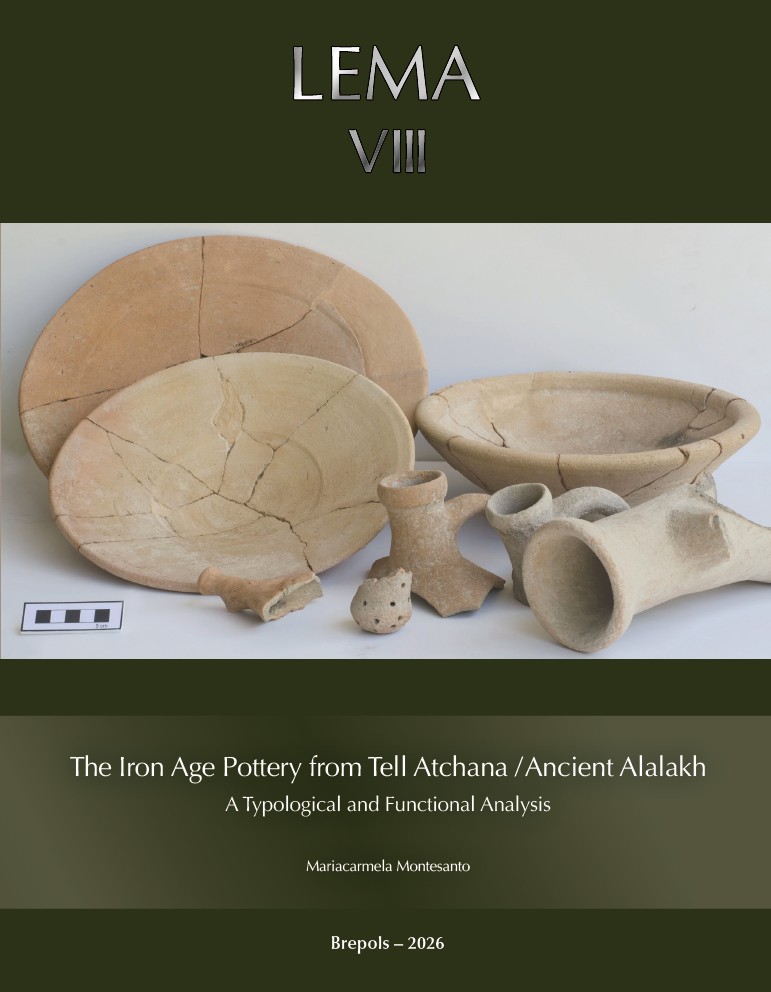 The Iron Age Pottery from Tell Atchana / Ancient Alalakh
A Typological and Functional Analysis
Volume 8


 Writing in the Church of the Nativity in Bethlehem
Inscription and Graffiti in a Multilingual and Multigraphic Perspective
Volume 45
 Zooarchaeology of Ancient Greek Sanctuaries in Southwestern Sicily
Faunal Analysis from Selinus and Akragas as Evidence of Differences in the Treatment of Animals for Ritual Purposes


