
Die Apostelkanne und das Tafelsilber im Hortfund von 1628 – Trierer Silberschätze des 5. Jahrhunderts
By (author) Annemarie Kaufmann-Heinimann By (author) Max Martin
Hardback (Published)
(January 2017)
ISBN: 9783954904938
6.69 x 9.49 inches
Price: $147.00
On back order
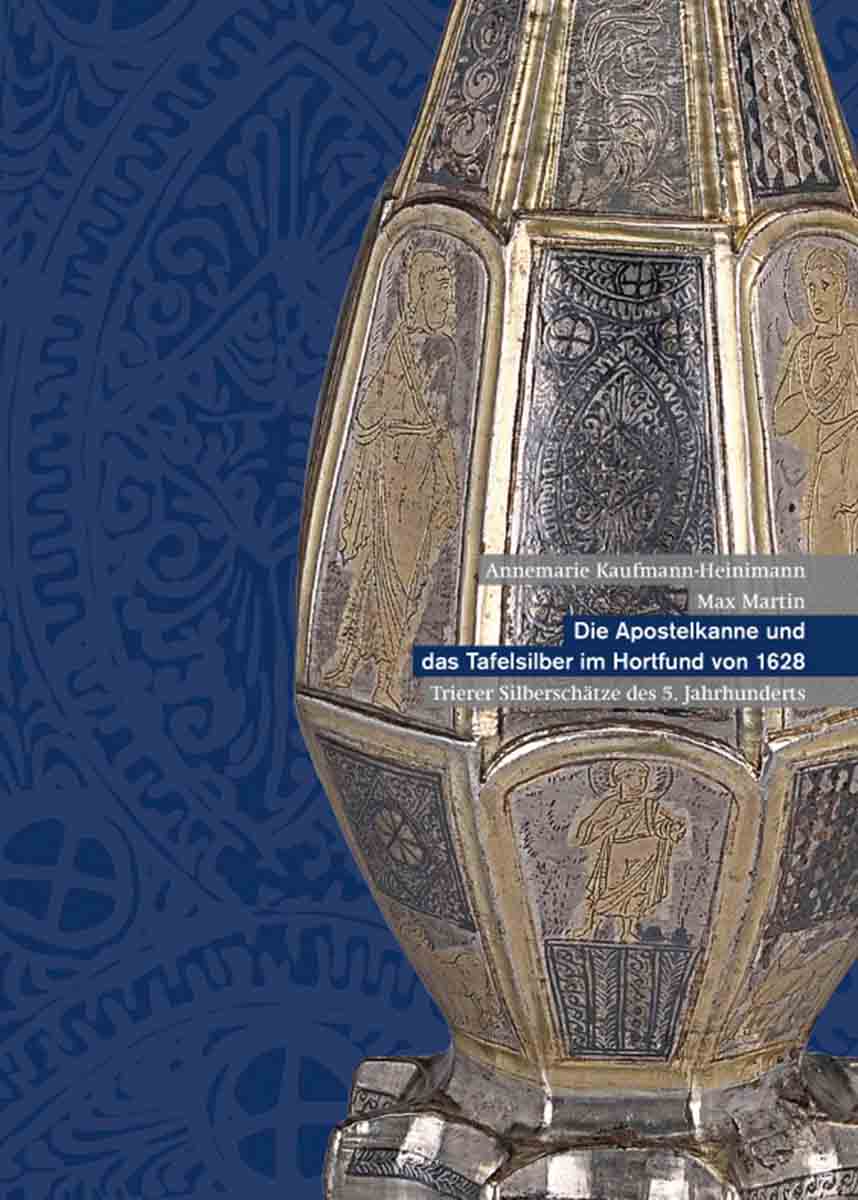
English summary: Two extraordinary late Roman silver finds were discovered in the same area close to the bank of the Mosel at Trier: in 1992 a splendid silver jug with decoration depicting the Apostles and nearly 400 years earlier, in 1628, a huge hoard of table silver. The Apostle jug is among the rare pieces of evidence testifying to late Roman table ware illustrating Christian subjects. The iconographic scheme with Apostles in dialogue goes back to early Christian sarcophagi. The eight-sided jug with gilding and niello decoration survived complete with its lid and handle and is notable for its very slender proportions. Its shape, decoration and function are analysed in comparison to other silver jugs. Technical and metallurgical examination give fascinating results as to the manufacturing process and the composition of the various parts of this masterpiece of ancient toreutics. The lost silver hoard from 1628 was the biggest hoard of its kind yet known. It weighed 114.5 kg in total and consisted of about fifty pieces of table ware, which were melted down shortly after their discovery. The surviving 17th-century descriptions and several comparisons with similar late Roman finds allow a pictorial reconstruction of the find and a proposed date of the second quarter of the 5th century. The proximity of the 1628 and 1992 findspots of the lost treasure and the jug as well as the assumption that the silver objects were of the same date suggest that both finds once belonged to one and the same complex of table silver. If so, the silver jug would be the only surviving object of this remarkable treasure which comprised, in a typical late Antique manner, vessels with traditional mythological and new Christian decoration. The publication on the late Roman silver from Trier provides new insights into the first half of the 5th century, a little known period of its history. French description: Deux decouvertes exceptionnelles d’argenterie ont ete faites dans un quartier proche de la Moselle, a Treves : en 1992, celle d’un vase d’apparat decore de representations des Apotres, et deja en 1628, celle d’un tresor de vaisselle de table d’epoque romaine tardive. L’aiguiere de Treves figurant les Apotres est une des rares attestations de motifs chretiens sur argenterie de table tardo-antique. L’ouvrage donne une analyse approfondie de la forme, du decor et de la fonction de l’objet, en reference a d’autres recipients en argent comparables. Le vase, de section octogonale, est integralement conserve. Il surprend par ses proportions elancees et ses parois facettees, alternant les plaquages dores et nielles. Le schema iconographique des Apotres figures en dialogue renvoie aux representations des sarcophages paleochretiens. Les analyses technologiques et archeometallurgiques effectuees sur l’aiguiere aux Apotres donnent de precieuses indications sur les techniques de fabrication et d’assemblage des differentes parties de ce chef d’oeuvre de la toreutique antique. Le tresor d’argenterie de Treves trouve en 1628, puis disparu, est le plus grand depot connu de ce genre. D’un poids estime a 114,5 kg, il comptait environ 50 recipients et ustensiles, qui ont ete fondus peu apres leur decouverte. Les descriptions qui en ont ete conservees, faites au 17eme siecle, et les comparaisons avec des trouvailles analogues d’argenterie de table tardo-antique permettent de proposer une reconstitution imagee ainsi qu’une attribution chronologique du depot. La proximite des lieux de decouverte du tresor d’argenterie et de l’aiguiere aux Apotres, la probable contemporaneite de leur production suggerent que les deux decouvertes appartenaient a l’origine au meme service d’argenterie de table. Ainsi, l’aiguiere serait le seul objet conserve de ce tresor remarquable, qui reunissait des pieces decorees de figures mythologiques traditionnelles avec d’autres portant les nouveaux motifs chretiens. Une situation relativement courante dans l’Antiquite tardive. Les recherches sur ces tresors d’argenterie renouvellent les connaissances sur une periode de l’histoire romaine de Treves peu etudiee jusqu’alors, qui est celle de la premiere moitie du 5eme siecle. German description: Zwei aussergewohnliche Silberfunde der Spatantike stammen aus einem Quartier am Moselufer in Trier: die 1992 gefundene Prunkkanne mit Aposteldarstellungen und ein bereits 1628 entdeckter Schatzfund von spatromischem Tafelgeschirr. Die Trierer Apostelkanne stellt einen der wenigen Belege fur spatantikes Tafelsilber mit christlichen Motiven dar. Form, Bildschmuck und Funktion werden hier vor dem Hintergrund anderer Silberkannen eingehend untersucht. Die achteckige Kanne ist vollstandig erhalten und fallt durch ihre schlanken Proportionen und die in Felder unterteilte Wandung mit Vergoldung und Nielloeinlagen auf. Das Bildschema der im Zwiegesprach dargestellten Apostel geht auf die fruhchristliche Sarkophagplastik zuruck. Technologische und archaometallurgische Untersuchungen an der Apostelkanne ergeben interessante Hinweise auf die Herstellungstechnik sowie die Zusammensetzung einzelner Teile dieses Meisterwerks antiker Toreutik. Der verlorene Trierer Silberfund von 1628 war der grosste bekannte Hort seiner Art. Er hatte ein Gewicht von ca. 114,5 kg und bestand aus etwa 50 Gefassen und Geraten, die bald nach der Auffindung eingeschmolzen wurden. Die erhaltenen Beschreibungen des 17. Jahrhunderts und der Vergleich mit ahnlichen Funden von spatantikem Tafelsilber erlauben eine bildhafte Rekonstruktion des Fundes und seine zeitliche Einordnung. Die Nahe der Fundstellen des Silberhorts und der Apostelkanne sowie die mutmasslich gleiche Entstehungszeit der Silberobjekte lassen vermuten, dass beide Funde ursprunglich zum gleichen Tafelgeschirr gehort haben. Damit ware die Apostelkanne das einzige erhaltene Objekt dieses bemerkenswerten Schatzes, der – in fur die Spatantike nicht untypischer Art – Gefasse mit traditionellen mythologischen und neuen christlichen Bildmotiven vereinigte. Die Untersuchung der Silberschatze liefert neue Erkenntnisse zu einer bisher wenig erforschten Phase in der romischen Geschichte von Trier – der ersten Halfte des 5. Jahrhunderts.
- By (author) Annemarie Kaufmann-Heinimann
- By (author) Max Martin
Other Titles in this Series


 Der römische Gutshof und das Gräberfeld bei Lösnich
Kreis Bernkastel-Wittlich. Ein Beitrag zur Rekonstruktion ländlicher Besiedlung im Trevererland

 Stadt – Land – Fluss. Grabdenkmäler der Treverer in lokaler und überregionaler Perspektive
Akten der Internationalen Konferenz 25.–27. Oktober 2018 in Neumagen und Trier
 Ein Hortfund spätantiker Bronzemünzen aus Meckel, Eifelkreis Bitburg-Prüm
7486 Prägungen vom 3. Jahrhundert bis zur tetrarchisch-konstantinischen Zeit, verborgen 312/13 n. Chr.
Similar Books




 Archaeological Excavations at Irmis Rka: An Investigation of a Multi-Layered Settlement in Southwest Georgia
Results from the 2020 Season: Early Bronze Age to Medieval Occupations


 Between Bones and Beliefs
Human-Bird Relations in Central and Northern Europe in the First Millennium AD
Volume 4


 Catuvellaunia and Rome: Economic and Political Relations during the Final Decades Pre-conquest
The Role of Grain from Southeastern Britain and Its Potential for Maintenance of the Roman Military along the Frontier on the Rhine

 Christina of Sweden in Context
A Celebration of Seventeenth-Century Queenship 400 Years in the Making

 Colour Concept “Secoli bui” a colori
Codici cromatici e architetture dipinte nell’età tardoantica e medievale
 Contesting Labeled Identities
The Sociology of Gentilics in Biblical and Northwest Semitic Literature


 Crossing Disciplines in the Study of Archaeology and Prehistoric Art: Insights from the Sahara and Mediterranean Africa
Proceedings of the XX UISPP World Congress (5–9 September 2023, Timișoara, Romania) Volume / Session 18
 Crossing Sacred Landscapes
Contacts and Continuities in the Desert Cults and Beliefs of Ancient Northern Arabia and the Arid Southern Levant
 Cuneiform Artefacts from Archaeological Contexts: New Research on Ancient Iraq
Proceedings of a Conference Held at the Bavarian Academy of Sciences and Humanities, July 4–5, 2024
Volume 2

 Drunk the Potion, No Whit Charmed
The Doctrine of Pure and Perfect Souls from Iamblichus to Damascius

 Engaged Languages and Literatures / Langues et Littératures engagées
Critical Views / Regards Critiques
 ENTANGLED AFRICA
Intra-African Relations Between Rain Forest and Mediterranean from Around 4,000 BCE to 1,500 CE
 Epigraphic “Shades” from Hellenistic Thrace
Contextualizing Inscriptions in Greek from Thracian Tombs

 Epiphanies of the Divine in the Septuagint and the New Testament
Fifth International Symposium of the Corpus Judaeo-Hellenisticum Novi Testamenti (CJHNT), 14-17 May 2015, Nottingham



 Exploring Prehistoric Pottery in Japan
A Study of Organic Inclusions, Adhering Materials, and Impressions of Woven Items

